
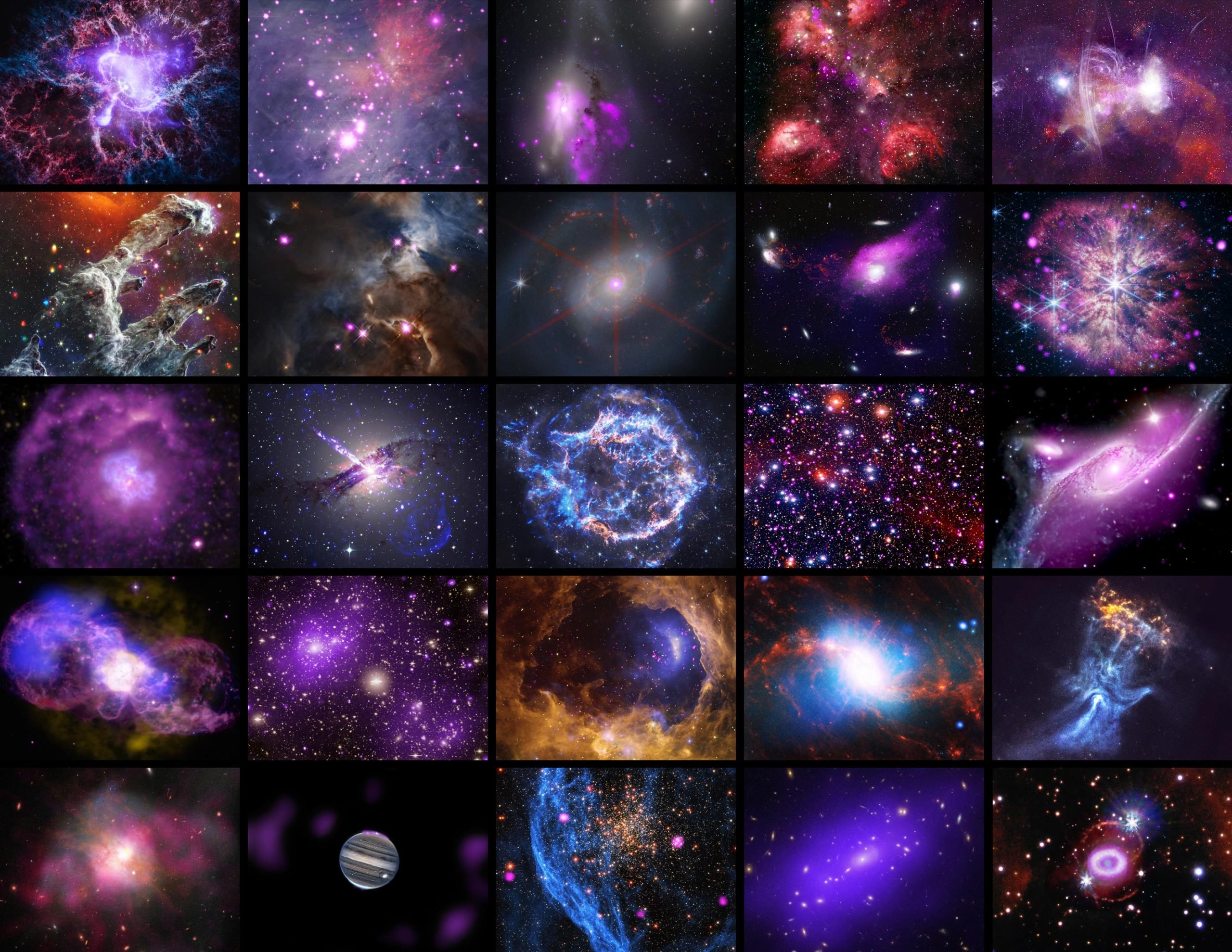
Chandra X-ray Observatory’s 25th anniversary is celebrated with new images that span from local solar system bodies to distant galaxy clusters, showcasing its role in advancing our understanding of the universe.
- A collection of 25 new images has been released to celebrate the 25th anniversary of NASA’s Chandra X-ray Observatory.
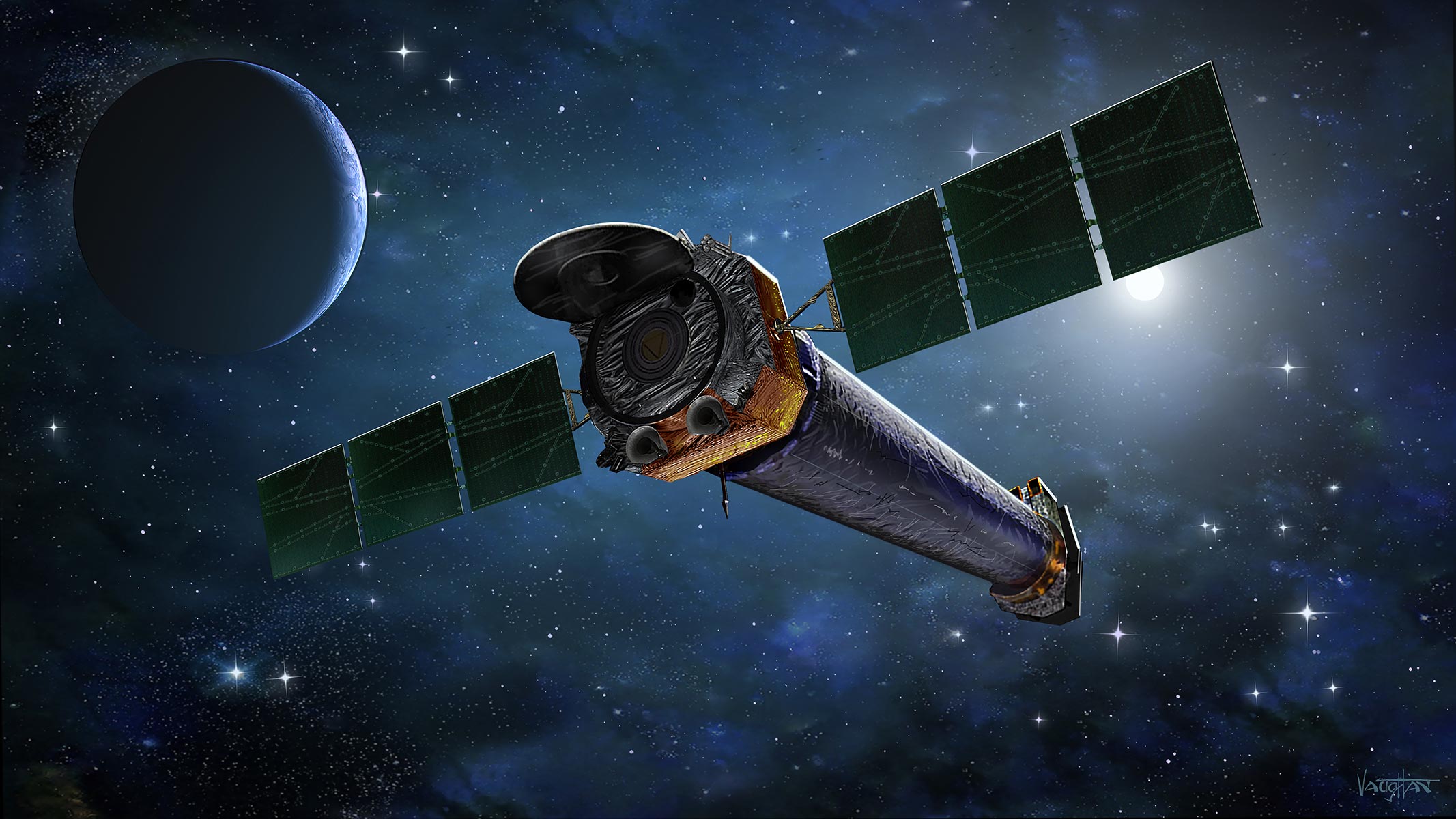
- The telescope was launched into space aboard the Space Shuttle Columbia on July 23, 1999.
- Since then, Chandra has observed thousands of objects — some of them repeatedly — to make unparalleled discoveries.
- This assembly represents the range of objects and phenomena that Chandra studies from black holes to exploded stars and much more.
Celebrating Chandra’s 25th Anniversary in Space
This montage contains 25 new images with data from NASA’s Chandra X-ray Observatory that is being released to commemorate the telescope’s 25th anniversary in space. Since its launch into space on July 23, 1999, Chandra has been NASA’s flagship mission for X-ray astronomy in its fleet of “Great Observatories.” Chandra discovers exotic new phenomena and examines old mysteries, looking at objects within our own Solar System out to nearly the edge of the observable Universe.
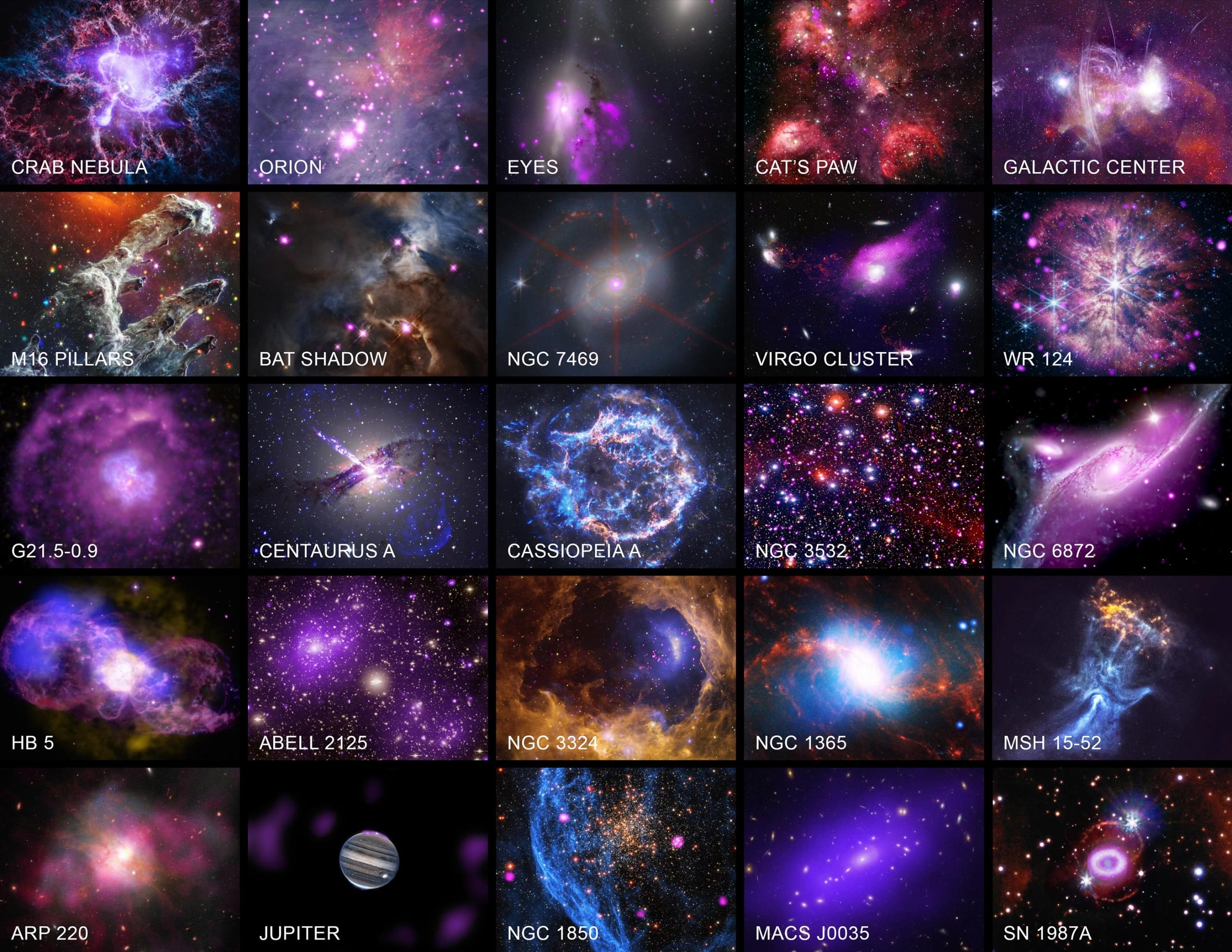
These images, which all include data from Chandra, demonstrate how X-ray astronomy explores all corners of the universe. (Some of the images have Chandra data newly added to previously released images and data from other telescopes.) There is a broad range of astronomical objects in this collection. At the center is one of Chandra’s most iconic targets, the supernova remnant Cassiopeia A (Cas A). This was one of the very first objects observed by Chandra after its launch in 1999, and astronomers have often returned to observe Cas A with Chandra since then.
Discoveries and Insights From Chandra
Chandra quickly discovered a point source of X-rays in Cas A’s center for the first time, later confirmed to be a neutron star. Later Chandra was used to discover evidence for a “superfluid” inside Cas A’s neutron star, to reveal that the original massive star may have turned inside out as it exploded, and to take an important step in pinpointing how giant stars explode.
The unmatched sharpness of Chandra’s X-ray images are perfect for studying the hot debris and energetic particles remaining behind after supernova explosions. Other examples in this new collection include the Crab Nebula, G21.5-0.9, MSH 15-52, and SN 1987A. Chandra also probes the different branches of stellar evolution such as “planetary nebulas” when stars like the Sun run out of fuel and shed their outer layers as seen in the Chandra image of HB 5.
The Stellar Lifecycle Through Chandra’s Lens
Chandra also looks at what happens at the start of the stellar life cycle, providing information about some of the youngest and most massive stars. Images of these stellar nurseries in the “25 for 25” montage include the Orion Nebula, Cat’s Paw, M16 (a.k.a., the “Pillars of Creation”), the Bat Shadow and NGC 3324. A view of a more mature star cluster, NGC 3532, is also included. X-ray data are particularly useful for studying objects like this because young stars are often copious producers of X-rays, allowing stars that are members of clusters to be picked out of a foreground or background of older objects. Chandra’s sharp images and sensitivity also allow many more sources to be seen.
Chandra observes galaxies — including our own Milky Way, where a supermassive black hole resides at its center. Chandra also studies other galaxies and this is represented in the new images of NGC 7469, Centaurus A, NGC 6872, NGC 1365, and Arp 220.
Observing Galaxies and Galaxy Clusters
Astronomers look at even larger structures like galaxy clusters with Chandra, where hundreds or thousands of galaxies are immersed in multimillion-degree gas that only an X-ray telescope can detect. In this release of images, M86 and the Virgo cluster, Abell 2125, and MACS J0035 are examples of galaxy clusters Chandra has observed.
Closer to home, Chandra has contributed to the study of planets and comets in our own Solar System including Venus, Mars, Saturn, and even Earth itself. This ability to explore the Solar System is represented by the image of aurora on Jupiter, captured in X-rays, in this collection.
Images of some of these objects had previously been released, but now include new X-ray data or have been combined with different data from other telescopes. Some of these objects have never been released before with Chandra data.
NASA’s Marshall Space Flight Center manages the Chandra program. The Smithsonian Astrophysical Observatory’s Chandra X-ray Center controls science from Cambridge Massachusetts and flight operations from Burlington, Massachusetts.
Never miss a breakthrough: Join the SciTechDaily newsletter.
Follow us on Google and Google News.
1 Comment
You have no idea about the gravitational formula of real space-time physics!
Newton’s formula does not give any explanation for this fact!
My formula is as follows:
F=λm(1)m(2)/((dt)²m)
Here is the time dt, which time it takes for light or gravitational wave to reach the origin!
Hey hey!