

How Scientists Hope To Use Algae-Grown Limestone To Build Cities
The burning of limestone from quarries contributes significantly to the 7% of the yearly greenhouse gas emissions from the manufacturing of cement worldwide. A research team headed by the University of Colorado in Boulder has discovered a method to use microalgae to absorb carbon dioxide from the atmosphere, making cement production carbon neutral or even carbon negative.
The U.S. Department of Energy’s (DOE) Advanced Research Projects Agency-Energy (ARPA-E) has awarded the CU Boulder engineers and their colleagues at the National Renewable Energy Laboratory (NREL) and the Algal Resources Collection at the University of North Carolina Wilmington (UNCW) $3.2 million for their creative work. The research group was recently chosen by the HESTIA program (Harnessing Emissions into Structures Taking Inputs from the Atmosphere) to advance and expand the production of biogenic limestone-based portland cement and contribute to the creation of a zero-carbon future.
“This is a really exciting moment for our team,” said Wil Srubar, lead principal investigator on the project and associate professor in Civil, Environmental, and Architectural Engineering and CU Boulder’s Materials Science and Engineering Program. “For the industry, now is the time to solve this very wicked problem. We believe that we have one of the best solutions, if not the best solution, for the cement and concrete industry to address its carbon problem.”
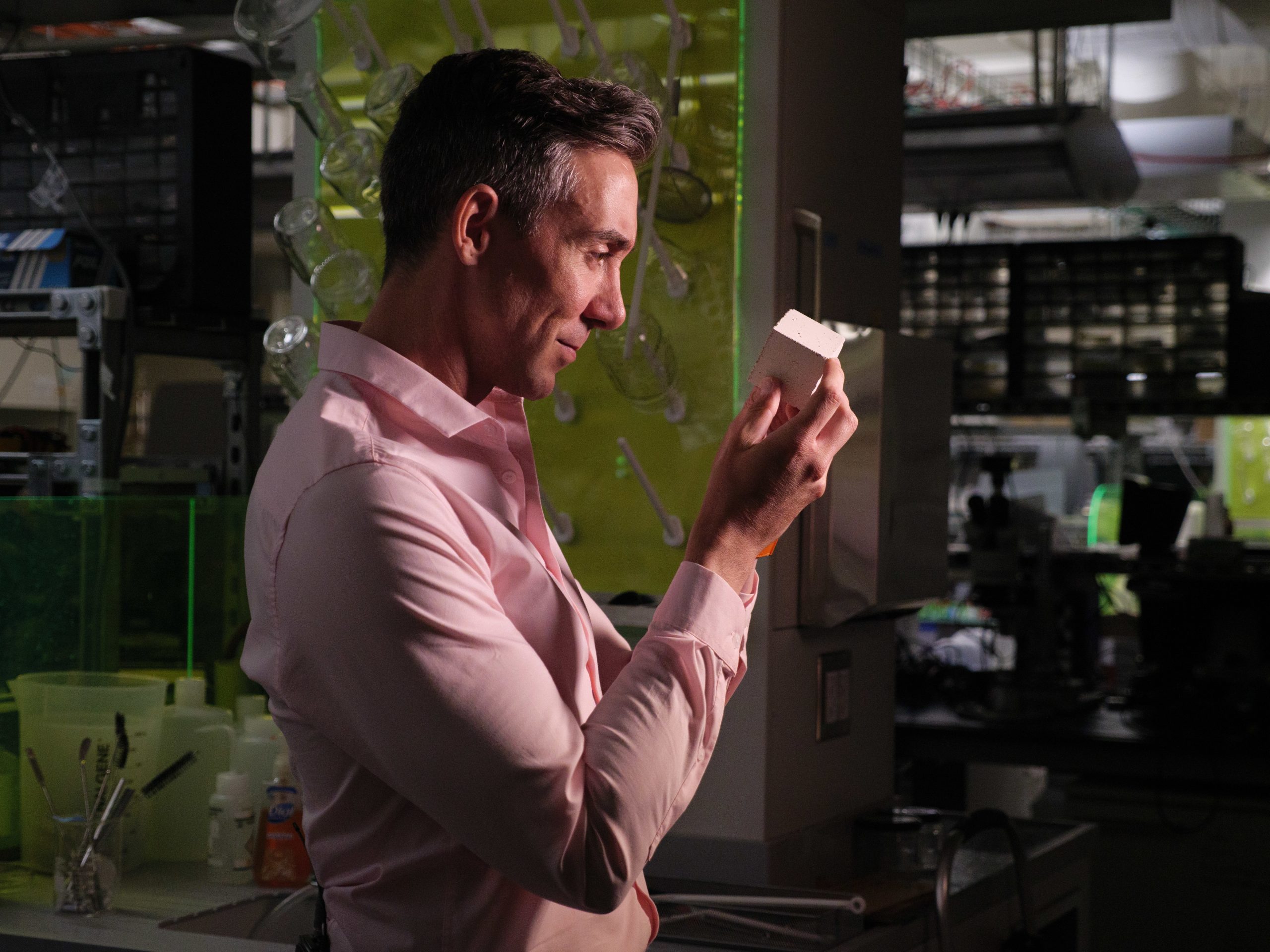
One of the most widespread materials on earth and a foundation of building all across the globe is concrete. It begins as a paste made of water and portland cement, to which components like sand, gravel, or crushed stone are then added. The paste holds the particles together and hardens the mixture into concrete.
The most popular form of cement, portland cement, is created by removing limestone from large quarries and burning it at high temperatures, which produces a lot of carbon dioxide. The study team discovered a net carbon neutral method of producing portland cement by substituting biologically generated limestone for quarried limestone, a natural process that certain species of calcareous microalgae complete via photosynthesis (much like building coral reefs). In other words, the amount of carbon dioxide that is released into the atmosphere is equivalent to what the microalgae have already captured.
Another common filler material used in portland cement is ground limestone, which generally replaces 15% of the mixture. Portland cement could become not just net neutral but even carbon negative by sucking carbon dioxide out of the atmosphere and storing it permanently in concrete if biogenic limestone was used as the filler instead of quarried limestone.
A whopping 2 gigatons of carbon dioxide would no longer be pumped into the atmosphere each year and more than 250 million additional tons of carbon dioxide would be pulled out of the atmosphere and stored in these materials if all cement-based construction worldwide were replaced with biogenic limestone cement.
This could theoretically happen overnight, as biogenic limestone can “plug and play” with modern cement production processes, said Srubar.
“We see a world in which using concrete as we know it is a mechanism to heal the planet,” said Srubar. “We have the tools and the technology to do this today.”
Limestone in Real-Time
Srubar, who leads the Living Materials Laboratory at CU Boulder, received a National Science Foundation CAREER award in 2020 to explore how to grow limestone particles using microalgae to produce concrete with positive environmental benefits. The idea came to him while snorkeling on his honeymoon in Thailand in 2017.
He saw firsthand in coral reefs how nature grows its own durable, long-lasting structures from calcium carbonate, a main component of limestone. If nature can grow limestone, why can’t we? he thought.
“There was a lot of clarity in what I had to pursue at that moment. And everything I’ve done since then has really been building up to this,” said Srubar.

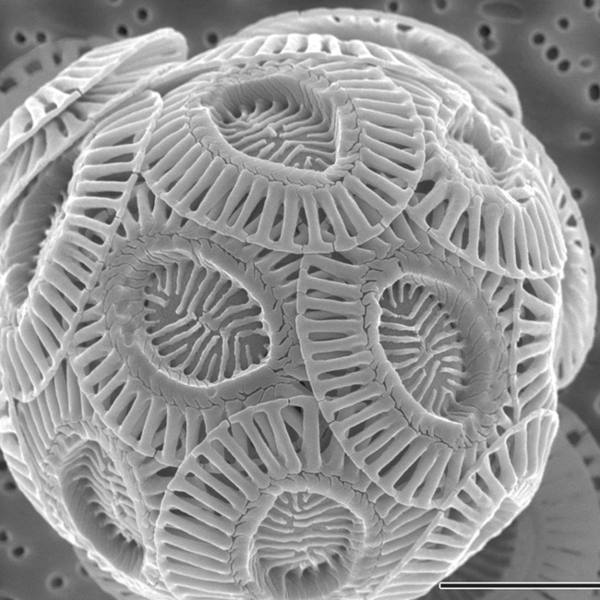
He and his team began to cultivate coccolithophores, cloudy white microalgae that sequester and store carbon dioxide in mineral form through photosynthesis. The only difference between limestone and what these organisms create in real-time is a few million years.
With only sunlight, seawater, and dissolved carbon dioxide, these tiny organisms produce the largest amounts of new calcium carbonate on the planet, and at a faster pace than coral reefs. Coccolithophore blooms in the world’s oceans are so big that they can be seen from space.
“On the surface, they create these very intricate, beautiful calcium carbonate shells. It’s basically an armor of limestone that surrounds the cells,” said Srubar.
Commercializing Coccolithophores
These microalgae are hardy little creatures, living in both warm and cold, salt and fresh waters around the world, making them great candidates for cultivation almost anywhere—in cities, on land, or at sea. According to the team’s estimates, only 1 to 2 million acres of open ponds would be required to produce all of the cement that the U.S. needs—0.5% of all land area in the U.S. and only 1% of the land used to grow corn.
And limestone isn’t the only product microalgae can create: microalgae’s lipids, proteins, sugars, and carbohydrates can be used to produce biofuels, food, and cosmetics, meaning these microalgae could also be a source of other, more expensive co-products—helping to offset the costs of limestone production.
To create these co-products from algal biomass and to scale up limestone production as quickly as possible, the Algal Resources Collection at UNCW is assisting with strain selection and growth optimization of the microalgae. NREL is providing state-of-the-art molecular and analytical tools for conducting biochemical conversion of algal biomass to biofuels and bio-based products.
There are companies interested in buying these materials, and the limestone is already available in limited quantities.
Minus Materials, Inc., a CU startup founded in 2021 and the team’s commercialization partner, is propelling the team’s research into the commercial space with financial support from investors and corporate partnerships, according to Srubar, a co-founder and acting CEO. Minus Materials previously won the university-wide Lab Venture Challenge pitch competition and secured $125,000 in seed funding for the enterprise.
The current pace of global construction is staggering, on track to build a new New York City every month for the next 40 years. To Srubar, this global growth is not just an opportunity to convert buildings into carbon sinks, but to clean up the construction industry. He hopes that replacing quarried limestone with a homegrown version can also improve air quality, reduce environmental damage, and increase equitable access to building materials around the world.
“We make more concrete than any other material on the planet, and that means it touches everybody’s life,” said Srubar. “It’s really important for us to remember that this material must be affordable and easy to produce, and the benefits must be shared on a global scale.”
Reference: “Cities of the future may be built with algae-grown limestone” by Kelsey Simpkins, University of Colorado Boulder.
Never miss a breakthrough: Join the SciTechDaily newsletter.
Follow us on Google and Google News.