
Close Menu
    Facebook X (Twitter) Instagram
    SciTechDaily
    • Biology
    • Chemistry
    • Earth
    • Health
    • Physics
    • Science
    • Space
    • Technology
    Facebook X (Twitter) Pinterest YouTube RSS
    SciTechDaily
    Home»Physics»Sometimes LEGO Is a Toy – At CERN, LEGO Helps Study the Building Blocks of the Universe
    Physics

    Sometimes LEGO Is a Toy – At CERN, LEGO Helps Study the Building Blocks of the Universe

    By CERNMarch 23, 2020No Comments3 Mins Read
    Facebook Twitter Pinterest Telegram LinkedIn WhatsApp Email Reddit
    Share
    Facebook Twitter LinkedIn Pinterest Telegram Email Reddit
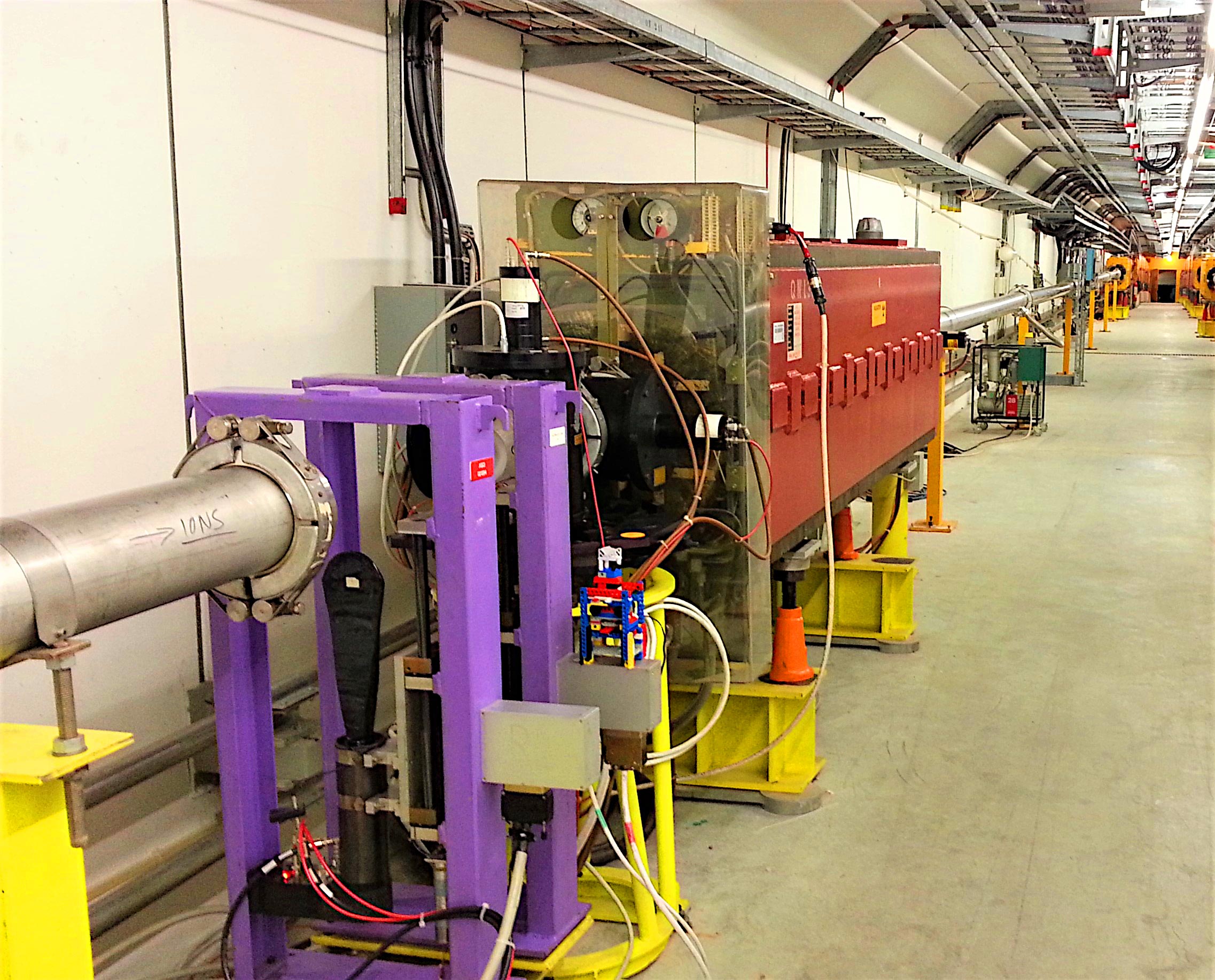
    LEGO CERN Beam Line
    Spot the moving table: the LEGO-based device can be seen next to the beam line. Credit: Michael Deveaux/CERN

    An improvised device, assembled using toy bricks, helped scientists conduct tests at CERN’s NA61/SHINE.

    CERN’s accelerator complex helps scientists probe the fundamental building blocks of the universe. But when one scientist needed to construct a radiation-hard apparatus to test novel sensors at CERN, he turned to the building blocks of his childhood: LEGO.

    NA61/SHINE is a fixed-target experiment that uses particle beams from the Super Proton Synchrotron to study the properties of hadrons, which are composite particles made of quarks and gluons. In 2015, the NA61/SHINE team planned to build a new subsystem based on pixel sensors. These sensors are essentially modified smartphone cameras and serve as excellent hadron detectors. First, though, the scientists had to know if the sensors could withstand aggressive radioactive impacts caused by a beam of lead nuclei.

    LEGO CERN
    A note from Michael reminds his colleagues of the serious nature of his LEGO apparatus. Credit: Michael Deveaux/CERN

    When an unforeseen issue with the NA61/SHINE magnets prevented regular data taking for a few weeks, the collaboration decided to use the available lead-ion beam to test the sensors. The sensor samples could be acquired at short notice, but a remote-controlled, movable table to hold them in the particle beam was needed. This table had to be lightweight and resistant to nuclear activation from the radiation. Building it at the mechanical workshop would have taken more time than was available for the tests.

    One evening, while playing with his two-year-old daughter, NA61/SHINE scientist Michael Deveaux absent-mindedly puzzled over the problem. He realized that not only would LEGO provide a light and activation-resistant material, a device made with the bricks could also be engineered quickly and modified if needed. Michael called his younger brother and implored him to retrieve their childhood LEGO boxes from their parents’ home. The brother – an architect by training – teamed up with his own ten-year-old son to fetch the boxes and design a prototype movable table. Meanwhile, Michael bought missing components, like an electric motor, from a LEGO shop in Frankfurt.

    The siblings reconvened the following weekend, tested the table and measured the speed at which it could move the sample. After all, without visual contact, one could only drive the device remotely by knowing its speed and counting the seconds. Once they were convinced it could work, Michael submitted a report to NA61/SHINE and the colorful device was installed in November 2015.

    “Soon, my colleagues started to complement the experiment by adding some LEGO trees on top of the structure,” recounts Michael. “I had to write a message asking them not to do so.”

    The tests were successful and provided the required information. And what about the improvised table? “Today,” Michael says with a grin, “the LEGO apparatus sits on a shelf in my office, awaiting use in the future, either by NA61/SHINE or my children!”

    Never miss a breakthrough: Join the SciTechDaily newsletter.
    Follow us on Google and Google News.

    CERN LEGO Particle Physics
    Share. Facebook Twitter Pinterest LinkedIn Email Reddit

    Related Articles

    New Results Indicate That Particle Discovered at LHC Is a Higgs Boson

    The Large Hadron Collider Prepares for Shutdown

    Higgs Duality: Contradictory Results At LHC

    CERN to Announce the Latest Results from ATLAS and CMS

    Discussing the Search for the Higgs Particle

    ICARUS Experiment Claims Neutrinos Aren’t Faster Than Light

    More Data of Elusive Higgs Boson from Defunct US Tevatron Collider

    Possible Mistakes Found in Faster Than Light Neutrino Measurement

    Higgs Boson Signals Gain Strength at Large Hadron Collider

    Leave A Reply Cancel Reply

    • Facebook
    • Twitter
    • Pinterest
    • YouTube

    Don't Miss a Discovery

    Subscribe for the Latest in Science & Tech!

    Trending News

    Breakthrough Bowel Cancer Trial Leaves Patients Cancer-Free for Nearly 3 Years

    Natural Compound Shows Powerful Potential Against Rheumatoid Arthritis

    100,000-Year-Old Neanderthal Fossils in Poland Reveal Unexpected Genetic Connections

    Simple “Gut Reset” May Prevent Weight Gain After Ozempic or Wegovy

    2.8 Days to Disaster: Scientists Warn Low Earth Orbit Could Suddenly Collapse

    Common Food Compound Shows Surprising Power Against Superbugs

    5 Simple Ways To Remember More and Forget Less

    The Atomic Gap That Could Cost the Semiconductor Industry Billions

    Follow SciTechDaily
    • Facebook
    • Twitter
    • YouTube
    • Pinterest
    • Newsletter
    • RSS
    SciTech News
    • Biology News
    • Chemistry News
    • Earth News
    • Health News
    • Physics News
    • Science News
    • Space News
    • Technology News
    Recent Posts
    • Scientists Discover Stem Cells That Could Regrow Teeth and Bone
    • Scientists Discover Natural Molecule That Stops Alzheimer’s Protein Clumps From Forming
    • Early Cannabis Use May Stall Key Brain Skills in Teens
    • Popular Vitamin D Supplement Has “Previously Unknown” Negative Effect, Study Finds
    • Powerful Antioxidant Found To Play a Key Role in Proper Protein Folding
    Copyright © 1998 - 2026 SciTechDaily. All Rights Reserved.
    • Science News
    • About
    • Contact
    • Editorial Board
    • Privacy Policy
    • Terms of Use

    Type above and press Enter to search. Press Esc to cancel.