
Close Menu
    Facebook X (Twitter) Instagram
    SciTechDaily
    • Biology
    • Chemistry
    • Earth
    • Health
    • Physics
    • Science
    • Space
    • Technology
    Facebook X (Twitter) Pinterest YouTube RSS
    SciTechDaily
    Home»Technology»Storing Electrical Energy in Red Bricks – Walls Could Act As Huge Batteries
    Technology

    Storing Electrical Energy in Red Bricks – Walls Could Act As Huge Batteries

    By Washington University in St. LouisAugust 25, 2020No Comments3 Mins Read
    Facebook Twitter Pinterest Telegram LinkedIn WhatsApp Email Reddit
    Share
    Facebook Twitter LinkedIn Pinterest Telegram Email Reddit
    Quasi-Solid-State Supercapacitor Bricks
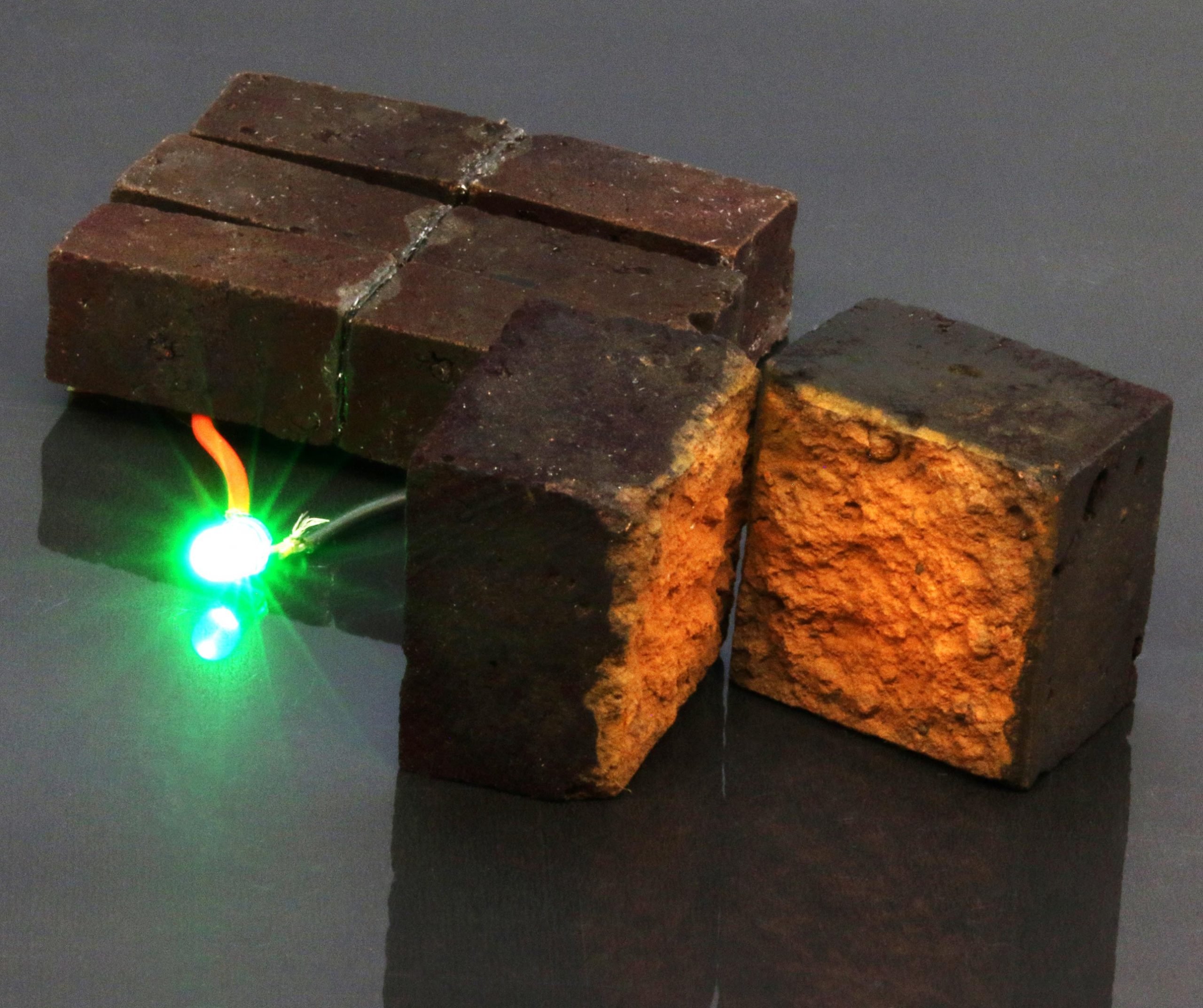
    Red brick device developed by chemists at Washington University in St. Louis lights up a green light-emitting diode. The photo shows the core-shell architecture of a nanofibrillar PEDOT-coated brick electrode. Credit: D’Arcy Laboratory, Department of Chemistry, Washington University in St. Louis

    Imagine plugging into your brick house.

    Red bricks — some of the world’s cheapest and most familiar building materials — can be converted into energy storage units that can be charged to hold electricity, like a battery, according to new research from Washington University in St. Louis.

    Brick has been used in walls and buildings for thousands of years, but rarely has been found fit for any other use. Now, chemists in Arts & Sciences have developed a method to make or modify “smart bricks” that can store energy until required for powering devices. A proof-of-concept published on August 11, 2020, in Nature Communications shows a brick directly powering a green LED light.

    “Our method works with regular brick or recycled bricks, and we can make our own bricks as well,” said Julio D’Arcy, assistant professor of chemistry. “As a matter of fact, the work that we have published in Nature Communications stems from bricks that we bought at Home Depot right here in Brentwood (Missouri); each brick was 65 cents.”

    Walls and buildings made of bricks already occupy large amounts of space, which could be better utilized if given an additional purpose for electrical storage. While some architects and designers have recognized the humble brick’s ability to absorb and store the sun’s heat, this is the first time anyone has tried using bricks as anything more than thermal mass for heating and cooling.

    D’Arcy and colleagues, including Washington University graduate student Hongmin Wang, first author of the new study, showed how to convert red bricks into a type of energy storage device called a supercapacitor.

    “In this work, we have developed a coating of the conducting polymer PEDOT, which is comprised of nanofibers that penetrate the inner porous network of a brick; a polymer coating remains trapped in a brick and serves as an ion sponge that stores and conducts electricity,” D’Arcy said.

    The red pigment in bricks — iron oxide, or rust — is essential for triggering the polymerization reaction. The authors’ calculations suggest that walls made of these energy-storing bricks could store a substantial amount of energy.

    “PEDOT-coated bricks are ideal building blocks that can provide power to emergency lighting,” D’Arcy said. “We envision that this could be a reality when you connect our bricks with solar cells — this could take 50 bricks in close proximity to the load. These 50 bricks would enable powering emergency lighting for five hours.

    “Advantageously, a brick wall serving as a supercapacitor can be recharged hundreds of thousands of times within an hour. If you connect a couple of bricks, microelectronics sensors would be easily powered.”

    Reference: “Energy storing bricks for stationary PEDOT supercapacitors” by Hongmin Wang, Yifan Diao, Yang Lu, Haoru Yang, Qingjun Zhou, Kenneth Chrulski and Julio M. D’Arcy, 11 August 2020, Nature Communications.
    DOI: 10.1038/s41467-020-17708-1

    Never miss a breakthrough: Join the SciTechDaily newsletter.
    Follow us on Google and Google News.

    Battery Technology Energy Washington University in St. Louis
    Share. Facebook Twitter Pinterest LinkedIn Email Reddit

    Related Articles

    Rival Emerges to Lithium-Ion Batteries: New Potassium Metal Technology

    New Battery Can Self-Charge Without Losing Energy

    Next-Generation Energy Storage Breakthrough: Fast-Charging, Long-Running, Flexible

    New Aqueous Lithium-Ion Battery – Low Cost & Improved Safety

    Iron-Air Batteries Promise Higher Energy Density Than Lithium-Ion Batteries

    New Aluminum Batteries Increase the Range of UUVs Tenfold

    MIT Engineers Look Toward All-Solid Lithium Batteries

    Engineers Design Calcium-Based Multi-Element for Liquid Batteries

    Power Conserving Chip May Increase Smartphone Battery Life

    Leave A Reply Cancel Reply

    • Facebook
    • Twitter
    • Pinterest
    • YouTube

    Don't Miss a Discovery

    Subscribe for the Latest in Science & Tech!

    Trending News

    Monster Storms on Jupiter Unleash Lightning Beyond Anything on Earth

    Scientists Create “Liquid Gears” That Spin Without Touching

    The Simple Habit That Could Help Prevent Cancer

    Millions Take These IBS Drugs, But a New Study Finds Serious Risks

    Scientists Unlock Hidden Secrets of 2,300-Year-Old Mummies Using Cutting-Edge CT Scanner

    Bread Might Be Making You Gain Weight Even Without Eating More Calories

    Scientists Discover Massive Magma Reservoir Beneath Tuscany

    Europe’s Most Active Volcano Just Got Stranger – Here’s Why Scientists Are Rethinking It

    Follow SciTechDaily
    • Facebook
    • Twitter
    • YouTube
    • Pinterest
    • Newsletter
    • RSS
    SciTech News
    • Biology News
    • Chemistry News
    • Earth News
    • Health News
    • Physics News
    • Science News
    • Space News
    • Technology News
    Recent Posts
    • This Simple Fruit Wash Could Make Produce Safer and Last Days Longer
    • These Tiny Robots 50x Smaller Than a Hair Can Hunt and Move Bacteria
    • Simple Blood Test May Predict Alzheimer’s Years Before Brain Scans Show Signs
    • Scientists Say Adding This Unusual Seafood to Your Diet Could Reverse Signs of Aging
    • U.S. Waste Holds $5.7 Billion Worth of Crop Nutrients
    Copyright © 1998 - 2026 SciTechDaily. All Rights Reserved.
    • Science News
    • About
    • Contact
    • Editorial Board
    • Privacy Policy
    • Terms of Use

    Type above and press Enter to search. Press Esc to cancel.