

New data on baryon acoustic oscillations strengthen the case for a local cosmic void. The finding offers a possible solution to the Hubble tension.
When we look at the night sky, it can appear as though our cosmic surroundings are filled with countless stars, planets, and galaxies. However, researchers have long proposed that our local region of the universe may contain far fewer galaxies than expected.
Evidence increasingly points to the possibility that we inhabit a vast cosmic void, with a matter density around 20% lower than the cosmic average.
Not every physicist is convinced that this is the case. But our recent paper analyzing distorted sounds from the early universe, published in the Monthly Notices of the Royal Astronomical Society, strongly backs up the idea.
The Hubble tension problem
Cosmology is currently in a crisis known as the Hubble tension: the local universe appears to be expanding about 10% faster than expected. The expected rate is derived by taking precise observations of the infant universe and projecting them forward using the standard cosmological framework, known as Lambda-Cold Dark Matter (ΛCDM).
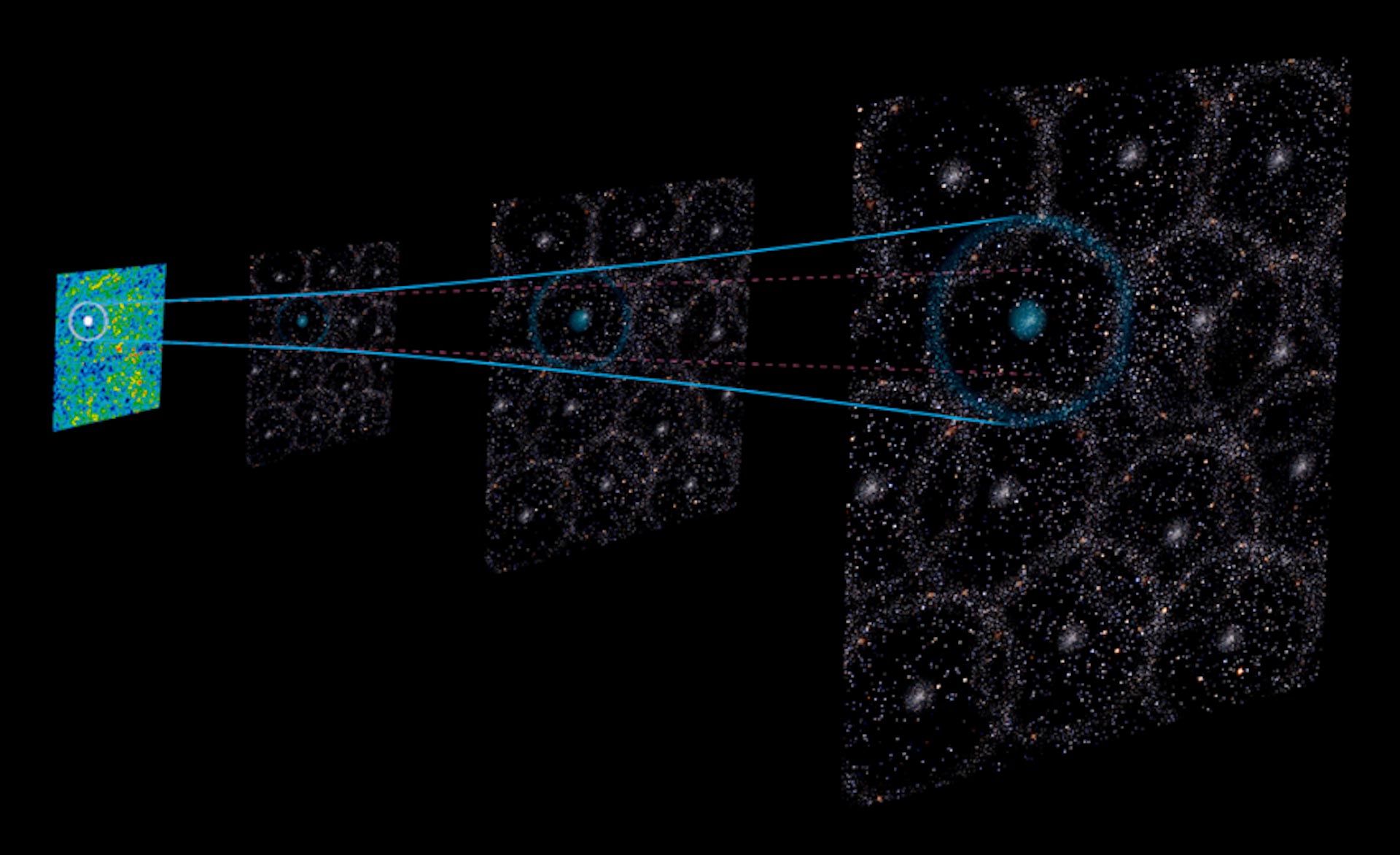
We can examine the early universe with exceptional detail through the cosmic microwave background (CMB), the relic radiation dating back to when the universe was about 1,100 times smaller than today. Sound waves that traveled through the hot plasma of the early universe left behind alternating regions of higher and lower density, and thus variations in temperature.
By analyzing fluctuations in the CMB on a range of scales, scientists can effectively “listen” to the echoes of these primordial sound waves, which resonate most strongly at certain characteristic scales.
Baryon acoustic oscillations as a standard ruler
These patterns are preserved in the CMB and are known as baryon acoustic oscillations (BAOs). Because they seeded the formation of galaxies and large-scale structures, the same patterns can also be detected in the present-day distribution of galaxies.
By studying how galaxies cluster at different redshifts (which correspond to distance), researchers can trace these oscillations. One particularly distinctive clustering feature, called the “angular BAO scale,” serves as a key marker.
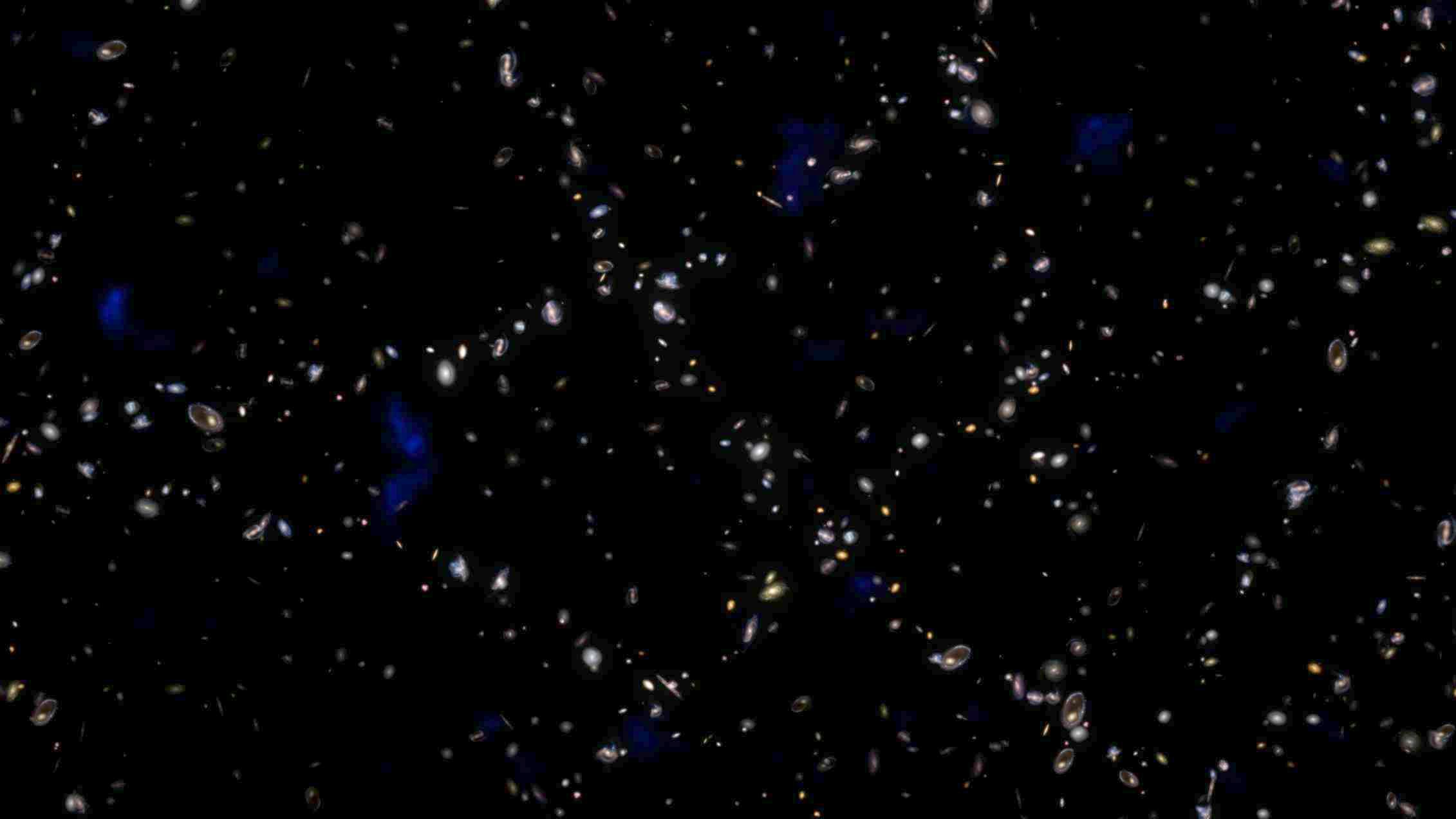
This feature provides what cosmologists call a “standard ruler,” a known size that allows them to determine distances across the universe. By measuring how large this scale appears in the sky at a given redshift, scientists can calculate both the distance to those galaxies and the rate of cosmic expansion.
Testing the void hypothesis
Using these measurements, cosmologists can determine expansion rates with trigonometry and redshift data. If the BAO feature appears larger at a certain distance, it implies that the local universe is expanding more quickly.
My colleagues and I previously argued that the Hubble tension might be due to our location within a large void. That’s because the sparse amount of matter in the void would be gravitationally attracted to the more dense matter outside it, continuously flowing out of the void.
In previous research, we showed that this flow would make it look like the local universe is expanding about 10% faster than expected. That would solve the Hubble tension.
But we wanted more evidence. And we know a local void would slightly distort the relation between the BAO angular scale and the redshift due to the faster-moving matter in the void and its gravitational effect on light from outside.
So in our new paper, Vasileios Kalaitzidis and I set out to test the predictions of the void model using BAO measurements collected over the last 20 years. We compared our results to models without a void under the same background expansion history.
In the void model, the BAO ruler should look larger on the sky at any given redshift. And this excess should become even larger at low redshift (close distance), in line with the Hubble tension.
Strong evidence for a local void
The observations confirm this prediction. Our results suggest that a universe with a local void is about one hundred million times more likely than a cosmos without one, when using BAO measurements and assuming the universe expanded according to the standard model of cosmology informed by the CMB.
Our research shows that the ΛCDM model without any local void is in “3.8 sigma tension” with the BAO observations. This means the likelihood of a universe without a void fitting these data is equivalent to a fair coin landing heads 13 times in a row. By contrast, the chance of the BAO data looking the way they do in void models is equivalent to a fair coin landing heads just twice in a row. In short, these models fit the data quite well.
In the future, it will be crucial to obtain more accurate BAO measurements at low redshift, where the BAO standard ruler looks larger on the sky – even more so if we are in a void.
The average expansion rate so far follows directly from the age of the universe, which we can estimate from the ages of old stars in the Milky Way. A local void would not affect the age of the universe, but some proposals do affect it. These and other probes will shed more light on the Hubble crisis in cosmology.
Reference: “Testing the local void hypothesis using baryon acoustic oscillation measurements over the last 20 yr” by Indranil Banik and Vasileios Kalaitzidis, 13 May 2025, Monthly Notices of the Royal Astronomical Society.
DOI: 10.1093/mnras/staf781
Adapted from an article originally published in The Conversation.
Indranil Banik receives funding from the Royal Society as part of a University Research Fellowship managed by his boss Harry Desmond. The second author on the paper was Vasileios Kalaitzidis, who received an undergraduate summer project grant from the Royal Astronomical Society to undertake the analysis described here.
Never miss a breakthrough: Join the SciTechDaily newsletter.
Follow us on Google and Google News.
12 Comments
There would have been either a stupendous reflection within an early “Big Bang” expansion wave, or two bangs. This would seem to look the same regardless if we were in an antinode, as it would simply appear larger embracing us so
The cosmic microwave background shows that there is only one smooth expansion.
Notably the proposed earlier solution is a non-relativistic model. The new paper claims that local ladder supernova distances have a 20 % underdensity explanation, but a 2019 paper show that there is no local underdensity and that it wouldn’t affect Hubble rates if it did.
“We conclude that the SN luminosity distance–redshift relation is inconsistent at the 4–5σ confidence level with large local underdensities (|δ| > 20 %, where the density contrast δ = Δρ/ρ) proposed in some galaxy count studies, and find no evidence of a change in the Hubble constant corresponding to a void with a sharp edge in the redshift range 0.023 < z < 0.15. With an empirical precision of sigma_H = 0.60 %, we conclude that the distance ladder measurement is not affected by local density contrasts, in agreement with a cosmic variance of sigma_H = 0.42 %, predicted from simulations of large-scale structure. Given that uncertainty in the distance ladder value is sigma_H = 2.2%, this does not affect the Hubble tension. We derive a 5σ constraint on local density contrasts on scales larger than
69 Mpc h^-1 of |δ| < 27 %. The presence of local structure does not appear to impede the possibility of measuring the Hubble constant to 1% precision." [W. D’Arcy Kenworthy et al 2019 ApJ 875 145]
Moreover, Efstathiou just showed in an arxiv analysis how that works with a comprehensive BAO update using the latest DESI data. "From the comparison of Planck and DESI BAO measurements, we find no significant evidence in support of evolving dark energy. [One alternative to a void.] … We show that the combination of DESI BAO measurements and the CMB constrain w(z = 0.5) = −0.996 ± 0.046, i.e. very close to the value expected for a cosmological constant." https://arxiv.org/pdf/2505.02658
The universe interest me but unfortunately I don’t have the slightest idea what your talking about. Its not you its me. My average IQ along with only a basic high school general math and planetary teachings is the reason.
IQ has nothing to do with this. People of the same group (say, astrophysicists, doctors, or, even say, plumbers) pepper their words with jargon that they only understand. This is efficient when they talk amongst themselves. But to outsiders that seems esoteric – but it is not because you can get up to speed with the jargon if you spend enough time on the subject.
Einstein supposedly said: “If you can’t explain it to a six-year-old, you don’t understand it yourself.” This is quite true. Now, this doesn’t say that “experts” can explain the math and the derivations to a six-year old, but they should be able to explain the effects and the experiments that give us confidence on those effects.
One of those experts would could communicate to people outside the field is astrophysicist Carl Sagan. His video series Cosmos is available for free over the internet, and it is a good explanation of the cosmos without any of the jargon. He also has a book – personally I find the video series more engaging.
Without question, ‘Cosmos’ is prime viewing if you want a better understanding of the Universe. Make certain your children and grandchildren see it.
20% less is a void? Bahaha
The truth is that no one knows anything about the universe. Some say it’s finite some say the opposite.
I believe the universe is just one massive structure. There’s likely multiples. We have no idea what’s beyond our known universe. Much like those who observed other galaxies for the first time.
“No one knows anything” is perhaps too strong a characterization. But you are mostly right – we don’t know everything about the universe(s) and we probably know very little about the universe. We should admit our ignorance and look for answers.
So, you’re saying that, regardless of what point on Earth we may find ourselves on, we’re still in the middle of nowhere.
We are indeed in the middle of nowhere.
There will never be a shuttle service to the nearest exoplanet. It’s not a technological limitation, it is a limitation imposed by known science.
When you die, your soul will go to the great light which can be confirmed by numerous NDEs not to mention Ian Richardson’s work on studying children I remember past lives. The bottom line is we do not die and once we leave earth you are tapped into the universe. You know all about it every little detail and there are no surprises and no speculation. So why waste your time on earth which is so precious and so short on this subject when you’re gonna know all about it very very soon.