
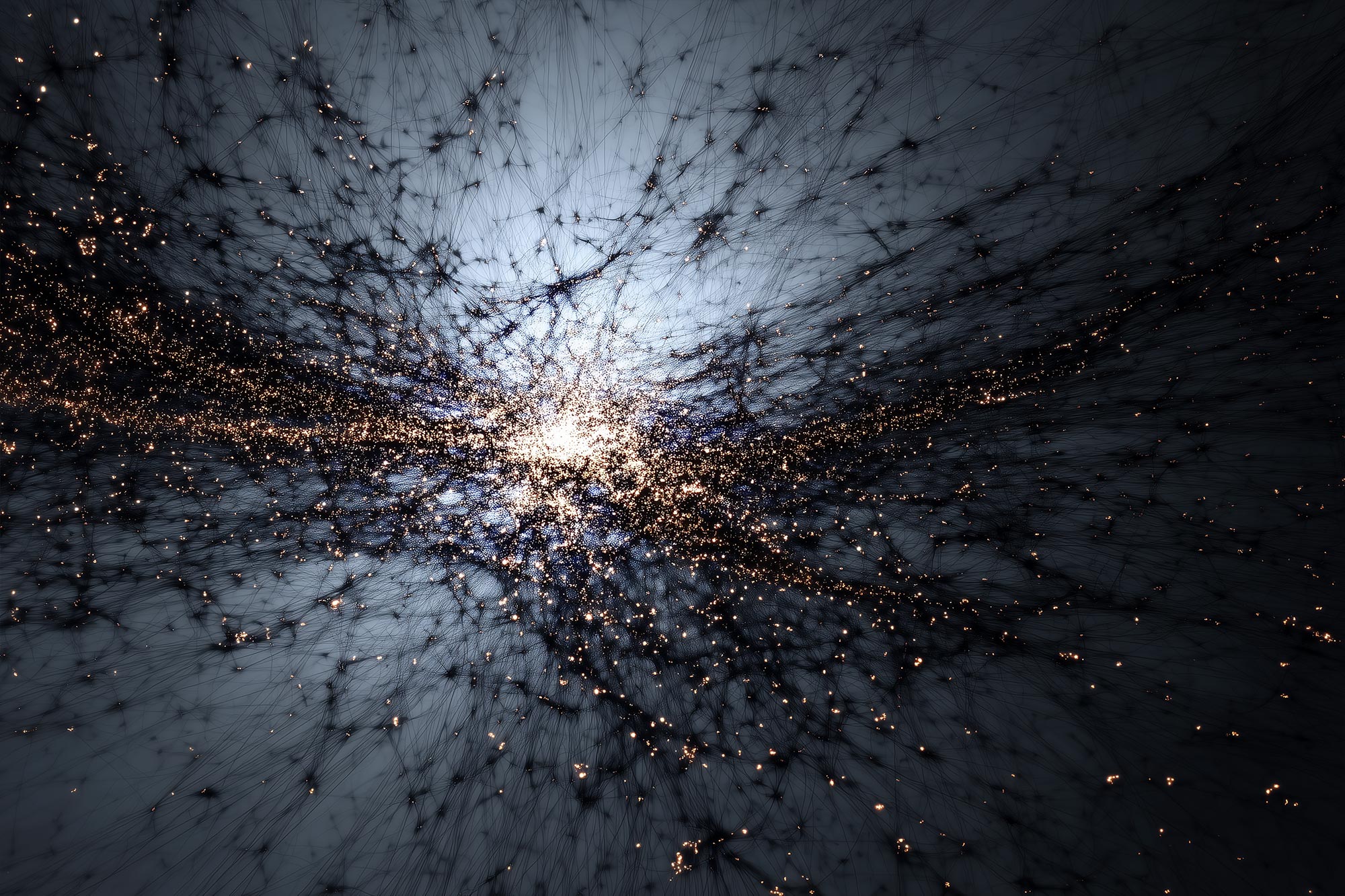
A new model suggests dark matter may be more complex than a single substance, potentially reshaping how scientists interpret hidden structures across the universe.
Dark matter is one of the universe’s most puzzling ingredients. It does not emit, absorb, or reflect light, yet its gravitational pull quietly shapes galaxies, bends light across cosmic distances, and influences how structures form on the largest scales.
For decades, the leading explanation has been the “cold dark matter” model, which assumes dark matter particles move slowly and interact only through gravity. That framework has been remarkably successful, but recent high-precision observations are beginning to expose its limits.
In some dwarf galaxies, dark matter seems unusually “diffuse,” with a lower density at their centers than expected. At the same time, studies of strong gravitational lensing have uncovered extremely dense clumps of dark matter that are far more compact than standard theories predict. These conflicting observations have persisted for years and remain difficult to reconcile within a single framework.
A recent study led by physicists at the Purple Mountain Observatory, Chinese Academy of Sciences (CAS), offers a possible solution. The team suggests that dark matter may not be made of a single type of particle, but instead consists of particles with different masses.
A New Two-Component Perspective
The researchers propose a “two-component self-interacting dark matter” model. In this picture, dark matter is made up of at least two kinds of particles, one heavier and one lighter. These particles interact not only through gravity but also through direct collisions, which leads to a process known as “mass segregation.”
Over time, this effect causes heavier dark matter particles to move inward toward the centers of galaxies, while lighter particles spread outward. A similar process occurs in star clusters, where more massive stars drift toward the center and lighter ones move farther away.
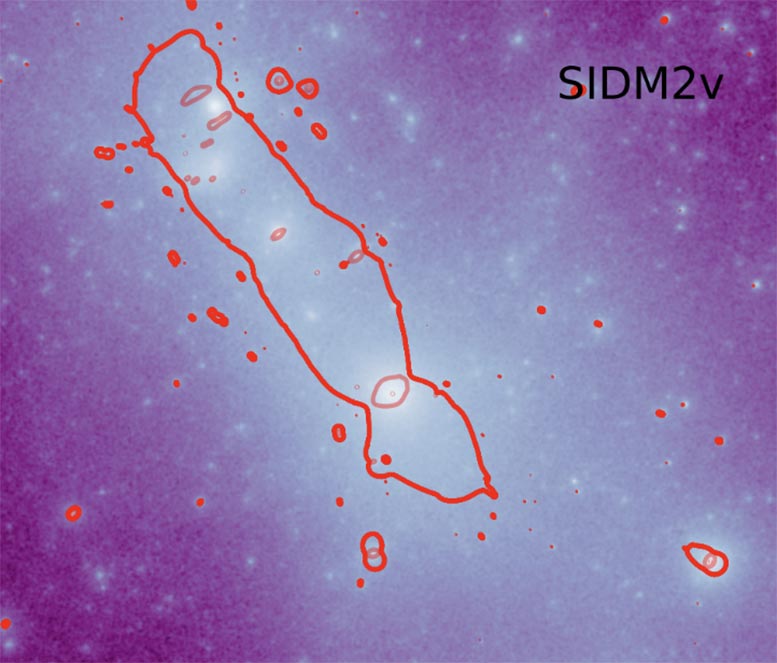
Using high-resolution simulations along with detailed theoretical analysis, the team showed that mass segregation can reproduce a wide range of observed cosmic features.
Explaining Galaxy Structures and Lensing
In dwarf galaxies, the process produces dark matter cores with relatively low central densities, matching recent observations of galaxy clustering. In denser and more complex environments, some dark matter halos become increasingly compact, forming dense regions that can generate strong gravitational lensing.
The model also boosts the likelihood of small-scale lensing events. By concentrating dark matter in certain regions, mass segregation makes substructures more effective at “magnifying” light from distant background galaxies. This helps address a long-standing issue in which observations appear to show more small-scale lensing events than theory predicts.
Toward a More Complex View of Dark Matter
According to the researchers, several seemingly conflicting small-scale anomalies may actually point to the same conclusion. The internal behavior of dark matter could be far more complex than previously thought.
As astronomical surveys and lensing measurements continue to improve, scientists may be able to use these “cosmic magnifying glasses” to test whether dark matter truly has multiple components. Such findings could significantly reshape our understanding of the universe.
Ongoing Research and Scientific Context
This work is the second study from the Purple Mountain Observatory team focused on two-component self-interacting dark matter and was recently published in Science Bulletin. In an earlier paper published in Physical Review D, the researchers examined how mass segregation influences the range of core density profiles in dwarf galaxies.
Reference: “Self-interacting dark matter with mass segregation: a unified explanation of dwarf cores and small-scale lenses” by Daneng Yang, Yi-Zhong Fan, Siyuan Hou and Yue-Lin Sming Tsai, 3 February 2026, Science Bulletin.
DOI: 10.1016/j.scib.2026.01.077
Never miss a breakthrough: Join the SciTechDaily newsletter.
Follow us on Google and Google News.
4 Comments
Since 2012 I’ve been demonstrating the coherent radiant pulsing angular lines of force nature of gravity on my own video channel, first YouTube (until deleted) and now Odysee dot com, with my most recent of four uploaded just last June (https://odysee.com/@charlesgshaver:d/5Gravity:c). I believe my model of gravity satisfies the conditions the scientists very imaginatively propose and simulate. Suffice it for me to add for now only that my uploaded videos are actual demonstrations, not simulations.
So dark matter bends light. Perhaps it also red-shifts light? Why not?
thanks for this
If there is dark matter, then it is a good story. It can be seen that there is a correlation between the amount of dark matter and speed, in the case of Milkyway and Bullet cluster. Speed dependent G can explain the shortage of matter in these. Three is no dark matter. My paper is available in acdemia.edu.