
Superheavy charged gravitinos may be the long-sought answer to dark matter.
Dark Matter remains one of the biggest mysteries in fundamental physics. Many theoretical proposals (axions, WIMPs) and 40 years of extensive experimental search have not explained what Dark Matter is. Several years ago, a theory that seeks to unify particle physics and gravity introduced a radically different possibility: superheavy, electrically charged gravitinos as Dark Matter candidates.
A recent paper in Physical Review Research by scientists from the University of Warsaw and the Max Planck Institute for Gravitational Physics shows that new underground detectors, in particular the JUNO detector that will soon begin taking data, are well-suited to detect charged Dark Matter gravitinos even though they were designed for neutrino physics. Simulations that bridge elementary particle physics with advanced quantum chemistry indicate that a gravitino would leave a signal in the detector that is unique and unambiguous.
In 1981, Nobel Prize laureate Murray Gell-Mann, who introduced quarks as fundamental constituents of matter, observed that the particles of the Standard Model—quarks and leptons—appear within a purely mathematical theory formulated two years earlier: N=8 supergravity, noted for its maximal symmetry. N=8 supergravity includes, in addition to the Standard Model matter particles of spin 1/2, a gravitational sector with the graviton (of spin 2) and 8 gravitinos of spin 3/2. If the Standard Model is indeed connected to N=8 supergravity, this relationship could point toward a solution to one of the hardest problems in theoretical physics — unifying gravity with particle physics. In its spin ½ sector, N=8 supergravity contains exactly 6 quarks (u,d,c,s,t,b) and 6 leptons (electron, muon, taon and neutrinos), and it forbids any additional matter particles.
After 40 years of intensive accelerator research without discoveries of new matter particles, the matter content predicted by N=8 supergravity remains consistent with observations and is still the only known theoretical explanation for why the Standard Model has precisely that number of quarks and leptons. However, a direct mapping between N=8 supergravity and the Standard Model faced a major issue: the electric charges of quarks and leptons were shifted by ±1/6 relative to their known values. For example, the electron would have charge -5/6 instead of -1.
Extending Supergravity
Several years ago Krzysztof Meissner from the Faculty of Physics at the University of Warsaw, Poland and Hermann Nicolai from the Max Planck Institute for Gravitational Physics (Albert Einstein Institute/AEI), Potsdam, Germany returned to the Gell-Mann’s idea and were able to go beyond N=8 supergravity and modify the original proposal obtaining correct electric charges of the Standard Model matter particles. The modification is very far reaching pointing to an infinite symmetry K(E10), little known mathematically and replacing the usual symmetries of the Standard Model.
One of the surprising outcomes of the modification, described in papers in Physical Review Letters and Physical Review, is the fact that the gravitinos, presumably of the extremely large mass close to the Planck scale i.e. billion billion proton masses, are electrically charged: 6 of them have charge ±1/3 and 2 of them ±2/3. The gravitinos, even though they are extremally massive, cannot decay since there are no particles they could decay into. Meissner and Nicolai proposed therefore that 2 gravitinos of charge ±2/3 (the other 6 have much lower abundance) could be Dark Matter particles of very different kind than anything proposed so far. Namely, the widely advertized usual candidates, either extremely light like axions or intermediate (proton) mass like WIMPs (weakly interacting massive particles) were electrically neutral, in compatibility with the name ‘Dark Matter’. However, after more than 40 years of intensive search by many different methods and devices no new particles beyond the Standard Model were detected.
However, gravitinos present a new alternative. Even though they are electrically charged, they can be Dark Matter candidates because being so massive they are extremely rare and therefore observationally ‘do not shine on the sky’ and avoid the very tight constraints on the charge of Dark Matter constituents. Moreover, the electric charge of gravitinos suggested a completely different way of trying to prove their existence.
The original paper in 2024 in Eur. Phys. J. by Meissner and Nicolai pointed out that neutrino detectors, based on scintillators different from water, could be suitable for the detection of Dark Matter gravitinos. However, the search is made enormously difficult by their extreme rarity (presumably only one gravitino per 10,000 km3 in the Solar System), which is why there is no prospect of detection with currently available detectors. However, new giant, oil or liquid argon underground detectors, are either constructed or planned and realistic possibilities for searching for these particles are now opening up.
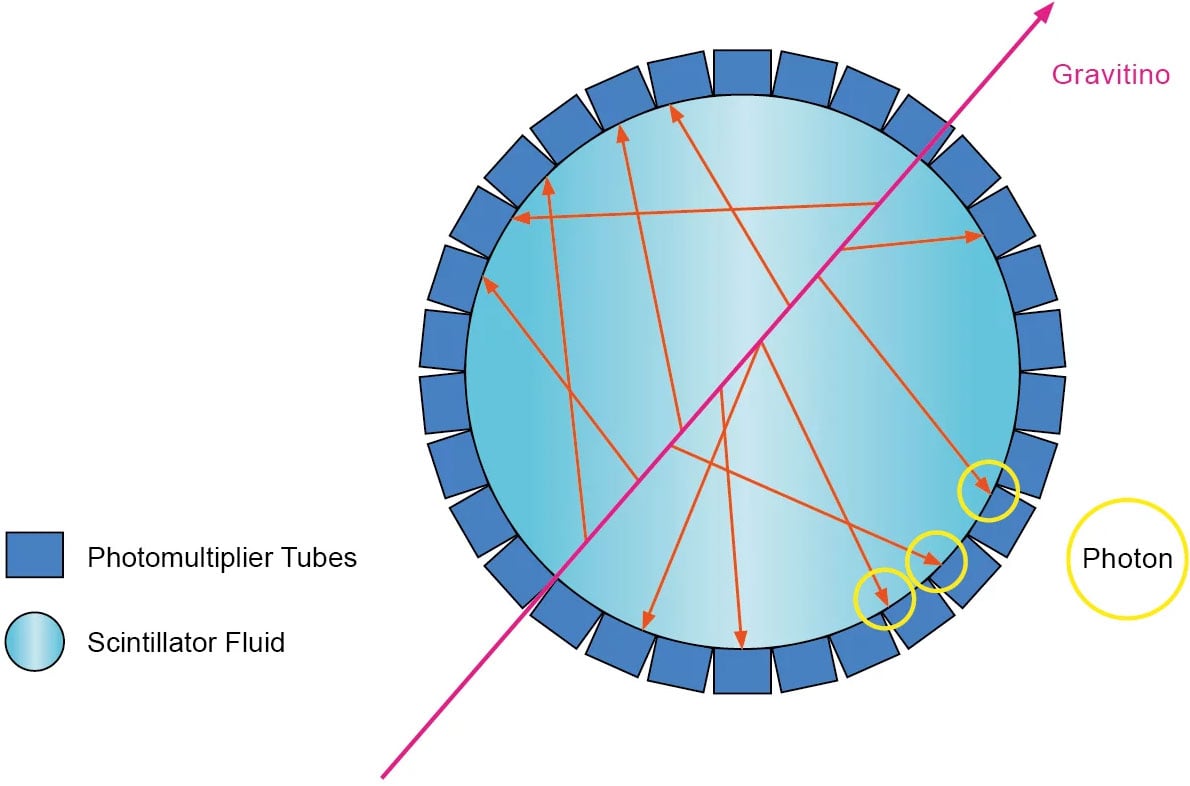
Among all detectors, the Chinese Jiangmen Underground Neutrino Observatory (JUNO) now under construction, seems predestined for such a search. It aims to determine the properties of neutrinos (actually antineutrinos) but since neutrinos interact extremely weakly with matter the detectors must have very large volumes. In the case of the JUNO detector, this means 20,000 tons of an organic, synthetic oil-like liquid, commonly used in chemical industry, with special additions, in a spherical vessel with a diameter of approximately 40 meters with more than 17 thousand photomultipliers around the sphere. JUNO is scheduled to begin measurements in the second half of 2025.
The JUNO Advantage
The recently published paper in Physical Review Research by Meissner and Nicolai, with collaborators Adrianna Kruk and Michal Lesiuk from the Faculty of Chemistry at the University of Warsaw, presents a detailed analysis of the specific signatures that events caused by gravitinos could produce at JUNO and in future liquid argon detectors such as the Deep Underground Neutrino Experiment (DUNE) in the United States.
The paper describes not only the theoretical background both on the physics and chemistry sides but also very detailed simulation of the possible signatures as a function of the velocity and track of a gravitino traveling through the oil vessel. It required very advanced knowledge of quantum chemistry and intensive CPU-time consuming calculations. The simulations had to take into account many possible backgrounds – decay of radioactive C14 present in the oil, dark count rate and efficiency of photomultipliers, absorption of photons in oil etc.
The simulations show that, with the appropriate software, passage of a gravitino through the detector will leave a unique signal impossible to be wrongly identified with a passage of any of the presently known particles. The analysis sets new standards in terms of interdisciplinarity by combining two different areas of research: theoretical and experimental elementary particle physics on one hand and very advanced methods of modern quantum chemistry on the other.
The detection of the superheavy gravitinos would be a major step forward in the search for a unified theory of gravity and particles. Since gravitinos are predicted to have masses on the order of the Planck mass, their detection would be the first direct indication of physics near the Planck scale and could thus provide valuable experimental evidence for a unification of all forces of nature.
References:
“Signatures of supermassive charged gravitinos in liquid scintillator detectors” by Adrianna Kruk, Michał Lesiuk, Krzysztof A. Meissner and Hermann Nicolai, 13 August 2025, Physical Review Research.
DOI: 10.1103/fm6h-7r78
“Standard model symmetries and K(E10)” by Krzysztof A. Meissner and Hermann Nicolai, 7 August 2025, Journal of High Energy Physics.
DOI: 10.1007/JHEP08(2025)054
Never miss a breakthrough: Join the SciTechDaily newsletter.
Follow us on Google and Google News.
2 Comments
As the lone lay discoverer of the true nature of gravity in 2009, since 2012 (despite multiple hardships) I’ve had low-budget online videos demonstrating rotation increasing the pull-push of gravity in various objects/wheels, with the most recent one uploaded in June of this year (https://odysee.com/@charlesgshaver:d/5Gravity:c). What else is it going to take to convince these more highly educated and better funded scientists that enhanced gravity in rotating celestial objects, not dark matter, is what holds galaxies together as they rotate at higher than expected rates?
Hello fellows, you all, people, people. The theory of everything has already been found, and covers gravity’s particles. It’s detailed in Geometria Essendi. Since urls can’t be posted in these comments, the pdf can be found accordingly:
Go to github dot com.
User muRtmuRtmuRt, by adding it behind a / in the url.
Open the one repository that’s there in the middle.
Commit historic, by a clock symbol in the top right of the list.
Comments of the commit from May the 4th 2024, by a text-bubble symbol on it.
Here the pdf is found in the first comment, where what happened to the graviton/gravitino is perhaps best summarized in ch.27 page 85, where gravitational potential is represented by the yellow force-vector:) Best of luck!