
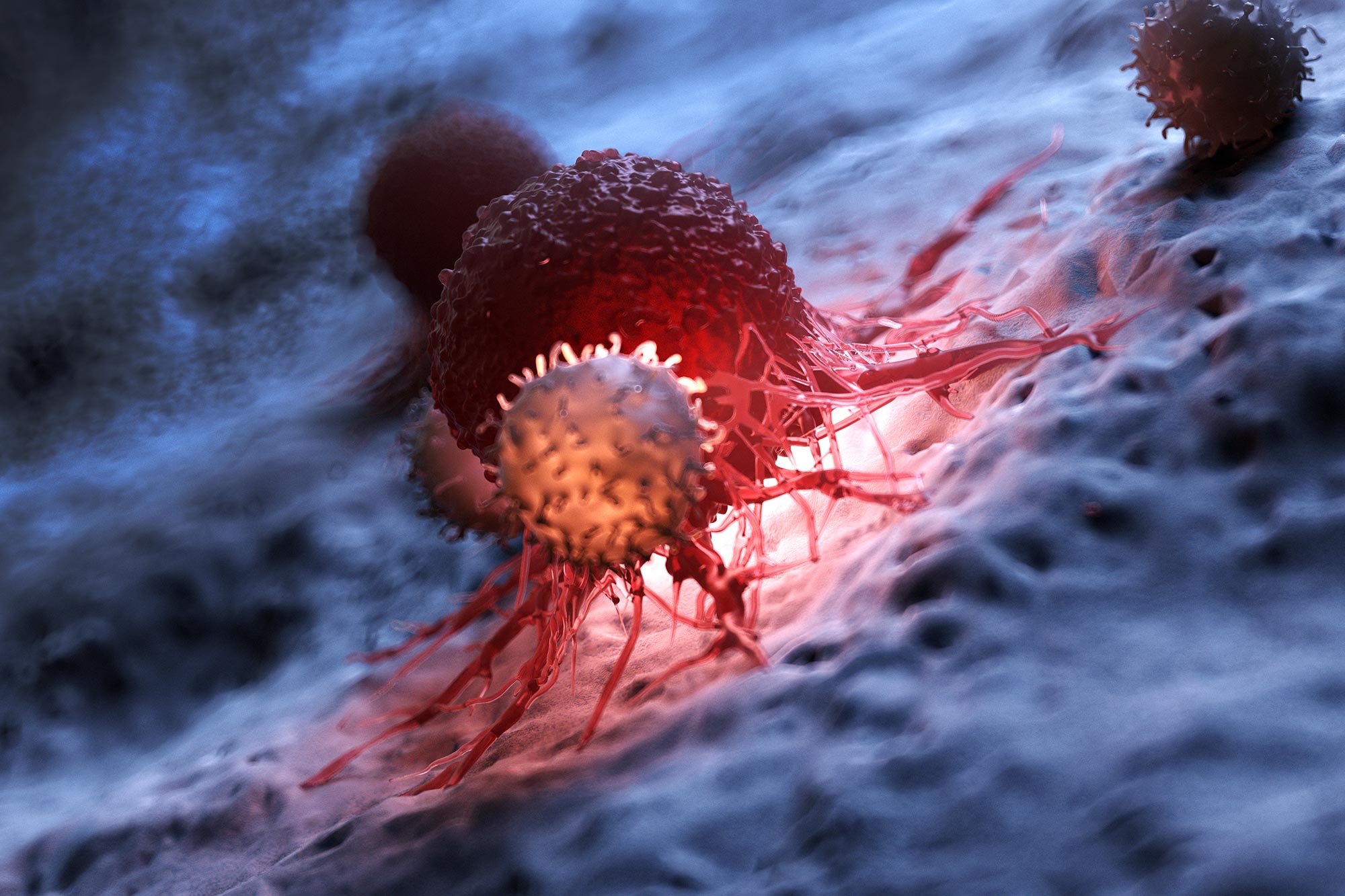
A new study reveals a possible way to make CAR T-cell therapy more durable and effective by targeting a single gene-regulating protein.
CAR T-cell therapy is widely seen as a breakthrough in personalized cancer care. The treatment works by modifying a patient’s own immune cells so they can identify and attack cancer cells. Although the therapy has been highly successful against some blood cancers, it has been far less effective in treating solid tumors.
Now, an international team led by Prof. Michel Sadelain, MD, PhD, at Columbia University in New York, working with Prof. Judith Feucht, MD, at University Hospital Tübingen, has identified a possible way to improve those results in animal studies. Sadelain is considered one of the leading pioneers of CAR T-cell therapy because of his major role in developing and advancing the treatment for clinical use.
The researchers carried out a large-scale analysis of about 400 transcription factors, which are proteins that control whether specific genes inside a cell are switched on or off. Their experiments revealed that a protein called NFIL3 is strongly linked to CAR T-cell exhaustion, a process in which the cells gradually lose their cancer-fighting ability over time. When NFIL3 was disabled, the CAR T cells stayed active longer, multiplied more effectively, and maintained stronger anti-tumor responses.
NFIL3 Identified as a Key Driver of CAR T-Cell Exhaustion
The team used CRISPR/Cas9 technology to deactivate the NFIL3 gene. Often described as “gene editing scissors,” the technique allows scientists to precisely cut and disable targeted genes. “Switching off NFIL3 could be a decisive step toward significantly improving the long-term potency of CAR T cells,” explains Prof. Feucht.
In multiple mouse studies, CAR T cells without NFIL3 fought tumors more successfully and helped extend survival. The findings could provide an important foundation for developing treatments against cancers that remain difficult to target with current therapies.
“Our goal is to improve the effectiveness of CAR T cells in solid tumors as well,” says Celina May, co–first author of the study and a member of Prof. Feucht’s research group. “We expect this to open up new possibilities in the treatment of cancer patients,” adds Feucht.
CRISPR Gene Editing Boosts CAR T-Cell Effectiveness
Prof. Judith Feucht combines laboratory research with direct patient care. She conducts research within Germany’s only oncology Cluster of Excellence, iFIT (Image Guided and Functionally Instructed Tumor Therapies), while also treating children and adolescents at the Department of Pediatrics at University Hospital Tübingen.
Her work follows the “bench-to-bedside” approach, which focuses on turning scientific discoveries into treatments for young cancer patients. Although more research is needed before these findings can be applied in clinical care, the results offer cautious optimism that the strategy could eventually benefit people as well.
Reference: “Integrated Chronic In Vivo and In Vitro Screens Uncover NFIL3 as a Driver of T-cell Dysfunction” by Nayan Jain, Yuzhe Shi, Celina May, Sneha Mitra, Philip Bucher, Anton Dobrin, Zeguo Zhao, Sophie Hanina, Vinagolu K. Rajasekhar, Yonghong Yao, Jorge Mansilla-Soto, Josef Leibold, Christina S. Leslie, Francisco J. Sánchez-Rivera, Judith Feucht and Michel Sadelain, 12 May 2026, Cancer Discovery.
DOI: 10.1158/2159-8290.CD-25-1524
Never miss a breakthrough: Join the SciTechDaily newsletter.
Follow us on Google and Google News.
1 Comment
Well the OFF SWITCH WAS DEFINITELY OFF FROM INJECTION, my father received CAR T cell treatment July 29, 2025 and after his 3 month review in November the cancer was more progressive and metastatic. By December 19, 2025 my father was deceased, over $800 thousand dollars spent and it did NOTHING. Need more work more research and trials on this method as treatment. I honestly believe the cell markers used for CAR T were not the same as whatever this was that grew over 3 months and took over my dad’s body. It’s like the treatment cells needed a boost or some new direction..