
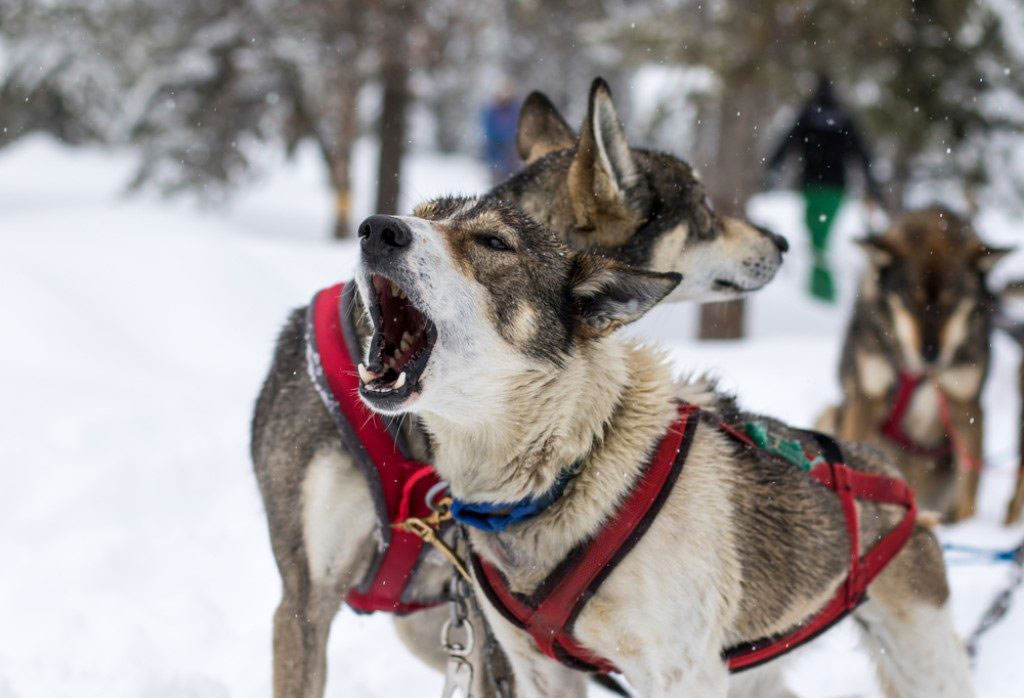
Dogs have been man’s best friend for more than 10,000 years, but a new study shows it has been a doggone tough road to get here: their ancestors in the Americas likely came from Siberia, and these early dog populations almost totally disappeared, but not before leaving a cancerous tumor that is still found in their canine descendants today.
A team of international researchers who worked on the study includes Anna Linderholm, assistant professor of anthropology at Texas A&M University, and their work is in the current issue of Science magazine.
The team collected genetic information from 71 ancient dog remains from the Americas and found that early dogs arrived alongside people who eventually settled throughout North, Central, and South America.
But closer study of the ancient dog genomes shows that they almost completely disappeared following the arrival of European settlers, leaving little or no trace in more modern American dogs. The researchers also found that a cancerous condition spread through the mating of dogs thousands of years ago is still present today and is the last remaining trace of these early dog populations that arrived in the Americas.
“It is fascinating that a huge population of dogs that inhabited all corners of the Americans for thousands of years could have disappeared so rapidly,” the team said in a joint statement.
“This suggests something catastrophic must have happened, but we do not have the evidence to explain this sudden disappearance yet. It is ironic that the only vestige of a population that was likely wiped out by a disease is the genome of a transmissible cancer.”
Linderholm, who directs the BIG (bioarchaeology and genomics lab) at Texas A&M and who did much of the genome work, said, “The sudden disappearance of dogs in America was probably associated with European colonization, but we don’t know the details yet. This is further evidence of the strong bond between humans and dogs. Humans will bring their dogs to every new place they explore and colonize, regardless of time and space.
“When we compare our ancient dog DNA to all other known dog/wolf DNA, we find that the closest relatives are the Siberian dogs. This mirrors what we know about humans at the time and sites in Siberia have records of people using dogs then.”
Linderholm said the study further proves “that we can say with certainty that the first wave of people entering the Americas brought dogs with them.
“But the cancer genome we found was a real surprise,” Linderholm said.
“This is the biggest twist I have seen in any project I have done. It is amazing to think that these cancerous cells spread and that they still exist all over the world. So in a weird way, the ancient dogs of America live on through these cancerous cells.”
Reference: “The evolutionary history of dogs in the Americas” by Máire Ní Leathlobhair, Angela R. Perri, Evan K. Irving-Pease, Kelsey E. Witt, Anna Linderholm, James Haile, Ophelie Lebrasseur, Carly Ameen, Jeffrey Blick, Adam R. Boyko, Selina Brace, Yahaira Nunes Cortes, Susan J. Crockford, Alison Devault, Evangelos A. Dimopoulos, Morley Eldridge, Jacob Enk, Shyam Gopalakrishnan, Kevin Gori, Vaughan Grimes, Eric Guiry, Anders J. Hansen, Ardern Hulme-Beaman, John Johnson, Andrew Kitchen, Aleksei K. Kasparov, Young-Mi Kwon, Pavel A. Nikolskiy, Carlos Peraza Lope, Aurélie Manin, Terrance Martin, Michael Meyer, Kelsey Noack Myers, Mark Omura, Jean-Marie Rouillard, Elena Y. Pavlova, Paul Sciulli, Mikkel-Holger S. Sinding, Andrea Strakova, Varvara V. Ivanova, Christopher Widga, Eske Willerslev, Vladimir V. Pitulko, Ian Barnes, M. Thomas P. Gilbert, Keith M. Dobney, Ripan S. Malhi, Elizabeth P. Murchison, Greger Larson and Laurent A. F. Frantz, 6 July 2018, Science.
DOI: 10.1126/science.aao4776
Never miss a breakthrough: Join the SciTechDaily newsletter.
Follow us on Google and Google News.
1 Comment
Wow i didnt know that its an ancient disease. Thanks for the information