

Scientists have identified a new RNA molecule that may play a key role in improving survival in cancer patients.
In a recent study published in the Proceedings of the National Academy of Sciences (PNAS), scientists at the Texas A&M University Health Science Center (Texas A&M Health) report the discovery of a previously unknown RNA molecule that helps maintain the stability of an important cellular structure called the nucleolus (a dense region of the cell containing a subset of crucial genetic material).
Their findings also indicate that this molecule may be linked to survival outcomes in certain blood cancers.
A surprising discovery inside a familiar gene
RNA, or ribonucleic acid, is a temporary molecule produced from DNA that allows cells to use genetic instructions. Segments of DNA are transcribed into RNA, which then carries those instructions to the cellular systems that build proteins. In this way, RNA serves as an intermediary, converting genetic information into active biological processes.
This study identifies an RNA molecule that does not become a protein but instead regulates cellular activity directly, classifying it as a non-coding RNA.
Researchers in the laboratory of Dr. Irtisha Singh at the Texas A&M Naresh K. Vashisht College of Medicine discovered this molecule, named CUL1-IPA. It originates from the well-studied CUL1 gene, which typically produces a protein. Unlike the standard RNA from this gene, CUL1-IPA remains in the cell nucleus and carries out a different role by helping preserve the structure and function of the nucleolus, which is responsible for producing ribosomes.
“This finding redefines the conventional assumption that protein-coding genes produce only protein-related messages,” said Singh, senior author of the study.
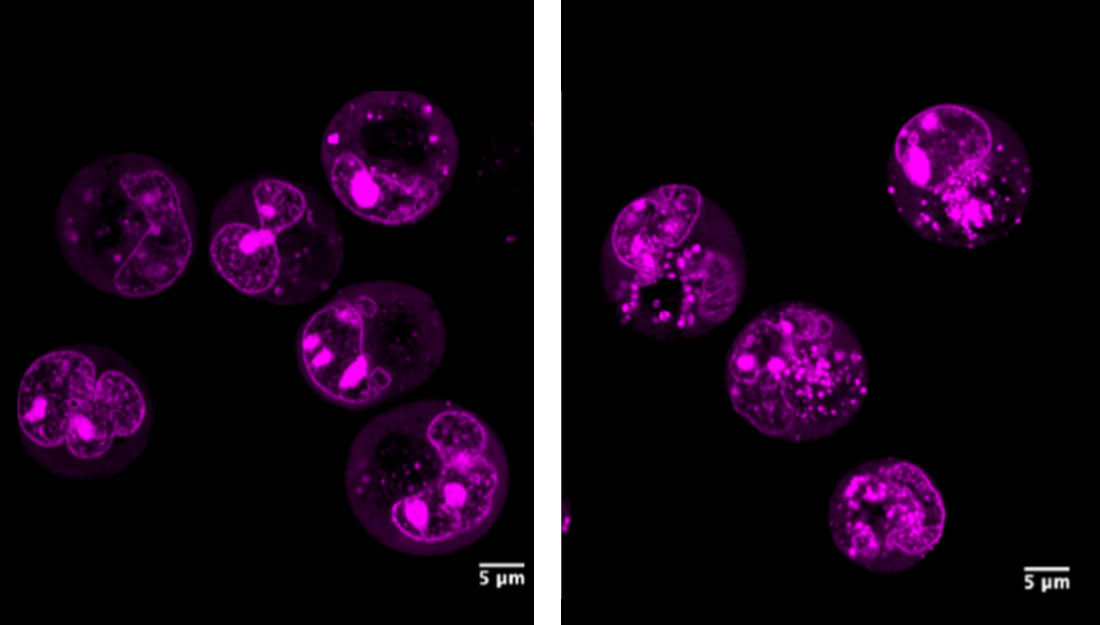
When the researchers removed CUL1-IPA from living cells, they observed striking changes. The nucleolus (a dense region of the cell containing a subset of crucial genetic material) lost its structure, and the affected cells showed clear signs of stress.
“We were amazed at how essential this RNA turned out to be,” said Dr. Sumana Mallick, co-first author of the study. “Removing it caused the nucleolus to lose its structural integrity, making it clear that non-coding RNAs from protein-coding genes can play central regulatory roles.”
A link to cancer patient outcomes
The implications of this discovery extend beyond basic cell biology. The Singh Lab examined clinical data from patients with multiple myeloma and chronic lymphocytic leukemia. Their analysis showed that individuals with more aggressive forms of these diseases had higher levels of CUL1-IPA, independent of the levels of the conventional CUL1 RNA.
“Its expression correlates with patient survival in blood cancers and may contribute to how aggressive these cancers become,” said Dr. Pranita Borkar, co-first author of the article.
Because cancer cells rely heavily on producing ribosomes to support rapid growth, molecules that enhance nucleolar activity may also support tumor progression. This makes CUL1-IPA a potential biomarker for disease severity and a possible target for future treatments.
Rethinking how genes work
The identification of CUL1-IPA adds to increasing evidence that genes can produce more than one functional RNA. A single gene may generate multiple RNA molecules with distinct roles, some of which can have significant effects on cellular behavior and disease development.
In the future, molecules like CUL1-IPA could be used to guide treatment decisions or serve as targets for new therapies, pointing toward new strategies in cancer research and drug development.
Reference: “Intronic polyadenylation–derived long noncoding RNA modulates nucleolar integrity and function” by Sumana Mallick, Pranita Borkar, Jaspreet Thind, Daniel Chung, Taylor Hubbs and Irtisha Singh, 30 January 2026, Proceedings of the National Academy of Sciences.
DOI: 10.1073/pnas.2514521123
The study was supported by grants from the National Institutes of Health, the Cancer Prevention and Research Institute of Texas (CPRIT) and Texas A&M Health, along with additional internal funding that supports early-stage scientific discovery.
Never miss a breakthrough: Join the SciTechDaily newsletter.
Follow us on Google and Google News.
2 Comments
Dc superhero girls
Great news today,,, thank you for sharing 🥰