

A rare stegosaurian skull discovery in Spain redefines dinosaur evolution and unveils a new group, Neostegosauria.
Paleontologists from the Fundación Conjunto Paleontológico de Teruel-Dinópolis have made an exciting discovery. In a new study published in the journal Vertebrate Zoology, they describe a remarkable partial stegosaur skull unearthed in Riodeva, a town in Teruel, Spain. Along with this discovery, they introduce a new hypothesis that could change what we know about the evolutionary history of plated dinosaurs.
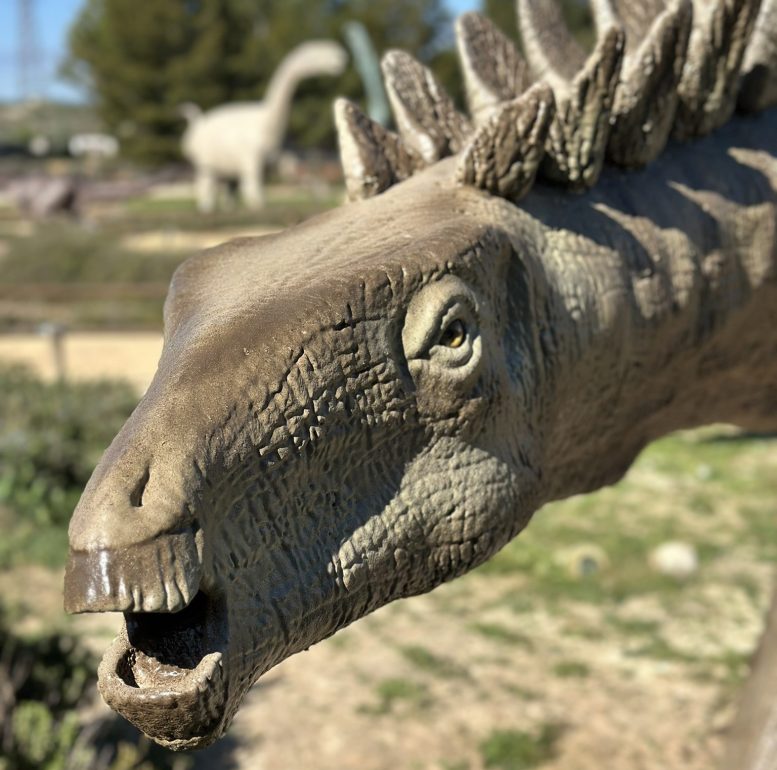
Stegosaurs were plant-eating dinosaurs that walked on all fours, instantly recognizable by the two rows of plates or spines lining their backs from neck to tail. The specimen examined in the study was carefully excavated by the Fundación Dinópolis team at the “Están de Colón” site.
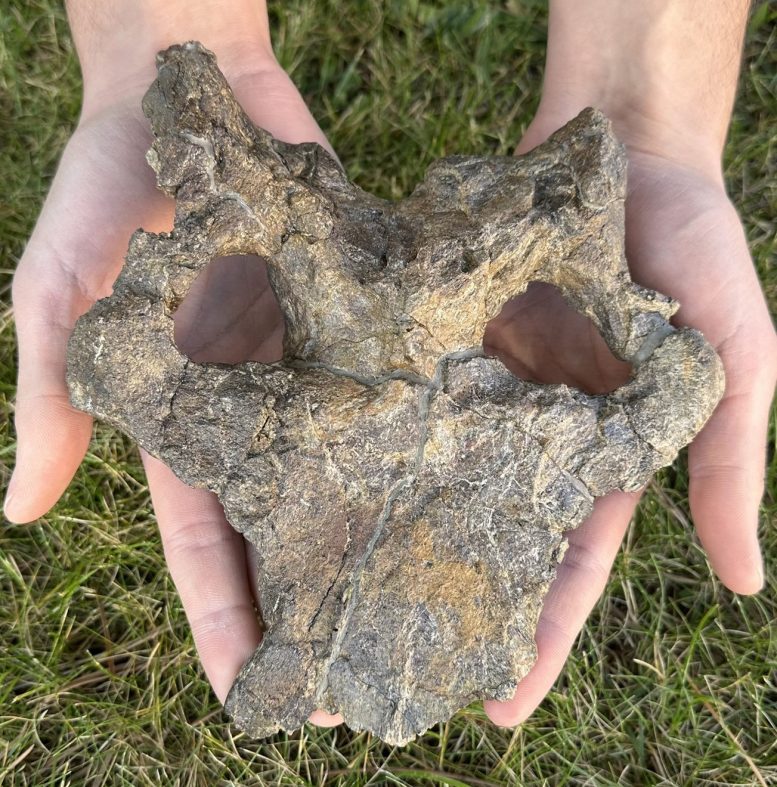
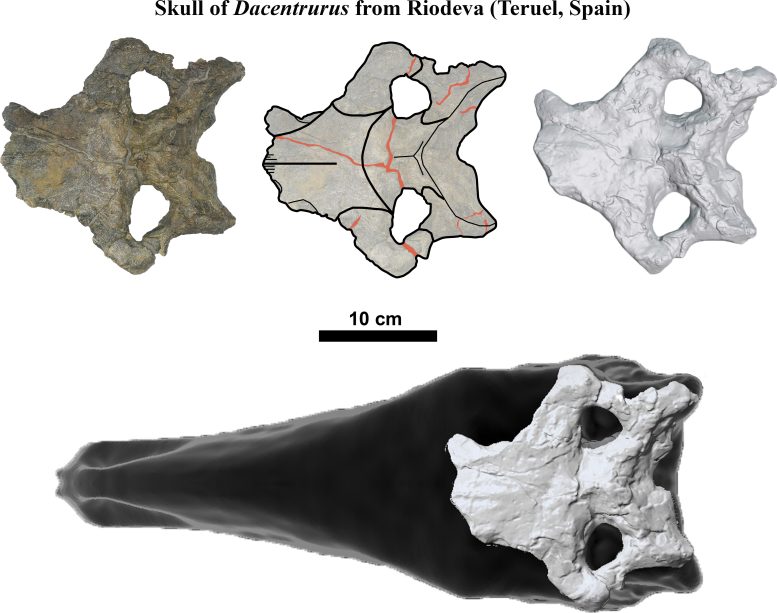
The rocks that held the fossil are part of the Villar del Arzobispo Formation, dating back about 150 million years to the Late Jurassic period. The skull is the most complete stegosaur skull ever found in Europe and has been identified as belonging to Dacentrurus armatus, one of the continent’s iconic dinosaur species.
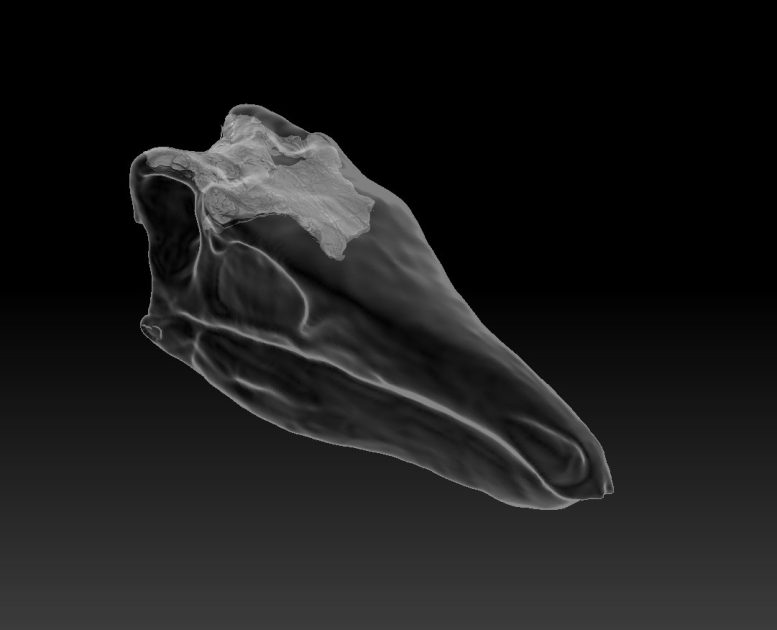
Sergio Sánchez Fenollosa, a researcher at the Fundación Dinópolis and co-author of the study, explains: “The detailed study of this exceptional fossil has allowed us to reveal previously unknown aspects of the anatomy of Dacentrurus armatus, the quintessential European stegosaur, which in 2025 marks 150 years since its first description. Dinosaurian skulls are rarely preserved due to the extreme fragility of their bones. This discovery is key to understanding how stegosaurian skulls evolved.”
He continues, “Furthermore, alongside the anatomical study, we have also proposed a new hypothesis that redefines the evolutionary relationships of stegosaurs worldwide. As a result of this work, we have formalized the definition of a new group called Neostegosauria.”
According to the researchers, this new group includes medium to large-sized stegosaurian species that at least lived in what is now Africa and Europe during the Middle and Late Jurassic, in North America during the Late Jurassic, and in Asia during the Late Jurassic and Early Cretaceous.
Teruel’s fossil site remains a treasure trove
Alberto Cobos, managing director of the Fundación Dinópolis and co-author of the publication, adds: “This dual achievement–both the study of an exceptional fossil and the proposal of a new evolutionary hypothesis–positions this research as a global reference in stegosaurian studies.”
He continues, This fossil site from Riodeva continues to be a subject of research and still holds numerous relevant fossils, including more postcranial elements from the same adult specimen and, notably, juvenile individuals, a particularly rare combination in this type of dinosaurs. These discoveries continue to exponentially increase the paleontological heritage of the province of Teruel, making it one of the iconic regions for understanding the evolution of life on Earth.”
Reference: “New insights into the phylogeny and skull evolution of stegosaurian dinosaurs: An extraordinary cranium from the European Late Jurassic (Dinosauria: Stegosauria)” by Sergio Sánchez-Fenollosa and Alberto Cobos, 26 May 2025, Vertebrate Zoology.
DOI: 10.3897/vz.75.e146618
Funding: This contribution from the Fundación Dinópolis, affiliated with the Dept. of Medio Ambiente y Turismo of the Gobierno de Aragón, is part of the activities of Research Group E04-23R FOCONTUR, funded by the Gobierno de Aragón (through the Dept. of Empleo, Ciencia y Universidades). Additionally, it is part of the research of the Unidad de Paleontología de Teruel, funded by the Gobierno de España (through the Ministry of Ciencia, Innovación y Universidades). The work at this site is also supported by the project titled Los yacimientos paleontológicos de la provincia de Teruel como factor de desarrollo territorial (IV), subsidized by the Gobierno de España and the Gobierno de Aragón through the Teruel Investment Fund (via the Dept. of Presidencia, Economía y Justicia).
Never miss a breakthrough: Join the SciTechDaily newsletter.
Follow us on Google and Google News.
26 Comments
There is no such thing as 150 million years ago. This is only 2025. Where are the rest of the years ?
Oh come on, not this now.
But I’m really happy and excited for this find because Dacentrurus is one of my favourite Stegosaurids and was the largest Stegosaurid species. Thanks for the article!!!
Gone –
Where is the rest of your brain?
Lol you must be overly naive and or super religious .Where are the rest of the years!? HAha…. Ask your “God” don’t believe in science and dating and fossils that’s all bs! …. i love it!
There’s no need to think your way is better than any other way. People have misunderstood what they called scientific results far too many times to act like it’s superior to anything. Not saying science isn’t valid, but don’t think science casts everything else aside. It’s never even complete-even “laws” have been wrong. So relax
My way is best for me
Please don’t trust those crazy people that will have you believe history goes back almost 6,000 years. That sooo wild!!
If only you understood B.C and A.D. Then you could be smart
You don’t measure geological ages over millions of years in individual calendar years. The Jurassic is named after the Jura mountains, with sedimentary rocks as old and older.
“The geologic folds comprise three major bands (lithological units) of building that date from three epochs: the Lias (Early Jurassic), the Dogger (Middle Jurassic) and the Malm (Late Jurassic) geologic periods. Each era of folding reveals effects of previously shallow marine environments as evidenced by beds with carbonate sequences, containing abundant bioclasts and oolitic divisions between layers (called horizons).
Structurally, the Jura consists of a sequence of geologic folds, the formation of which is facilitated by an evaporitic decollement layer. The box folds are still relatively young, which is evident by the general shape of the landscape showing that they have not existed long enough to experience erosion, thus revealing recent mountain building.”
– Wikipedia
There is a govt rule in South Korea, the picture of the snacks/ cookies on its pack will be as large as the snack/ cookies inside it so that the consumers doesn’t get deceived by the cookie size 🍪 depicted on the wrapper/pack.
Same rule should apply while reporting news on giant creatures like dinosaur 🦖/ giant snake 🐍
This is a joke, right?
But I’m really happy and excited for this find because Dacentrurus is one of my favourite Stegosaurids and was the largest Stegosaurid species. Thanks for the article!!!
Notice they call it a stegosuarian. Like Norwegian or African or Egyptian.
The earth is many years older than 2025. 4.543 billion years old to be exact.
150,002, 025 AD years later we finally found its scull!!
Nice tri funny guy but it’s spelled skull.
So little bone and so many assumptions. I still remember the Apatosaurus skull.
If they lived 150 my ago, we wouldn’t find their uneroded tracks. Hello, logic
Your logic is faulty. If there were track imprints, the covering sediments have recently eroded away or we wouldn’t see them. Hello, logic.
I would change the title since it’s mildly misleading, especially when you’re talking about a different species.
Bro….🫢 No…🤡 lol
I disagree in the whole “stegosaurus skull changes dinosaur evolution” part but it needs a little bit more looked into.
The title inflation is big on this site now. “150-Million-Year-Old Stegosaurus Skull Rewrites Dinosaur Evolution” (June 5), “500-Million-Year-Old Mystery Fossil Rewrites Early Animal Evolution” (June 6).
None wrong, all clickbait enforced by competition with other popular science outlets. Adjust your expectations (and ask them for more informative titles).
The most complete skull ever found looks to be about 20% of their reconstruction of what its head looked like. And that’s being very generous. It’s almost like they’re just making sh*t up as they go and really don’t have a clue what it actually looked like