

A newly studied Vegavis iaai skull from Antarctica confirms that modern bird lineages, like ducks and geese, were evolving alongside non-avian dinosaurs. This study supports Vegavis’ placement in the Anseriformes group despite its unexpected beak shape, highlighting the diversity of ancient birds.
A new study in Nature describes a nearly complete and intact fossilized bird skull from Antarctica, providing insight into the early evolution of modern birds and avian diversity at the end of the Age of Dinosaurs.
The skull belongs to Vegavis iaai, an extinct duck-like bird that lived during the Late Cretaceous, just before non-avian dinosaurs went extinct. It is one of the few known three-dimensional bird skulls from the Cretaceous—a 79-million-year geological period and the final era when non-avian dinosaurs roamed the Earth.
Vegavis is among the best-known bird species from this era. There are multiple fossils of this bird, including the oldest known fossil bird vocal organ. But research on the new skull — and the shape of the brain inside it — isn’t only helping scientists learn more about this particular extinct bird species, but the origins and evolution of birds that are still living today.
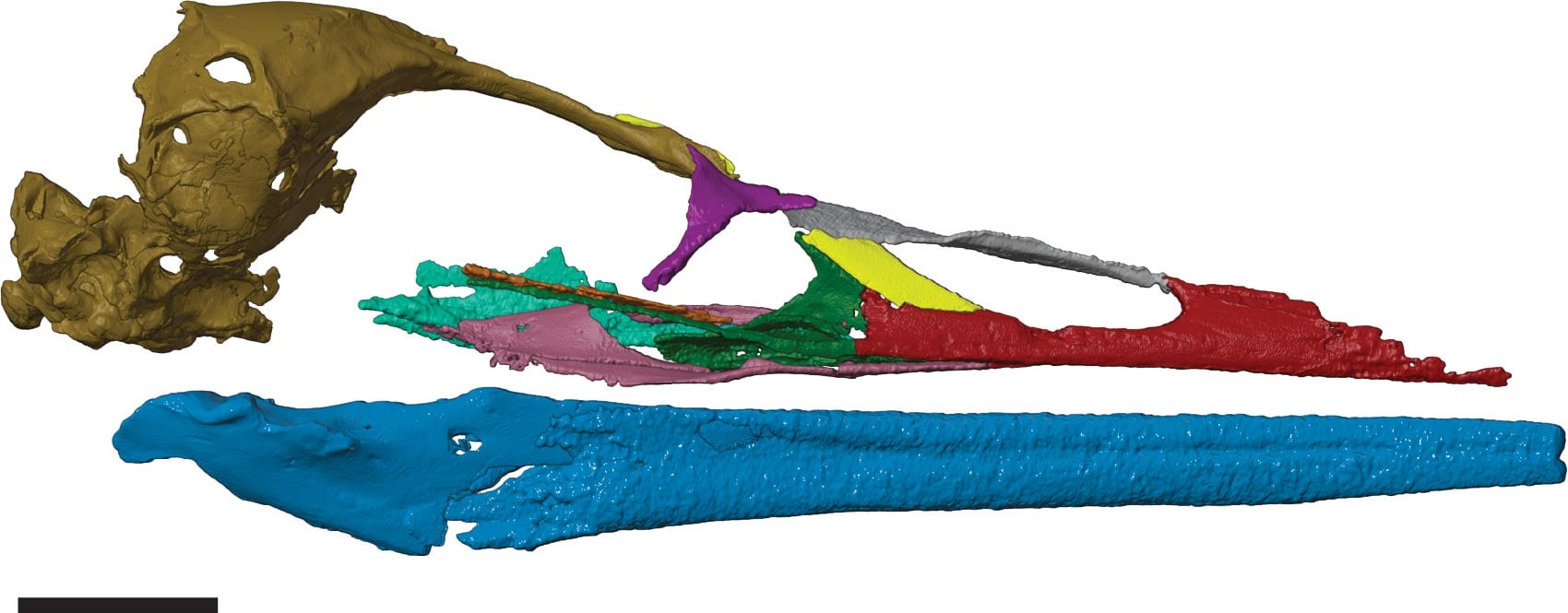
“There are very few brains to illuminate this phase of avian evolution,” said Chris Torres, an assistant professor at the University of the Pacific, who led the study.
Torres conducted the research as a National Science Foundation postdoctoral fellow at Ohio University, and began it as a graduate student at The University of Texas at Austin, working with Julia Clarke, a professor at the UT Jackson School of Geosciences.
Decades of Research on Vegavis
The new study is the latest in a long list of Vegavis discoveries by Clarke. She and colleagues identified and named the species in 2005, working with a specimen that was discovered on Antarctica’s Vega Island in 1992. The specimen was the first example of a direct relative of modern birds from the Late Cretaceous — and served as evidence that living bird relatives and their non-avian dinosaur cousins co-existed. In 2016, Clarke and other collaborators discovered a fossilized syrinx — a bird vocal organ — in a different Vegavis specimen. And in 2011, she was part of the fossil finding mission to Antarctica where the skull was discovered by study co-author and geologist Eric Roberts, a professor at the Colorado School of Mines.
When Clarke identified Vegavis, she determined that it was closely related to modern ducks and geese and could be categorized in an evolutionary group called Anseriformes that encompasses both types of birds. But since then, other researchers have suggested that Vegavis is much more distantly related to most bird lineages today.
“Few birds are as likely to start as many arguments among paleontologists as Vegavis,” said Torres.
But answering the question of where Vegavis lands on the tree of life isn’t just a technical point of discussion between paleontologists. It can help answer a big open question in bird evolution: Did it take the demise of non-avian dinosaurs for modern birds to diversify into the many lineages still with us today? Or was this diversification already well underway during the Age of Dinosaurs? Also, what role, if any, did the asteroid impact that ended the Cretaceous have on modern birds and their diversification?

Surprising Anatomical Features
Thanks to this new study, the researchers have confidently found a taxonomic home for Vegavis. Its broad collection of anatomical traits keeps it in the Anseriformes group, as Clarke previously hypothesized. This outcome suggests that the earliest diverging modern bird lineages were evolving alongside non-avian dinosaurs.
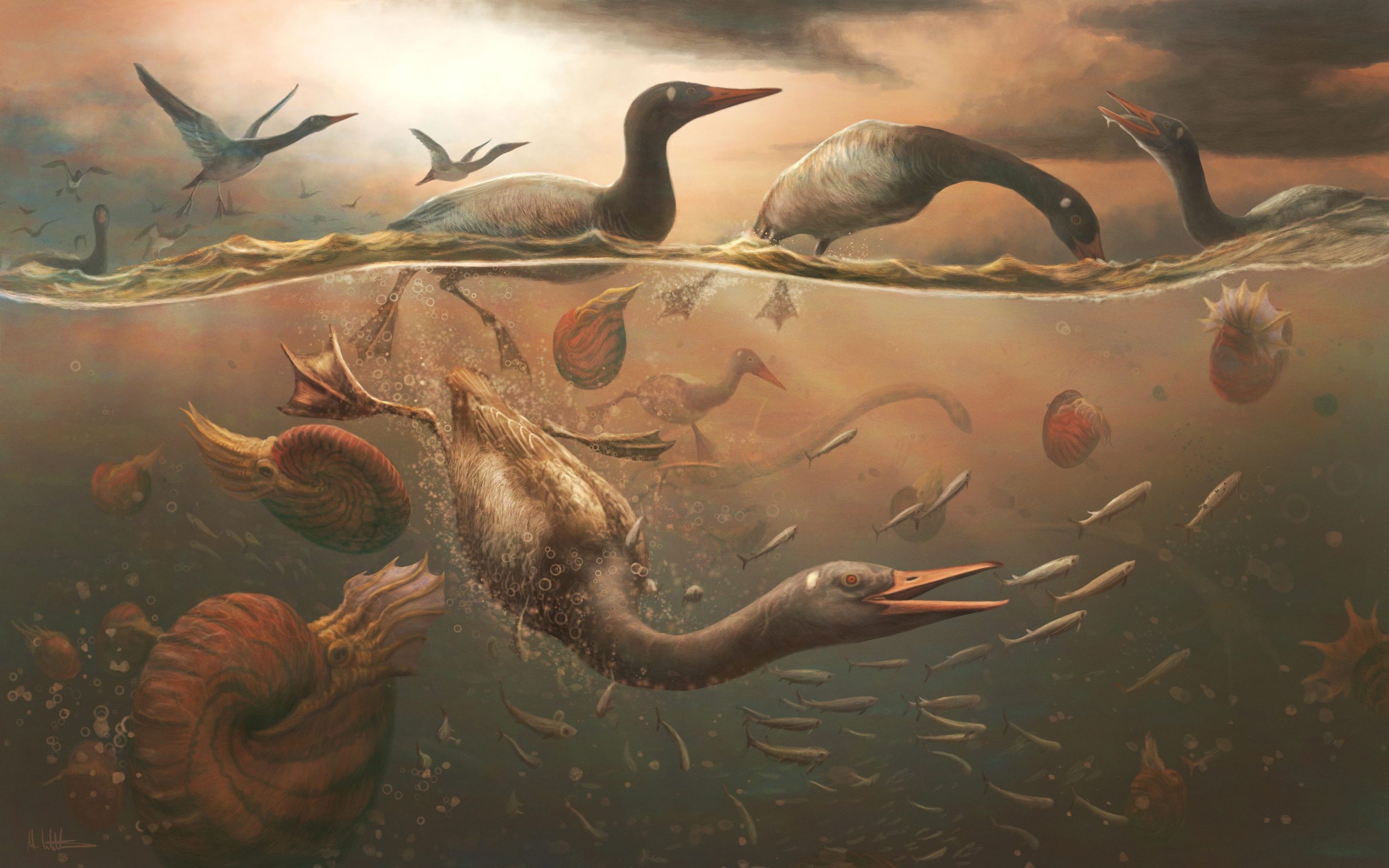
Its placement came as a bit of a surprise, according to the researchers. That’s because the Vegavis skull has some decidedly un-ducklike features. Most notably, a long, spear-shaped beak.
“I think it gave some people pause,” Clarke said. “They expected [the skull] to be more duck or goose-like.”
Clarke notes that the ducks and geese of today are just a small selection of the anseriform birds that have lived over time. There are examples from the fossil record of duck-like birds that had lifestyles akin to today’s herons and flamingos. Vegavis and its distinctive beak underscore the diversity of duck-like birds that once walked the Earth.
“In the past, they were weird and wonderful,” Clarke said. “We have this huge range [of now-extinct anseriform birds] and Vegavis is consistent with that.”
This study also highlights the value of deeply researching a single species. Clarke and her colleagues have spent decades analyzing Vegavis fossils from Antarctica. But what they have discovered is having ripple effects across the entire evolutionary tree, said co-author Patrick O’Connor, a professor at Ohio University and the director of Earth and Space Sciences at the Denver Museum of Nature & Science.
“This new fossil reveals that Antarctica has much to tell us about the earliest stages of modern bird evolution,” he said.
Fossils of animals and plants from this time in Antarctica are extremely rare, leading to many more questions about the nature of the environments in which birds and other life forms originated and diversified.
“Something very different seems to have been happening in the far reaches of the Southern Hemisphere, specifically in Antarctica,” said O’Connor. “This requires a much closer look into the fossil record and the changing environments of this region through time.”
Explore Further: A 69-Million-Year Evolutionary Mystery: Scientists Discover Oldest Modern Bird
Reference: “Cretaceous Antarctic bird skull elucidates early avian ecological diversity” by Christopher R. Torres, Julia A. Clarke, Joseph R. Groenke, Matthew C. Lamanna, Ross D. E. MacPhee, Grace M. Musser, Eric M. Roberts and Patrick M. O’Connor, 5 February 2025, Nature.
DOI: 10.1038/s41586-024-08390-0
The study’s additional co-authors are Joseph Groenke of Ohio University, Matthew Lamanna of Carnegie Museum of Natural History, Ross MacPhee of the American Museum of Natural History, and Grace Musser of UT Austin and the Smithsonian National Museum of Natural History.
The research was funded by the National Science Foundation.
Never miss a breakthrough: Join the SciTechDaily newsletter.
Follow us on Google and Google News.
3 Comments
None avian dinosaur only living dinosaur is modern crocodilian that have nothing avian about it and spinosauridae live.compsognathus has fish vertebrae the gar fish advance vertebrae allso found in amphibian and fossil gator type mesoeucrocodilian the opisthocoelous vertebrae .the it’s only coelurosauria has it the rest of compsognathus do not have it and looks like tetanuran dinosaur dinosaur do not have it and thecodont it is found in carnotaurus dinosaur and spinosauridae simular to spinosaurus clearly compsognathus is aquatic only show evolution of mesoeucrocodylia the spinosauridae .not bird evolution .clearly compsognathus has sprawling ankle like spinosauridae clearly link aquatic feature
This is on the reevaluation of the French compsognathus academi edu. These opisthocoelous vertebrae are found on neck vertebrae compsognathus .dinosaur have a very diverse vertebrae like modern crocodilian mesoeucrocodylia .compsognathus has aquatic sickness ankylosis .it seam dinosaur lost lot of aquatic feature like the kink found in the gator they are more of land animal the early thecodont were semi aquatic .ceratosaur carnotaurus claim to be aquatic they are right with opisthocoelous vertebra rare in tetanuran dinosaur they are suspection of one allosaurus type of dinosaur that it have opisthocoelous
It’s like you’re trying to say something, but the words