
Close Menu
    Facebook X (Twitter) Instagram
    SciTechDaily
    • Biology
    • Chemistry
    • Earth
    • Health
    • Physics
    • Science
    • Space
    • Technology
    Facebook X (Twitter) Pinterest YouTube RSS
    SciTechDaily
    Home»Science»Historic Discovery: Ancient Venomous Reptile Species Discovered in Arizona
    Science

    Historic Discovery: Ancient Venomous Reptile Species Discovered in Arizona

    By PeerJOctober 24, 2024No Comments3 Mins Read
    Facebook Twitter Pinterest Telegram LinkedIn WhatsApp Email Reddit
    Share
    Facebook Twitter LinkedIn Pinterest Telegram Email Reddit
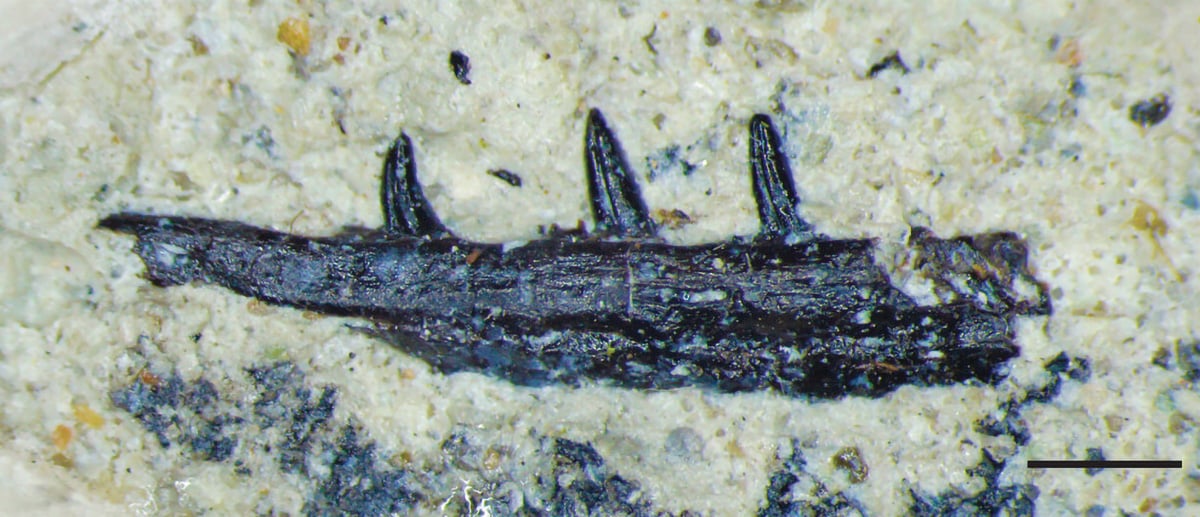
    Microzemiotes sonselaensis Holotype
    A new species of venomous reptile, Microzemiotes sonselaensis, has been discovered in Arizona’s Late Triassic Chinle Formation. This small reptile had venom-conducting teeth and sheds light on the independent evolution of venom systems in reptiles. Credit: PeerJ, 10.7717/peerj.18279

    The venomous reptile Microzemiotes sonselaensis was discovered in Arizona’s Late Triassic, shedding light on reptile venom evolution and ancient ecosystems.

    A newly discovered species of small, venomous reptile, Microzemiotes sonselaensis, has been identified in the Late Triassic Chinle Formation of northeastern Arizona. Recently published in PeerJ Life & Environment, the research provides fresh insights into the evolution of venomous feeding strategies in reptiles and enhances our understanding of ancient ecosystems in the southwestern United States.

    The fossil, consisting of a partial left dentary with distinctively grooved teeth, is believed to represent a new species of reptile that used venom to subdue its prey. This discovery marks the third venomous reptile from the Late Triassic and the earliest known reptile with venom-conducting teeth preserved within a jaw. Prior to this, evidence for venom use in reptiles from the Late Triassic was limited to isolated teeth from the genus Uatchitodon.

    Features of Microzemiotes sonselaensis

    The newly described species, Microzemiotes sonselaensis, displays two deep grooves on each tooth extending the entire length of the tooth crown, which are similar to the venom-conducting grooves of modern venomous beaded lizards and rear-fanged snakes. These grooves likely facilitated venom delivery, indicating that the species relied on venom in its feeding strategy.

    The teeth of Microzemiotes sonselaensis are approximately ten times smaller than those of Uatchitodon, suggesting that venom use may have evolved independently in multiple reptile groups of different body sizes. Microzemiotes sonselaensis was a very small reptile, probably no more than 30 cm in length.

    Microzemiotes sonselaensis Collage
    (A) Photograph of Microzemiotes sonselaensis holotype DMNH PAL 2018-05-0017, (B, C) three-dimensional render and line drawing of the dentary in lingual view, (D, E) labial view, and (F, G) dorsal view. Scale bar equals 1 mm, arrow points anterior. Abbreviations: im, intramandibular; mec, Meckelian canal; fac, facet; f, foramen; sa, surangular; vg, venom groove. Credit: PeerJ, 10.7717/peerj.18279

    Helen Burch, the study’s lead author and PhD student at Virginia Tech, notes that this discovery adds to the growing body of evidence for venom use among Mesozoic reptiles. “We know very little about the origins of reptile venom systems outside of living snakes and lizards, so Microzemiotes sonselaensis is a very exciting addition to a small handful of Mesozoic envenomaters,” said Burch.

    The research also highlights the evolutionary diversity of venom delivery systems in reptiles, drawing comparisons to modern venomous species such as helodermatid lizards and some snakes. Although the exact phylogenetic placement of Microzemiotes sonselaensis remains uncertain, it falls outside of the clade Toxicofera, which includes all living venomous snakes and lizard groups including Gila monsters, monitor lizards, and iguanas, representing an independent evolution of a venom system.

    This discovery not only expands the known diversity of Late Triassic reptiles but also contributes to the broader understanding of venom evolution. The implications extend beyond paleontology, offering insights into how ancient ecosystems functioned and how feeding methods have varied among reptiles.

    Reference: “A small venomous reptile from the Late Triassic (Norian) of the southwestern United States” by Helen E. Burch​, Hannah-Marie S. Eddins, Michelle R. Stocker, Ben T. Kligman, Adam D. Marsh, William G. Parker and Sterling J. Nesbitt, PeerJ Life & Environment.
    DOI: 10.7717/peerj.18279

    Never miss a breakthrough: Join the SciTechDaily newsletter.
    Follow us on Google and Google News.

    Evolutionary Biology Fossils New Species Paleontology Popular
    Share. Facebook Twitter Pinterest LinkedIn Email Reddit

    Related Articles

    500-Million-Year-Old Fossil Reveals Astonishing Secrets of a Strange Group of Marine Invertebrates

    Bizarre: Scientists Discover New Species of Mosasaur With Strange “Screwdriver Teeth”

    One of the Oldest Ever Found: New Ancient “Marine Crocodile” Discovered

    Controversial Prehistoric Egg Identified To Be the Last of the “Demon Ducks of Doom”

    Fearsome New Species of Stegosaur May Be the Oldest Ever Discovered in the World

    Triassic Archosaur Fossils Excavated in the 1960s Add Missing Link to Crocodile Evolution

    Kyhytysuka: 130-Million-Year-Old Hypercarnivore “Fish Lizard” Discovered

    New Species of Tardigrade (Water Bear) Discovered in 16 Million-Year-Old Dominican Amber

    Giant Waikato Penguin: School Kids in New Zealand Discover New Species

    Leave A Reply Cancel Reply

    • Facebook
    • Twitter
    • Pinterest
    • YouTube

    Don't Miss a Discovery

    Subscribe for the Latest in Science & Tech!

    Trending News

    One of the Universe’s Largest Stars May Be Getting Ready To Explode

    Scientists Discover Enzyme That Could Supercharge Ozempic-Like Weight Loss Drugs

    Popular Sweetener Linked to DNA Damage – “It’s Something You Should Not Be Eating”

    Ancient “Rock” Microbes May Reveal How Complex Life Began

    Researchers Capture Quantum Interference in One of Nature’s Rarest Atoms

    “A Plague Is Upon Us”: The Mass Death That Changed an Ancient City Forever

    Scientists Discover Game-Changing New Way To Treat High Cholesterol

    This Small Change to Your Exercise Routine Could Be the Secret to Living Longer

    Follow SciTechDaily
    • Facebook
    • Twitter
    • YouTube
    • Pinterest
    • Newsletter
    • RSS
    SciTech News
    • Biology News
    • Chemistry News
    • Earth News
    • Health News
    • Physics News
    • Science News
    • Space News
    • Technology News
    Recent Posts
    • New Study Challenges 40-Year Puzzle About Childhood Body Fat
    • 20-Year Study Finds Daily Multivitamins Don’t Extend Lifespan
    • Landmark Study Links Never Marrying to Significantly Higher Cancer Risk
    • Revolutionary Imaging Technique Unlocks Secrets of Matter at Extreme Speeds
    • Where Does Mass Come From? Scientists Find Evidence of a New Exotic Nuclear State
    Copyright © 1998 - 2026 SciTechDaily. All Rights Reserved.
    • Science News
    • About
    • Contact
    • Editorial Board
    • Privacy Policy
    • Terms of Use

    Type above and press Enter to search. Press Esc to cancel.