
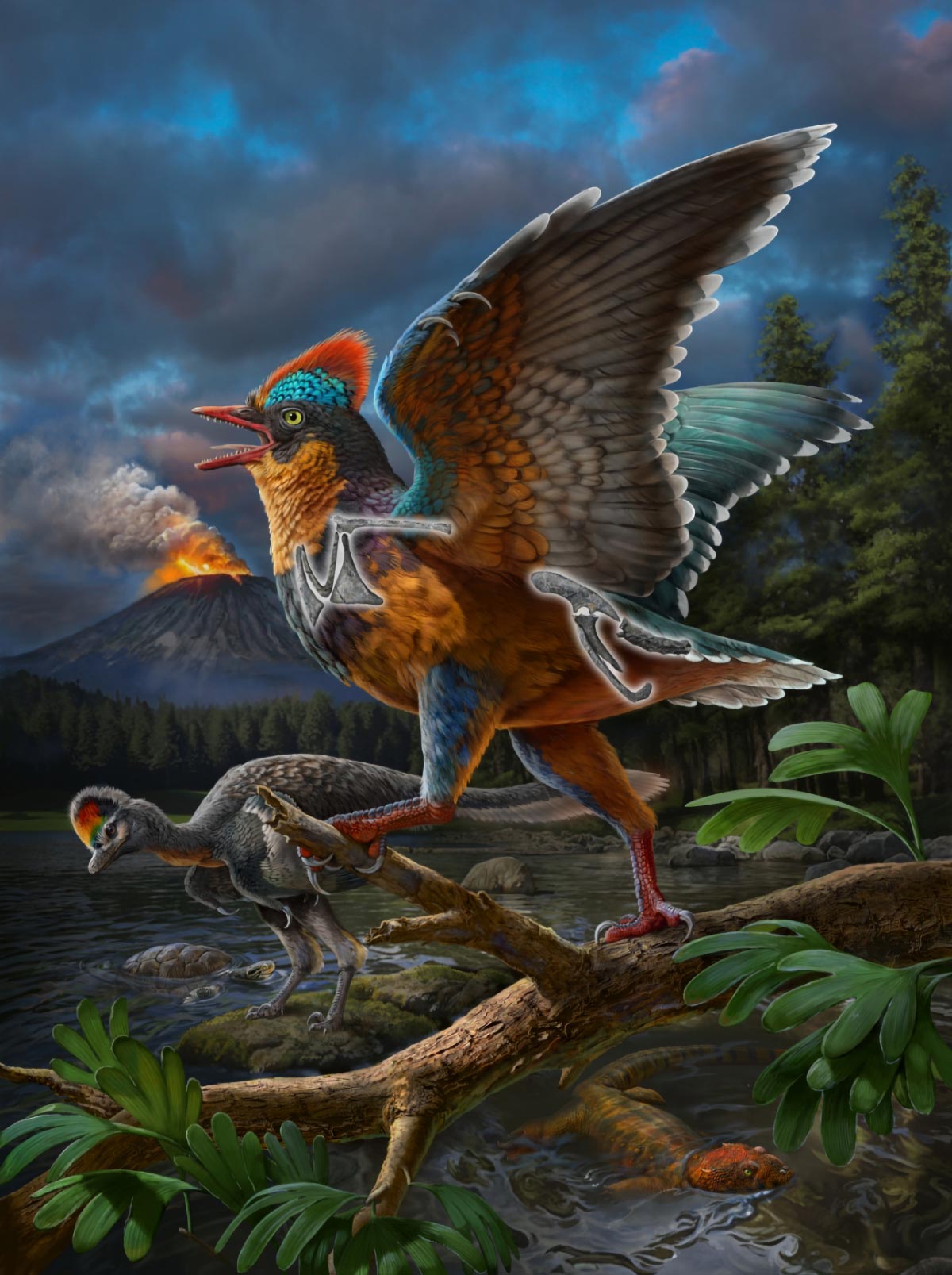
Scientists discovered two Jurassic bird fossils in China, pushing back bird diversification by 20 million years. One, Baminornis zhenghensis, had a short tail and mixed dinosaur-like and bird-like traits. The second, an isolated furcula, may belong to Ornithuromorpha but requires further study.
A research team led by Professor Min Wang from the Institute of Vertebrate Paleontology and Paleoanthropology (IVPP) at the Chinese Academy of Sciences has discovered two bird fossils in Jurassic-era rocks in Fujian Province, southeast China.
Dating back approximately 149 million years, these fossils help bridge a spatiotemporal gap in the early evolution of birds. They also provide the strongest evidence to date that birds had already diversified by the end of the Jurassic period.
This study was published in Nature.
Birds are the most diverse group of terrestrial vertebrates. Certain macroevolutionary studies suggest that their earliest diversification dates back to the Jurassic period (approximately 145 million years ago). However, the earliest evolutionary history of birds has long been obscured by a highly fragmentary fossil record, with Archaeopteryx being the only widely accepted Jurassic bird.

Although Archaeopteryx had feathered wings, it closely resembled non-avialan dinosaurs, notably due to its distinctive long, reptilian tail—a stark contrast to the short-tailed morphology of modern and Cretaceous birds.
Recent studies have questioned the avialan status of Archaeopteryx, classifying it as a deinonychosaurian dinosaur, the sister group to birds. This raises the question of whether any unambiguous records of Jurassic birds exist.
3D Reconstruction of Baminornis zhenghensis. Credit: Ren Wenyu
A New Jurassic Bird: Baminornis zhenghensis
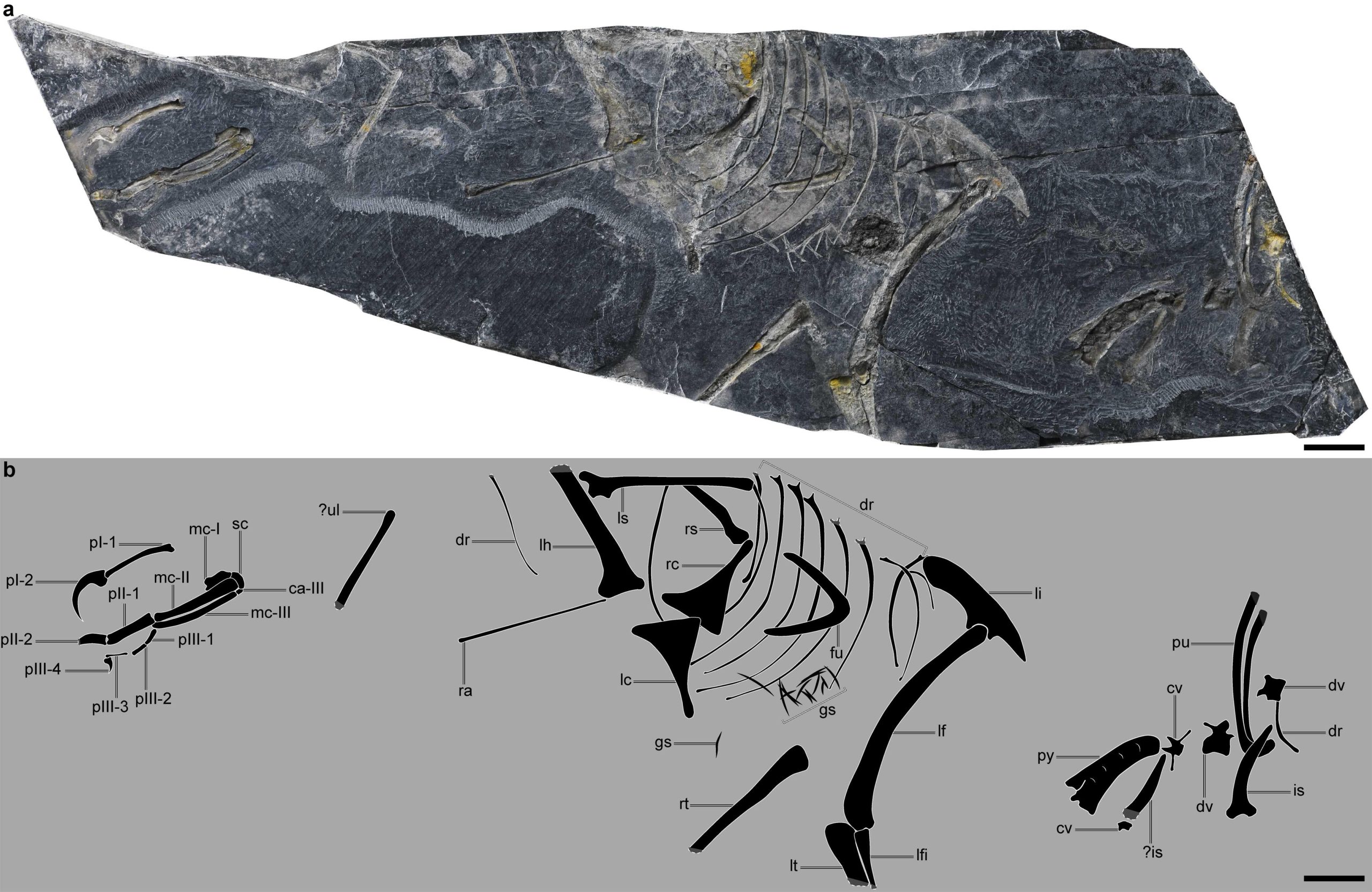
In this study, the researchers named one of the two fossils Baminornis zhenghensis. This fossil displays a unique combination of features, including derived ornithothoracine bird-like shoulder and pelvic girdles, as well as a plesiomorphic hand structure resembling that of non-avialan dinosaurs.
These characteristics highlight the role of mosaic evolution in early bird development. Notably, Baminornis zhenghensis has a short tail ending in a compound bone called the pygostyle, a feature also observed in living birds.
“Previously, the oldest record of short-tailed birds is from the Early Cretaceous. Baminornis zhenghensis is the sole Jurassic and the oldest short-tailed bird yet discovered, pushing back the appearance of this derived bird feature by nearly 20 million years,” said Prof. Wang, the lead and corresponding author of the study.
The researchers used several methods to explore the position of Baminornis zhenghensis in the evolutionary tree of birds. The results showed that Baminornis zhenghensis was only just derived than Archaeopteryx and it represents one of the oldest birds.
“If we take a step back, and reconsider the phylogenetic uncertainty of Archaeopteryx, we do not doubt that Baminornis zhenghensis is the true Jurassic bird,” said Dr. Zhonghe Zhou from IVPP, co-author of the study.
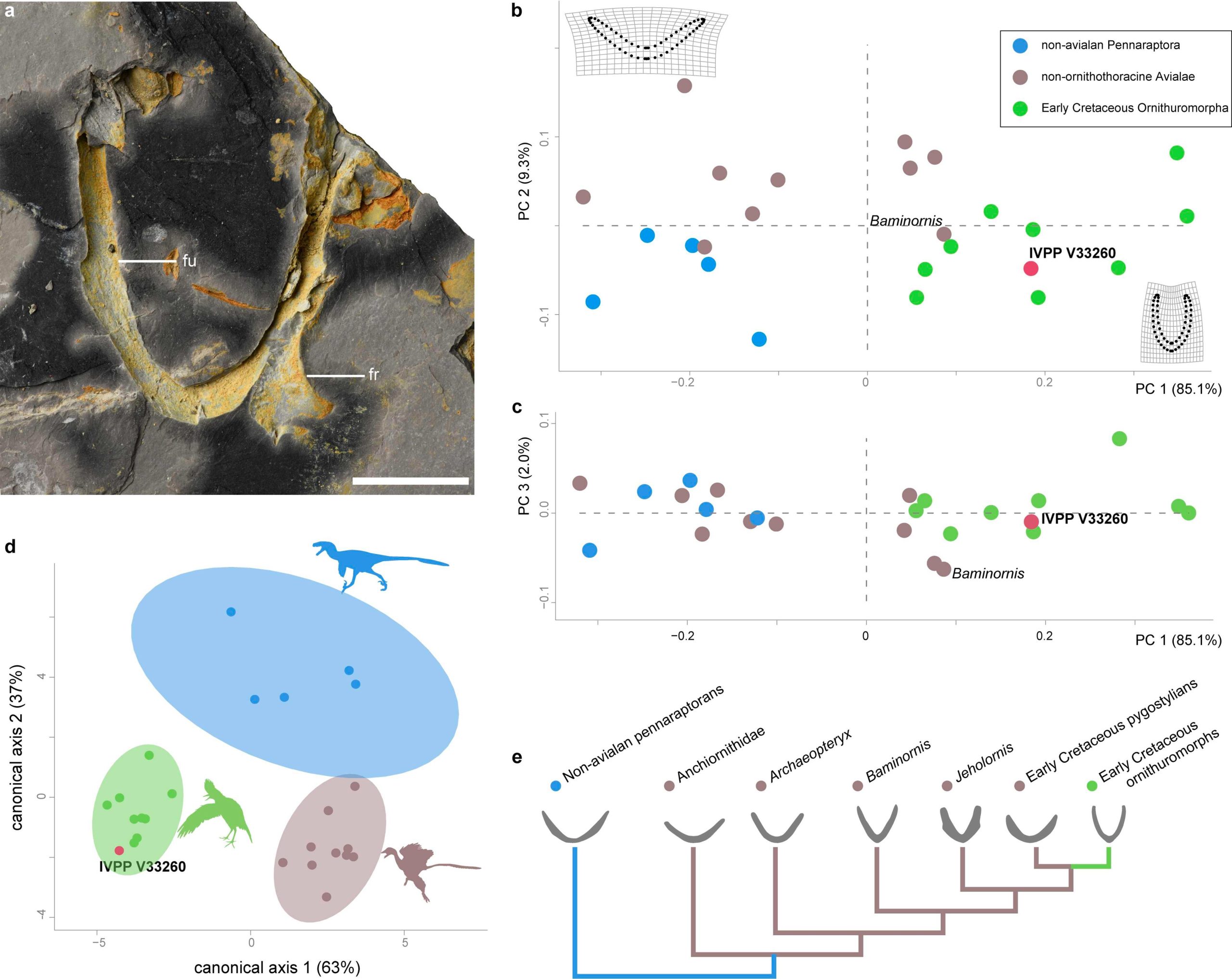
The second fossil is incomplete, consisting solely of a furcula. The researchers performed geometric morphometric and phylogenetic analyses to explore its relationship with other non-avialan and avialan theropods. Interestingly, the results supported the referral of this furcula to Ornithuromorpha, a diverse group of Cretaceous birds. Given its poor preservation, however, the team refrained from naming a new taxon based on this single bone, and its placement within birds needs further fossil evidence.
Reference: “Earliest short-tailed bird from the Late Jurassic of China” by Runsheng Chen, Min Wang, Liping Dong, Guowu Zhou, Xing Xu, Ke Deng, Liming Xu, Chi Zhang, Linchang Wang, Honggang Du, Ganmin Lin, Min Lin and Zhonghe Zhou, 12 February 2025, Nature.
DOI: 10.1038/s41586-024-08410-z
Never miss a breakthrough: Join the SciTechDaily newsletter.
Follow us on Google and Google News.
4 Comments
Pygostyle is tetanuran dinosaur feature that why only living dinosaur has it the modern crocodilian the mesoeucrocodylia dinosaur the spinosauridae dinosaur.its for bipedal balance and aquatic divering .archaeopteryx is true bird like velociraptor they have bird antebrachiocarpal joint.a flight feature for flopping flight the gator for fast run not bird like.a advance mammal feature the chameleon has it more advance than the gator
So one of bird is a modern bird at the same time archaeopteryx a bird like 230 million years ago modern bird so this bird advance than archaeopteryx so jaw is not akinetic .velociraptor bird jaw is akinetic like early birds
The none avian maniraptoran the maniraptoran are bird they are not dinosaur they are flying birds like microraptor the fossil crown skull crest feather like today flying birds and flightless like velociraptor .maniraptoran are not transition to flight they lost flight there flight feature are just like today birds there no transition feature these are advance flight feature velociraptor ancestor flew .
Tough to know what kind of bird it is the Wikipedia help .its jeholornis Confuciusornis type of bird .its more primitive than archaeopteryx .it has advance feature like a beak the scapula is not fuse to coracoid like modern birds it’s not like oviraptor bird or archaeopteryx bird.the jaw akinetic like jeholornis .on Wikipedia they say it’s after archaeopteryx that not true .its velociraptor type of bird .its not a modern bird.allso has pygostyle primitive animal allso has advance feature that were trouble happen