
Ancient bird fossil reveals a tiny head with T. rex features—unlocking secrets of dinosaur-to-bird evolution.
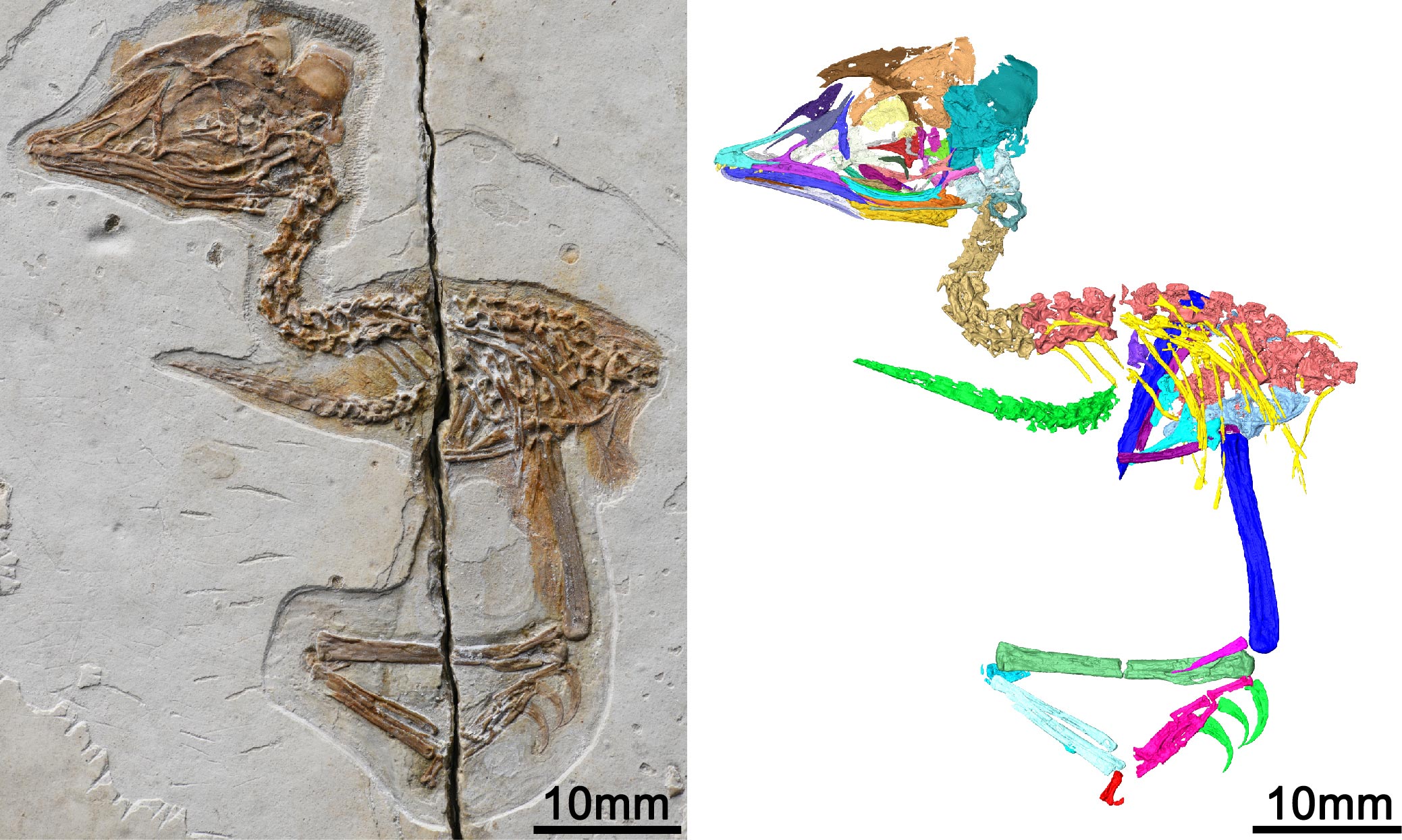
Researchers from the Institute of Vertebrate Paleontology and Paleoanthropology (IVPP) of the Chinese Academy of Sciences have discovered a 120-million-year-old partial fossil skeleton of a tiny extinct bird that fits in the palm of the hand and preserves a unique skull with a mix of dinosaurian and bird features.
The two-centimeter-long (0.75 inch) skull of the fossil shares many structural and functional features with the gigantic Tyrannosaurus rex, indicating that early birds kept many features of their dinosaurian ancestors and their skulls functioned much like those of dinosaurs rather than living birds.
Their findings were published in Nature Communications on June 23, 2021.
The bird was deposited 120 million years ago in a shallow lake in what is today Liaoning Province in northeastern China.
‘Opposite Bird’ Enantiornithines
Through detailed reconstruction of the bird family tree, the researchers demonstrated that the new fossil bird species belongs to an extinct group of birds called enantiornithines, or “opposite birds.” They are the most diverse group of birds from the time of the dinosaurs in the Cretaceous and have been found all over the world.
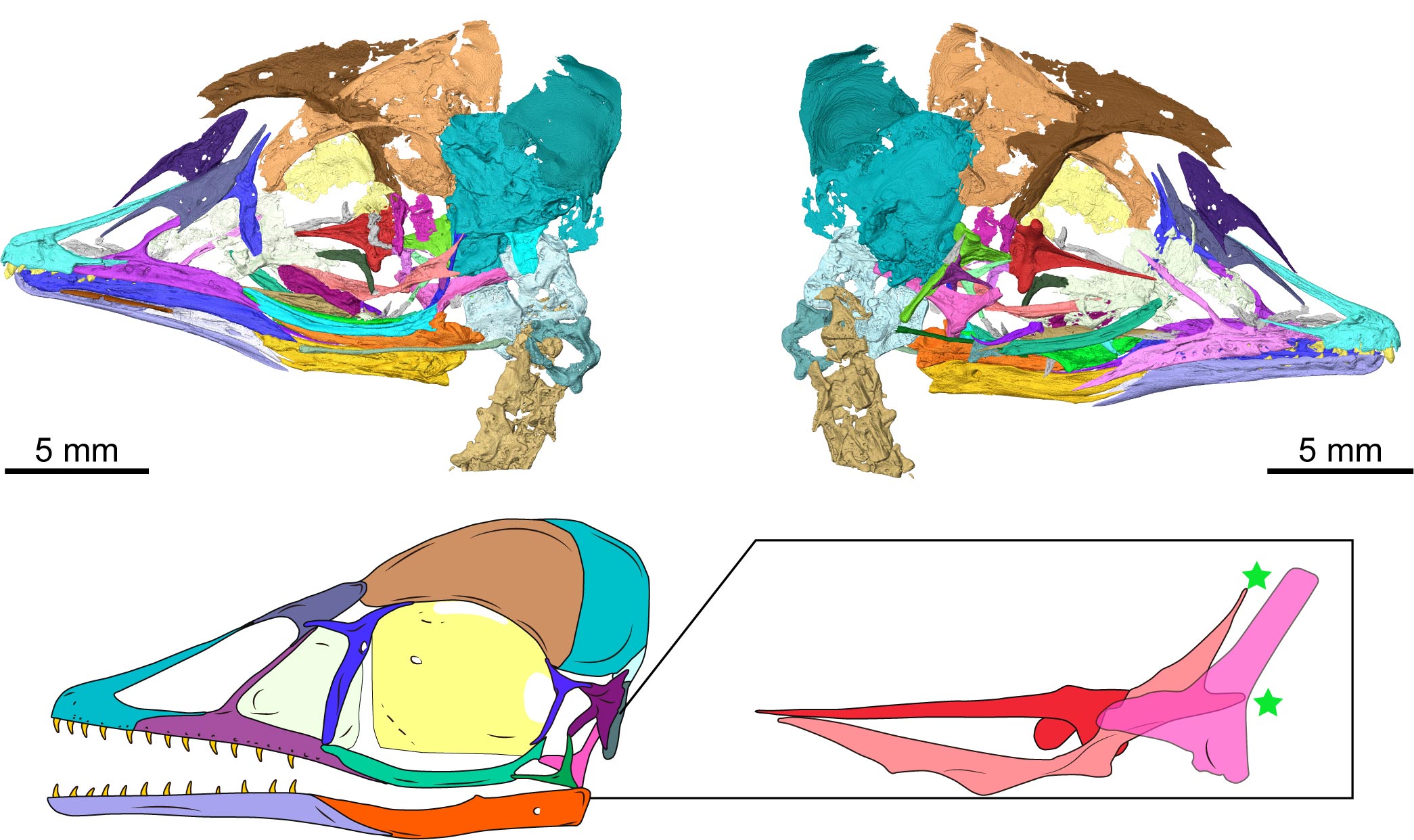
In living birds, the quadrate is one of the most movable bones in the skull and allows for the unique feature of living birds known as “kinetic skull,” which allows the upper jaw to move independently of the brain and the lower jaw.
In contrast with living birds, however, the skull of this new “opposite bird,” as well as those of dinosaurs like Tyrannosaurus rex and the close dinosaurian relatives of birds (e.g., troodontids and dromaeosaurs), is not kinetic. Instead, its bones are “locked up” and unable to move.
Reptile-Like Skull Features Identified
The temporal regions (sides) of the skull of this bird fossil are very different from living birds. This new species has two bony arches for jaw muscle attachment like those found in reptiles such as lizards, alligators, and dinosaurs, making the rear of the skull rigid and resistant to movement among the bones.
“When reconstructing all parts of the skull three-dimensionally from the high-resolution CT scans of the fossil, I had a problem figuring out one bone in particular,” said Dr. Min Wang, the lead and corresponding author of the study. He said his colleague Dr. Thomas Stidham proposed that the bone was the pterygoid and looked “exactly like that of the dromaeosaur Linheraptor.” The fossil has the first well-preserved pterygoid bone found in an early bird.
The researchers compared CT scans of the bird skull to scans of the skull of the well-known dromaeosaur Linheraptor from Inner Mongolia, China. The results showed that many other features of the rear portion of the skull, including the shape of the basisphenoid bone and its connections with other skull bones, also resemble dromaeosaurs rather than living birds.
“The fossil bird and dinosaurs also lack the discrete contact between the pterygoid and quadrate near the palate that is used in skull kinesis in living birds. In combination with the ‘locked up’ temporal bones, the difference in the palate structure also points to the absence of kinesis among early birds,” said Dr. Stidham, co-author of the study.
Reinforcing Birds’ Dinosaur Ancestry
Furthermore, the team’s discovery and meticulous anatomical research help to reinforce the already well-supported contention, based on many different lines of evidence, that birds are not only living dinosaurs, but evolved from the branch of dinosaurs that includes troodontids and dromaeosaurs like the “four-winged” Microraptor and swift Velociraptor.
“Having a ‘dinosaur’ skull on a bird body certainly did not stop the enantiornithines, or other early birds, from being highly successful in places all around the world for tens of millions of years during the Cretaceous,” said Dr. Wang.
Reference: “Cretaceous bird with dinosaur skull sheds light on avian cranial evolution” by Min Wang, Thomas A. Stidham, Zhiheng Li, Xing Xu and Zhonghe Zhou, 23 June 2021, Nature Communications.
DOI: 10.1038/s41467-021-24147-z
Never miss a breakthrough: Join the SciTechDaily newsletter.
Follow us on Google and Google News.