
Close Menu
    Facebook X (Twitter) Instagram
    SciTechDaily
    • Biology
    • Chemistry
    • Earth
    • Health
    • Physics
    • Science
    • Space
    • Technology
    Facebook X (Twitter) Pinterest YouTube RSS
    SciTechDaily
    Home»Science»Evidence T. Rex’s Long Legs Evolved for Distance, Not Speed Like Previously Thought
    Science

    Evidence T. Rex’s Long Legs Evolved for Distance, Not Speed Like Previously Thought

    By University of MarylandMay 14, 2020No Comments4 Mins Read
    Facebook Twitter Pinterest Telegram LinkedIn WhatsApp Email Reddit
    Share
    Facebook Twitter LinkedIn Pinterest Telegram Email Reddit
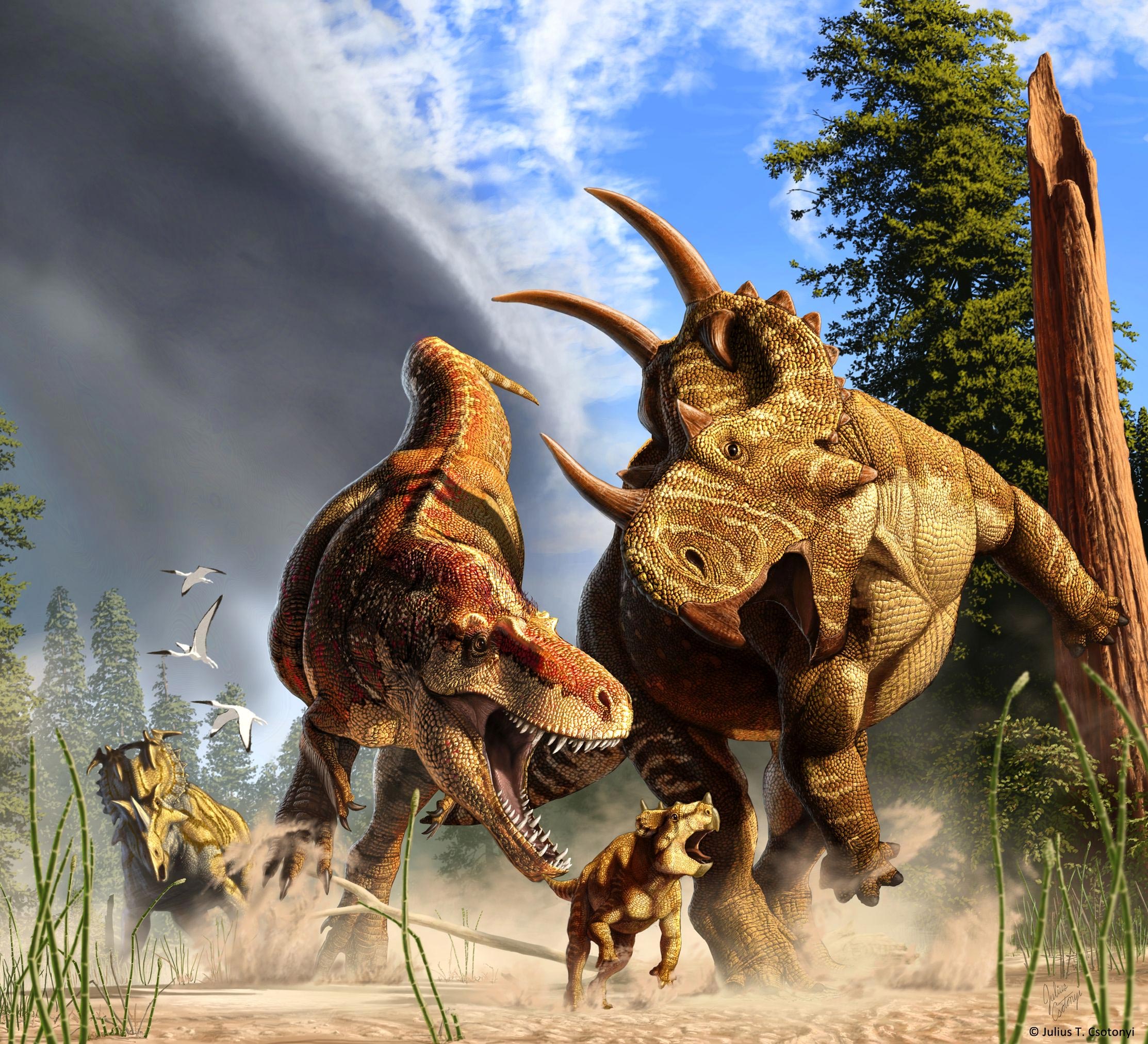
    Tyrannosaur Daspletosaurus Spinops Coronosaurus
    In this artist’s depiction of wildlife from Alberta, Canada, 77 million years ago, the tyrannosaur Daspletosaurus hunts a young horned Spinops, while an adult Spinops tries to interfere and a Coronosaurus watches from a distance. Credit: Illustration by Julius Csotonyi

    Research finds leg length gave giant predatory dinosaurs the advantage of efficiency, not speed as previously thought.

    Long legs may make good runners, but they’re great for walking, too. Scientists have generally assumed that long-limbed dinosaurs evolved their leggy proportions for speed to catch prey and avoid predators.

    But a new study by the University of Maryland’s Thomas Holtz and his colleagues suggests that long legs evolved among the biggest dinosaurs to help them conserve energy and go the distance as they ambled along searching for prey. The study was published in the journal PLOS ONE on May 13, 2020.

    “The assumption tends to be that animals with adaptations for running, such as long legs, are adapted for a higher maximum speed, but this paper shows that there’s more to running than top speed,” said Thomas Holtz, principal lecturer in the UMD Department of Geology. “When you’re a bigger animal, those adaptations may also be for endurance and efficiency. It may be about being a marathoner rather than a sprinter.”

    Small Theropod Long Hind Limbs
    Among small theropods, long hind limbs gave the advantage of speed, but among the giants, long hind limbs enabled more efficient locomotion. Credit: T. Holtz, University of Maryland

    Holtz and his colleagues analyzed a variety of metrics like limb proportions, size ratio, body mass, and gaits to estimate the top speeds of more than 70 species from a group of dinosaurs called theropods. Theropods ranged in size from less than a half-pound to more than nine tons. They included Tyrannosaurus rex and the many other two-legged predators that dominated the age of dinosaurs for 180 million years. Bipedalism and running speed have often been cited as major contributors to their success.
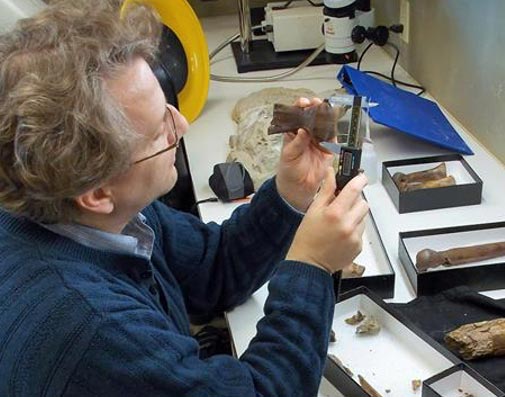
    Thomas Holtz Measuring Toe
    Thomas Holtz, principal lecturer in the UMD Department of Geology, measures a dinosaur toe bone. Holtz and his colleagues found that long lower limbs were an adaptation that made large theropod dinosaurs more efficient at walking, helping them conserve energy as they hunted. Credit: Thomas Holtz

    The study revealed a more nuanced story. According to the new analysis, longer legs were associated with higher top speeds in small and medium-sized dinosaurs, but that didn’t hold true for dinosaurs weighing over 2,200 pounds (1,000 kilograms). Scientists have known that larger body size can limit speed, and the study showed that large dinosaur species with longer legs were no faster than their stubby-limbed brethren. But they moved more efficiently.

    By calculating how much energy each dinosaur expended while moving at walking speeds, the researchers found that among the largest dinosaurs, those with longer legs needed less energy to cruise around.

    “That’s actually a very beneficial savings because predators tend to spend a great deal of their time foraging, searching for prey,” Holtz said. “If you are burning less fuel during the foraging part of the day, that’s an energy savings that dinosaurs with shorter leg forms didn’t get.”

    These results highlight the often-overlooked impact of body proportions on running ability and the limiting effect of large body size on running speed. Clearly, there are different kinds of runners. This work should broaden the discussion about what it means to be adapted for running.

    Reference: “The fast and the frugal: Divergent locomotory strategies drive limb lengthening in theropod dinosaurs” by T. Alexander Dececchi, Aleksandra M. Mloszewska, Thomas R. Holtz Jr., Michael B. Habib and Hans C. E. Lars, 13 May 2020, PLOS ONE.
    DOI: 10.1371/journal.pone.0223698

    In addition to Holtz, this work was conducted by collaborators from Mount Marty College, Keck School of Medicine of USC and McGill University.

    Never miss a breakthrough: Join the SciTechDaily newsletter.
    Follow us on Google and Google News.

    Archaeology Dinosaurs Evolution Paleontology Popular Tyrannosaurus Rex University of Maryland
    Share. Facebook Twitter Pinterest LinkedIn Email Reddit

    Related Articles

    Incredible Dinosaur Treasure Trove in Italy Rewrites History, Geography, and Evolution

    Tyrannosaurus rex Appears To Have Had an East Coast Cousin

    Tiny Ancient Bird Discovered in China Shares Skull Features With Tyrannosaurus rex

    When T. rex Dominated, Medium-Sized Predators Disappeared – Replaced by Juvenile Tyrannosaurs

    Meet the Massive Australotitan, the “Southern Titan” – Australia’s Largest Dinosaur!

    Shuvuuia: Extraordinary Dinosaurs That Hunted in the Dark

    Paleontologists Stunning Conclusion: 2.5 Billion T. Rexes Roamed North America Over the Cretaceous Period

    Paleontologists Surprising Discovery: Fossil Shark Turns Into Mystery Pterosaur

    Growing Up Tyrannosaurus Rex: Researchers Learn More About Teen-Age T.Rex

    Leave A Reply Cancel Reply

    • Facebook
    • Twitter
    • Pinterest
    • YouTube

    Don't Miss a Discovery

    Subscribe for the Latest in Science & Tech!

    Trending News

    New Pill Lowers Stubborn Blood Pressure and Protects the Kidneys

    Humans May Have Hidden Regenerative Powers, New Study Suggests

    Scientists Just Solved the Mystery of Why Crabs Walk Sideways

    Doctors Are Surprised by What This Vaccine Is Doing to the Heart

    This Popular Supplement May Boost Your Brain, Not Just Your Muscles

    Scientists Say This Simple Supplement May Actually Reverse Heart Disease

    Warming Oceans Could Trigger a Dangerous Methane Surge

    This Simple Movement Could Be Secretly Cleaning Your Brain

    Follow SciTechDaily
    • Facebook
    • Twitter
    • YouTube
    • Pinterest
    • Newsletter
    • RSS
    SciTech News
    • Biology News
    • Chemistry News
    • Earth News
    • Health News
    • Physics News
    • Science News
    • Space News
    • Technology News
    Recent Posts
    • Physicists May Be on the Verge of Discovering “New Physics” at CERN
    • AI Learns To Work Backward and Reveal Hidden Forces in Nature
    • Scientists Warn of Rising Male Childlessness As Global Fertility Changes
    • New Discovery Challenges Decades-Old Theory of DNA Damage and Aging
    • Scientists Just Rewrote Biology: “Hidden” Mechanism Could Transform Diabetes Treatment
    Copyright © 1998 - 2026 SciTechDaily. All Rights Reserved.
    • Science News
    • About
    • Contact
    • Editorial Board
    • Privacy Policy
    • Terms of Use

    Type above and press Enter to search. Press Esc to cancel.