
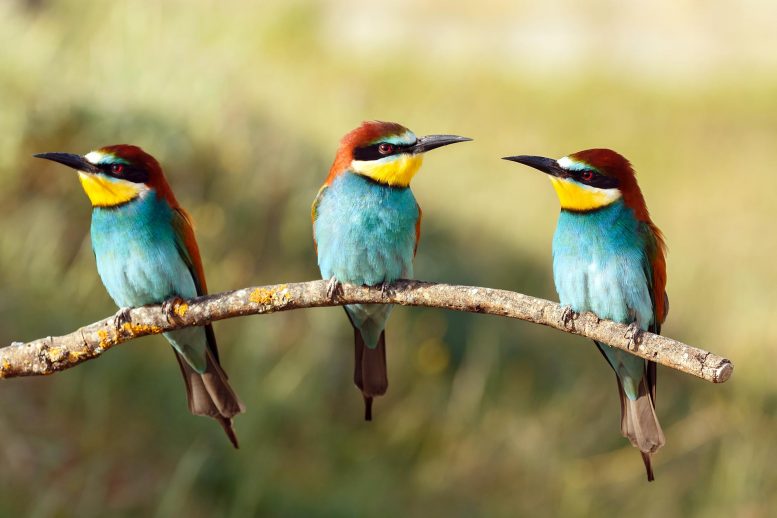
- Research from the University of Sheffield has revealed why some bird species take longer to develop than others
- Findings could help scientists predict how animals will adapt to climate breakdown and habitat destruction
- The study is the first to consider the importance of lifestyle, environment, evolutionary history, and body size when explaining variation
Size, safety, and parenting all have an impact on how quickly a species of bird matures, according to new research from the University of Sheffield that could help scientists to understand and predict how animals will respond to climate breakdown and the destruction of habitats.
The team of scientists has studied thousands of species of birds to understand why there is so much diversity in the length of time they take to grow from a fertilized egg to an independent adult.
The research, published in Nature Communications, is the first study to consider the importance of lifestyle and environmental factors alongside evolutionary history and body size to explain the variation.
All organisms face a trade-off between reproducing and surviving and they solve this problem in different ways. The team found that bird species with a ‘live fast die young’ strategy develop quicker, allowing them to maximize the number of offspring they can produce in the short time they have available.
Findings showed that birds that breed and live in safer environments with fewer predators typically took longer to develop, possibly because they can afford to spend longer in a vulnerable state.
They also found that migratory birds develop much quicker, which may ensure they are ready to return to their winter habitats at the end of the summer.
As expected, the research showed that bigger birds took longer to develop — but even among birds of a similar size there was variation in development times.
Dr. Chris Cooney, from the University of Sheffield’s Department of Animal and Plant Sciences and lead author of the research, said: “The amount of time it takes for a fertilized egg to develop into a fully grown adult varies hugely across the animal kingdom. For instance, it takes an elephant almost 10 years to reach independence, whereas a fruit fly is fully grown after only a matter of days.
“This extraordinary diversity is also encapsulated within birds, where albatrosses can take almost a year to develop from an embryo to an independent adult, but a typical UK garden songbird takes little more than a month. We found that certain aspects of a species’ lifestyle and environment are important in explaining how long they take to develop.”
Dr. Alison Wright, co-author of the research from the University of Sheffield, said: “Our study on birds gives us some clues about the type of factors that may be important in other species. However, it may be that different factors are important for determining development length in other animal groups.
“The next step is therefore to address these questions using data that covers the breadth of the animal kingdom — from fish to mammals to insects — to gain an even broader insight into the factors shaping these fundamental differences across species.”
Dr. Nicola Hemmings, co-senior author of the research from the University of Sheffield, said: “The insights from our research may prove crucial in understanding and even predicting how organisms may respond when conditions change, for instance as our climate warms and habitats become modified.”
The Department of Animal and Plant Sciences at the University of Sheffield is home to one of the biggest communities of whole-organism biologists in the UK. Our research covers animals, plants, humans, microbes, evolution and ecosystems, in habitats ranging from the polar regions to the tropics. This work aims to shed new light on the fundamental processes that drive biological systems and help solve pressing environmental problems.
Reference: “Ecology and allometry predict the evolution of avian developmental durations” by Christopher R. Cooney, Catherine Sheard, Andrew D. Clark, Susan D. Healy, András Liker, Sally E. Street, Camille A. Troisi, Gavin H. Thomas, Tamás Székely, Nicola Hemmings and Alison E. Wright, 14 May 2020, Nature Communications.
DOI: 10.1038/s41467-020-16257-x
Never miss a breakthrough: Join the SciTechDaily newsletter.
Follow us on Google and Google News.