
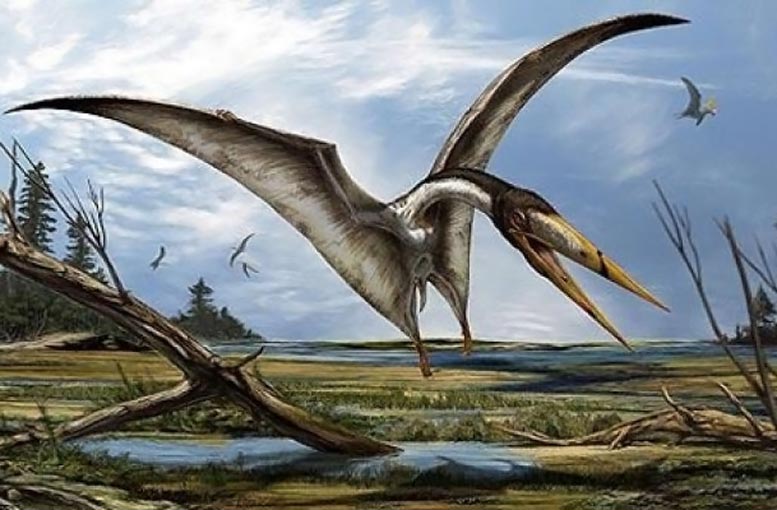
Paleontologists have made a surprising discovery while searching through 100-year-old fossil collections from the UK – a new mystery species of pterosaur, unlike anything seen before.
Lead author of the project, University of Portsmouth PhD student Roy Smith, discovered the mystery creature amongst fossil collections housed in the Sedgwick Museum of Cambridge and the Booth Museum at Brighton that were assembled when phosphate mining was at its peak in the English Fens between 1851 and 1900. These fossils found while workmen were digging phosphate nodules were frequently sold to earn a little bit of extra money.
It was while Smith was examining the fossils of shark spines that he made the amazing discovery. The fossils were actually fragments of jaws of toothless pterosaurs, which do indeed resemble shark fin spines, but there are many subtle differences that allow them to be distinguished.
“One such feature are tiny little holes where nerves come to the surface and are used for sensitive feeding by the pterosaurs. Shark fin spines do not have these, but the early palaeontologists clearly missed these features.”
Roy Smith, Lead author.
Smith says: “One such feature are tiny little holes where nerves come to the surface and are used for sensitive feeding by the pterosaurs. Shark fin spines do not have these, but the early paleontologists clearly missed these features. Two of the specimens discovered can be identified as a pterosaur called Ornithostoma, but one additional specimen is clearly distinct and represents a new species. It is a palaeontological mystery.
“Unfortunately, this specimen is too fragmentary to be the basis for naming the new species. Sadly, it is doubtful if any more remains of this pterosaur will be discovered, as there are no longer any exposures of the rock from which the fossils came. But I’m hopeful that other museum collections may contain more examples, and as soon as the COVID-19 restrictions are lifted I will continue my search.”
Smith’s supervisor, Professor Dave Martill, University of Portsmouth, says: “The little bit of beak is tantalizing in that it is small, and simply differs from Ornithostoma in subtle ways, perhaps in the way that a great white egret might differ from a heron. Likely the differences in life would have been more to do with color, call, and behavior than in the skeleton.”
“This find is significant because it adds to our knowledge of these ancient and fascinating flying prehistoric reptiles.”
Professor Dave Martill, University of Portsmouth
“Pterosaurs with these types of beaks are better known at the time period from North Africa, so it would be reasonable to assume a likeness to the North African Alanqa (pictured below). This is extremely exciting to have discovered this mystery pterosaur right here in the UK.
“This find is significant because it adds to our knowledge of these ancient and fascinating flying prehistoric reptiles, but also demonstrates that such discoveries can be made, simply by re-examining material in old collections.”
The third author of the study was Dr. Dave Unwin, from the University of Leicester’s Centre for Palaeobiology Research.
The results of Roy Smith’s discovery have been published in The Proceedings of the Geologists’ Association.
Reference: “Edentulous pterosaurs from the Cambridge Greensand (Cretaceous) of eastern England with a review of Ornithostoma Seeley, 1871″ by Roy E. Smith, David M. Martill, David M. Unwin and Lorna Steel, 6 November 2020, The Proceedings of the Geologists’ Association.
DOI: 10.1016/j.pgeola.2020.10.004
Never miss a breakthrough: Join the SciTechDaily newsletter.
Follow us on Google and Google News.