
Close Menu
    Facebook X (Twitter) Instagram
    SciTechDaily
    • Biology
    • Chemistry
    • Earth
    • Health
    • Physics
    • Science
    • Space
    • Technology
    Facebook X (Twitter) Pinterest YouTube RSS
    SciTechDaily
    Home»Science»New Species of Giant Predatory Dinosaur Discovered in Thailand Provides a New Glimpse at Dinosaur Evolution
    Science

    New Species of Giant Predatory Dinosaur Discovered in Thailand Provides a New Glimpse at Dinosaur Evolution

    By PLOSOctober 13, 20192 Comments2 Mins Read
    Facebook Twitter Pinterest Telegram LinkedIn WhatsApp Email Reddit
    Share
    Facebook Twitter LinkedIn Pinterest Telegram Email Reddit
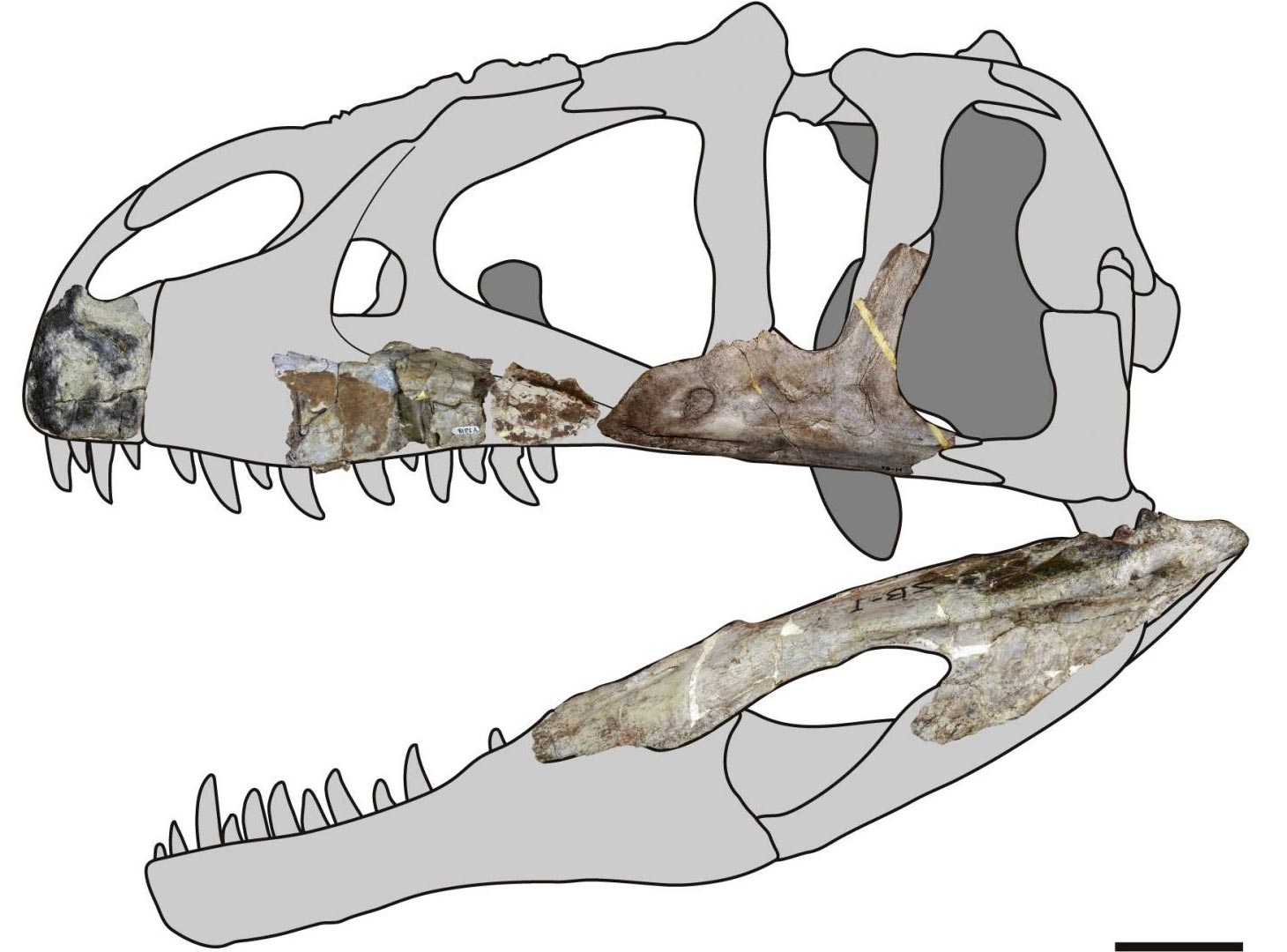
    Siamraptor Skull Reconstruction.
    Siamraptor skull reconstruction. Credit: Chokchaloemwong et al., 2019

    Siamraptor provides a new glimpse at the early evolution of carcharodontosaurian dinosaurs.

    Fossils discovered in Thailand represent a new genus and species of predatory dinosaur, according to a study released October 9, 2019 in the open-access journal PLOS ONE by Duangsuda Chokchaloemwong of Nakhon Ratchasima Rajabhat University, Thailand and colleagues.

    Carcharodontosaurs were a widespread and successful group of large predatory dinosaurs during the Jurassic and Cretaceous Periods and were important members of ecosystems on multiple continents. However, the fossil record of these animals is notably lacking from the Early Cretaceous of Asia, with no definite carcharodontosaurs known from Southeast Asia.

    In this study, Chokchaloemwong and colleagues describe fossil material from the Khok Kruat geologic formation in Khorat, Thailand, dating to the Early Cretaceous. These fossils include remains of the skull, backbone, limbs, and hips of at least four individual dinosaurs, and morphological comparison with known species led the authors to identify these remains as belonging to a previously unknown genus and species of carcharodontosaur which they named Siamraptor suwati.

    Phylogenetic analysis indicates that Siamraptor is a basal member of the carcharodontosaurs, meaning it represents a very early evolutionary split from the rest of the group. It is also the first definitive carcharodontosaur known from Southeast Asia, and combined with similarly-aged finds from Europe and Africa, it reveals that this group of dinosaurs had already spread to three continents by the Early Cretaceous.

    The authors summarize their work as follows: “A Siam predator: New carnivorous dinosaur Siamraptor suwati discovered in Thailand.

    ###

    Reference: “A new carcharodontosaurian theropod (Dinosauria: Saurischia) from the Lower Cretaceous of Thailand” by Duangsuda Chokchaloemwong, Soki Hattori, Elena Cuesta, Pratueng Jintasakul, Masateru Shibata and Yoichi Azuma, 9 October 2019, PLOS ONE.
    DOI: 10.1371/journal.pone.0222489

    Funding: This work was supported by the Fukui Prefectural Government, Japan, and Nakhon Ratchasima Rajabhat University, Thailand. EC research was financed by a Postdoctoral Fellowship program of the Japan Society of Promotion of Science (JSPS) (Ref. PE18034). The funders had no role in study design, data collection and analysis, decision to publish, or preparation of the manuscript.

    Never miss a breakthrough: Join the SciTechDaily newsletter.
    Follow us on Google and Google News.

    Archaeology Dinosaurs Evolution Paleontology
    Share. Facebook Twitter Pinterest LinkedIn Email Reddit

    Related Articles

    Surprising Diversity of Cretaceous Reptiles at Argentina Fossil Site – Revealed by Discovery of Ancient Teeth

    Tiny Ancient Bird Discovered in China Shares Skull Features With Tyrannosaurus rex

    Meet the Massive Australotitan, the “Southern Titan” – Australia’s Largest Dinosaur!

    Southern African Dinosaur Had Extremely Irregular Growth

    Shuvuuia: Extraordinary Dinosaurs That Hunted in the Dark

    260-Million-Year-Old Killing Machine Exposed

    Paleontologists Surprising Discovery: Fossil Shark Turns Into Mystery Pterosaur

    Naked Prehistoric Monsters! Pterosaurs, Ancient Flying Reptiles, May Not Have Had Feathers at All

    Evidence T. Rex’s Long Legs Evolved for Distance, Not Speed Like Previously Thought

    2 Comments

    1. soundos on October 14, 2019 1:43 am

      thank you for website

      Reply
    2. Ziane on October 26, 2019 8:15 pm

      We have benefited the subject thanks

      Reply
    Leave A Reply Cancel Reply

    • Facebook
    • Twitter
    • Pinterest
    • YouTube

    Don't Miss a Discovery

    Subscribe for the Latest in Science & Tech!

    Trending News

    Breakthrough Bowel Cancer Trial Leaves Patients Cancer-Free for Nearly 3 Years

    Natural Compound Shows Powerful Potential Against Rheumatoid Arthritis

    100,000-Year-Old Neanderthal Fossils in Poland Reveal Unexpected Genetic Connections

    Simple “Gut Reset” May Prevent Weight Gain After Ozempic or Wegovy

    2.8 Days to Disaster: Scientists Warn Low Earth Orbit Could Suddenly Collapse

    Common Food Compound Shows Surprising Power Against Superbugs

    5 Simple Ways To Remember More and Forget Less

    The Atomic Gap That Could Cost the Semiconductor Industry Billions

    Follow SciTechDaily
    • Facebook
    • Twitter
    • YouTube
    • Pinterest
    • Newsletter
    • RSS
    SciTech News
    • Biology News
    • Chemistry News
    • Earth News
    • Health News
    • Physics News
    • Science News
    • Space News
    • Technology News
    Recent Posts
    • Bowel and Ovarian Cancers Are Dramatically Rising in Young Adults and Scientists Aren’t Sure Why
    • Alzheimer’s May Begin Decades Earlier Than You Think, New Mayo Clinic Study Finds
    • The Hidden Risk of Taking Breaks From Weight-Loss Drugs Like Ozempic
    • Total Solar Eclipse Made Cities Go Eerily Quiet Beneath the Surface
    • This Common Plant Could Be an Unexpected New Source of Protein
    Copyright © 1998 - 2026 SciTechDaily. All Rights Reserved.
    • Science News
    • About
    • Contact
    • Editorial Board
    • Privacy Policy
    • Terms of Use

    Type above and press Enter to search. Press Esc to cancel.