
Close Menu
    Facebook X (Twitter) Instagram
    SciTechDaily
    • Biology
    • Chemistry
    • Earth
    • Health
    • Physics
    • Science
    • Space
    • Technology
    Facebook X (Twitter) Pinterest YouTube RSS
    SciTechDaily
    Home»Science»Naked Prehistoric Monsters! Pterosaurs, Ancient Flying Reptiles, May Not Have Had Feathers at All
    Science

    Naked Prehistoric Monsters! Pterosaurs, Ancient Flying Reptiles, May Not Have Had Feathers at All

    By University of PortsmouthSeptember 29, 2020No Comments4 Mins Read
    Facebook Twitter Pinterest Telegram LinkedIn WhatsApp Email Reddit
    Share
    Facebook Twitter LinkedIn Pinterest Telegram Email Reddit
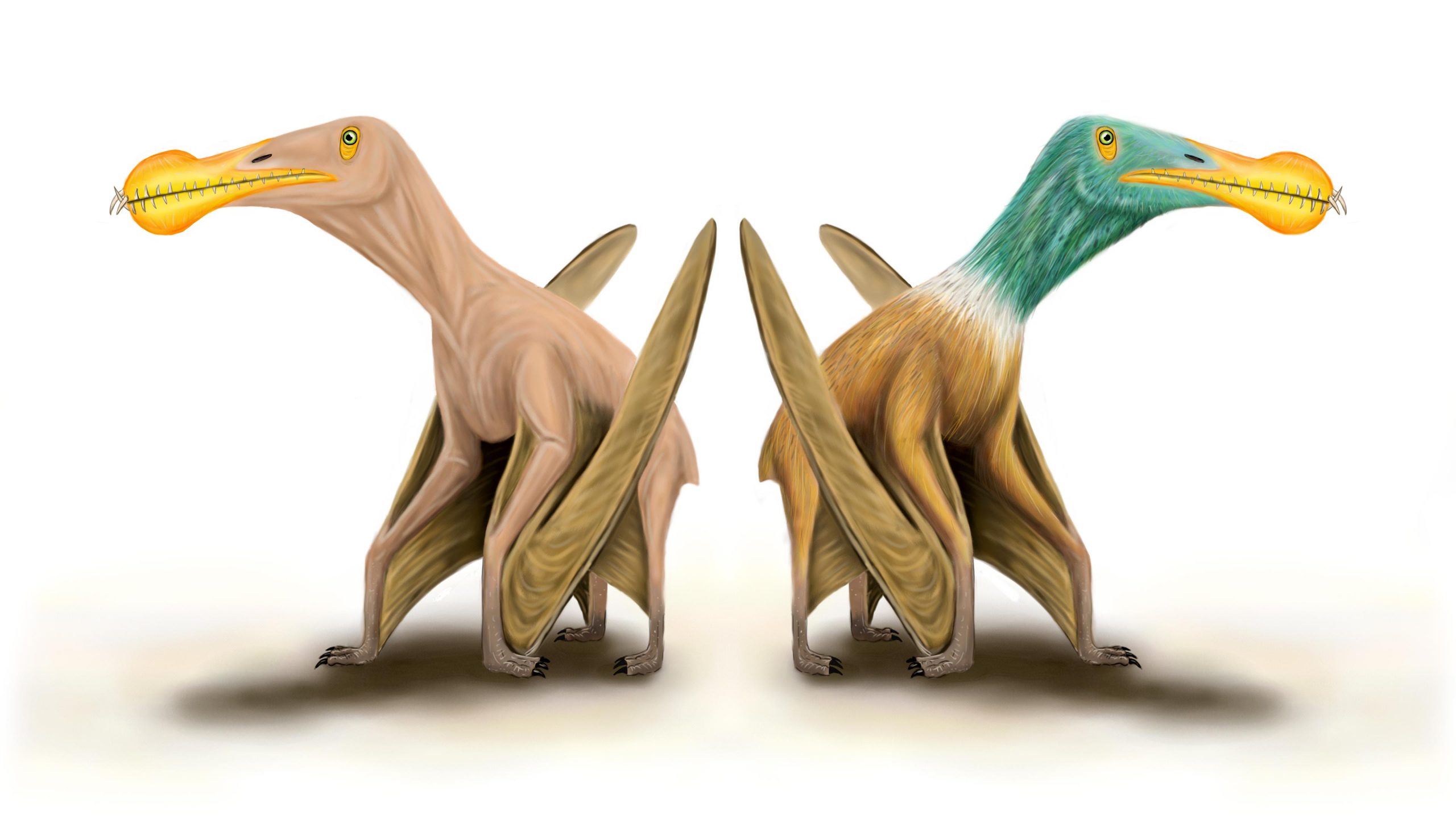
    What Pterosaurs Looked Like
    What did pterosaurs look like? Some researchers think they had a relatively smooth skin without any covering, similar in appearance to the skin on the palms of your hands. Others have argued that they were covered with small feather-like structures and looked a little bit like four-legged birds. Credit: Megan Jacobs, University of Portsmouth

    The debate about when dinosaurs developed feathers has taken a new turn with a paper refuting earlier claims that feathers were also found on dinosaurs’ relatives, the flying reptiles called pterosaurs.

    Pterosaur expert Dr. David Unwin from the University of Leicester’s Centre for Palaeobiology Research, and Professor David Martill, of the University of Portsmouth have examined the evidence that these creatures had feathers and believe they were in fact bald.

    They have responded to a suggestion by a group of his colleagues led by Zixiao Yang that some pterosaur fossils show evidence of feather-like branching filaments, ‘protofeathers’, on the animal’s skin.

    “If they really did have feathers, how did that make them look, and did they exhibit the same fantastic variety of colous exhibited by birds.” Professor Dave Martill, Professor of Palaeobiology

    Dr. Yang, from Nanjing University, and colleagues presented their argument in a 2018 paper in the journal Nature Ecology and Evolution. Now Unwin and Martill, have offered an alternative, non-feather explanation for the fossil evidence in the same journal.

    While this may seem like academic minutiae, it actually has huge palaeontological implications. Feathered pterosaurs would mean that the very earliest feathers first appeared on an ancestor shared by both pterosaurs and dinosaurs, since it is unlikely that something so complex developed separately in two different groups of animals.

    This would mean that the very first feather-like elements evolved at least 80 million years earlier than currently thought. It would also suggest that all dinosaurs started out with feathers, or protofeathers but some groups, such as sauropods, subsequently lost them again – the complete opposite of currently accepted theory.

    The evidence rests on tiny, hair-like filaments, less than one-tenth of a millimeter in diameter, which have been identified in about 30 pterosaur fossils. Among these, Yang and colleagues were only able to find just three specimens on which these filaments seem to exhibit a ‘branching structure’ typical of protofeathers.

    “The idea of feathered pterosaurs goes back to the nineteenth century but the fossil evidence was then, and still is, very weak.” Dr. David Unwin, University of Leicester’s Centre for Palaeobiology Research

    Unwin and Martill propose that these are not protofeathers at all but tough fibers which form part of the internal structure of the pterosaur’s wing membrane, and that the ‘branching’ effect may simply be the result of these fibers decaying and unraveling.

    Dr. Unwin said: “The idea of feathered pterosaurs goes back to the nineteenth century but the fossil evidence was then, and still is, very weak. Exceptional claims require exceptional evidence – we have the former, but not the latter.”

    Professor Martill noted that either way, paleontologists will have to carefully reappraise ideas about the ecology of these ancient flying reptiles. He said, “If they really did have feathers, how did that make them look, and did they exhibit the same fantastic variety of colors exhibited by birds. And if they didn’t have feathers, then how did they keep warm at night, what limits did this have on their geographic range, did they stay away from colder northern climes as most reptiles do today. And how did they thermoregulate? The clues are so cryptic, that we are still a long way from working out just how these amazing animals worked.

    Reference: “No protofeathers on pterosaurs” by David M. Unwin and David M. Martill, 28 September 2020, Nature Ecology & Evolution.
    DOI: 10.1038/s41559-020-01308-9

    Never miss a breakthrough: Join the SciTechDaily newsletter.
    Follow us on Google and Google News.

    Archaeology Dinosaurs Evolution Flying Reptile Paleontology University of Portsmouth
    Share. Facebook Twitter Pinterest LinkedIn Email Reddit

    Related Articles

    Meet the Massive Australotitan, the “Southern Titan” – Australia’s Largest Dinosaur!

    Southern African Dinosaur Had Extremely Irregular Growth

    Shuvuuia: Extraordinary Dinosaurs That Hunted in the Dark

    260-Million-Year-Old Killing Machine Exposed

    The Original Story of Flight: Pterosaur Precursors Discovered That Fill Gap in Early Evolutionary History

    Paleontologists Surprising Discovery: Fossil Shark Turns Into Mystery Pterosaur

    Chinese Pterodactyl Wings Its Way to England

    Evidence T. Rex’s Long Legs Evolved for Distance, Not Speed Like Previously Thought

    New Species of Giant Predatory Dinosaur Discovered in Thailand Provides a New Glimpse at Dinosaur Evolution

    Leave A Reply Cancel Reply

    • Facebook
    • Twitter
    • Pinterest
    • YouTube

    Don't Miss a Discovery

    Subscribe for the Latest in Science & Tech!

    Trending News

    Artificial Sweeteners May Harm Future Generations, Study Suggests

    Splashdown! NASA Artemis II Returns From Record-Breaking Moon Mission

    What If Consciousness Exists Beyond Your Brain

    Scientists Finally Crack the 100-Million-Year Evolutionary Mystery of Squid and Cuttlefish

    Beyond “Safe Levels”: Study Challenges What We Know About Pesticides and Cancer

    Researchers Have Found a Dietary Compound That Increases Longevity

    Scientists Baffled by Bizarre “Living Fossil” From 275 Million Years Ago

    Your IQ at 23 Could Predict Your Wealth at 27, Study Finds

    Follow SciTechDaily
    • Facebook
    • Twitter
    • YouTube
    • Pinterest
    • Newsletter
    • RSS
    SciTech News
    • Biology News
    • Chemistry News
    • Earth News
    • Health News
    • Physics News
    • Science News
    • Space News
    • Technology News
    Recent Posts
    • What if Dark Matter Has Two Forms? Bold New Hypothesis Could Explain a Cosmic Mystery
    • Researchers Expose Hidden Chemistry of “Ore-Forming” Elements in Biology
    • Geologists Reveal the Americas Collided Earlier Than We Thought
    • 20x Difference: Study Reveals True Source of Airborne Microplastics
    • Scientists Uncover Hidden Force Powering Yellowstone’s Supervolcano
    Copyright © 1998 - 2026 SciTechDaily. All Rights Reserved.
    • Science News
    • About
    • Contact
    • Editorial Board
    • Privacy Policy
    • Terms of Use

    Type above and press Enter to search. Press Esc to cancel.