

The Chicago Archaeopteryx provides rare 3D insights into skull evolution, soft tissue structure, and the first evidence of tertial feathers, marking a key stage in the origin of flight.
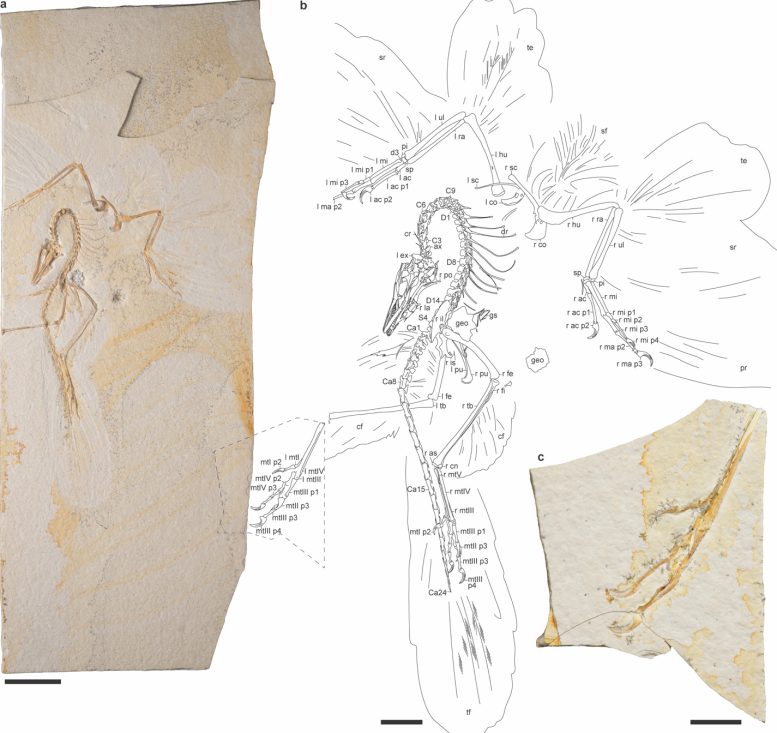
A Chinese-American research team, led by Dr. Han Hu of the Institute of Vertebrate Paleontology and Paleoanthropology (IVPP) and Dr. Jingmai O’Connor of the Field Museum of Natural History in Chicago, has announced the discovery and scientific description of the 14th known specimen of Archaeopteryx, now referred to as the Chicago Archaeopteryx.
Due to its exceptional preservation, the team used high-resolution CT scanning and 3D reconstruction to examine its skeletal structure, soft tissues, and feathers in extraordinary detail. Their analysis offers valuable insights into skull evolution and flight-related adaptations during the transition from non-avian dinosaurs to early birds. The study was published in Nature in May 2025.
Importance of the “first bird” in evolutionary theory
Archaeopteryx is one of the most iconic fossil species ever discovered. Its initial finding, soon after the release of Darwin’s On the Origin of Species, provided compelling evidence for evolutionary theory. For over 160 years, this “first bird” has intrigued both scientists and the public. However, limitations in fossil preservation and technology have left many aspects of its biology unresolved.
The newly described Chicago specimen, acquired by the Field Museum in 2022, is the smallest known Archaeopteryx, about the size of a pigeon. It is almost entirely intact, with many bones preserved in near three-dimensional form, and includes rare impressions of soft tissues such as skin, toe pads, and feathers. This makes it a landmark discovery in understanding early bird evolution.
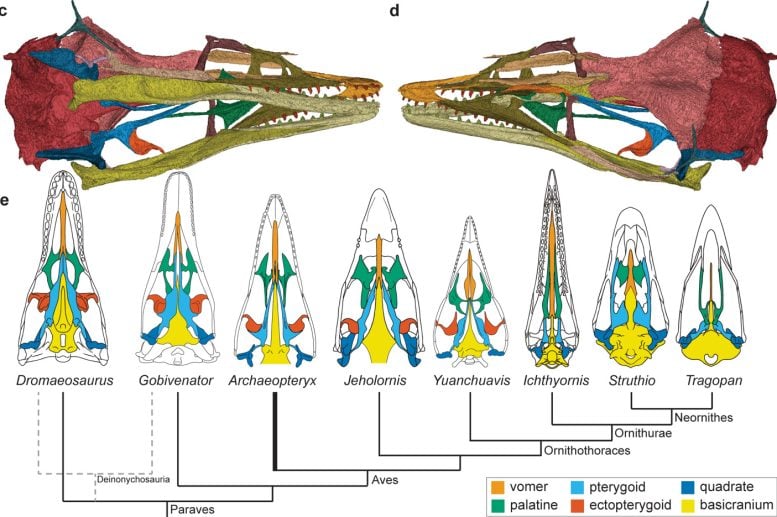
Thanks to the specimen’s extraordinary state, the team performed high-resolution CT scans and created a digital 3D model of the fossil. These revealed a nearly complete skull, including a well-preserved palatal region. The structure of the palate appears to be evolutionarily intermediate—more advanced than that of troodontid dinosaurs but less derived than in later Cretaceous birds. This suggests a transitional stage in the evolution from the fixed skulls of non-avian theropods to the more flexible skulls of modern birds.
The study also preserved details of soft tissues. Notably, the toe pads resemble those of present-day ground-foraging birds, indicating that Archaeopteryx was likely adapted for terrestrial movement rather than predation. These features support the view that Archaeopteryx had a versatile lifestyle, spending time both on the ground and possibly in trees, suggesting a broader ecological range than previously assumed.
First evidence of tertial feathers in Archaeopteryx
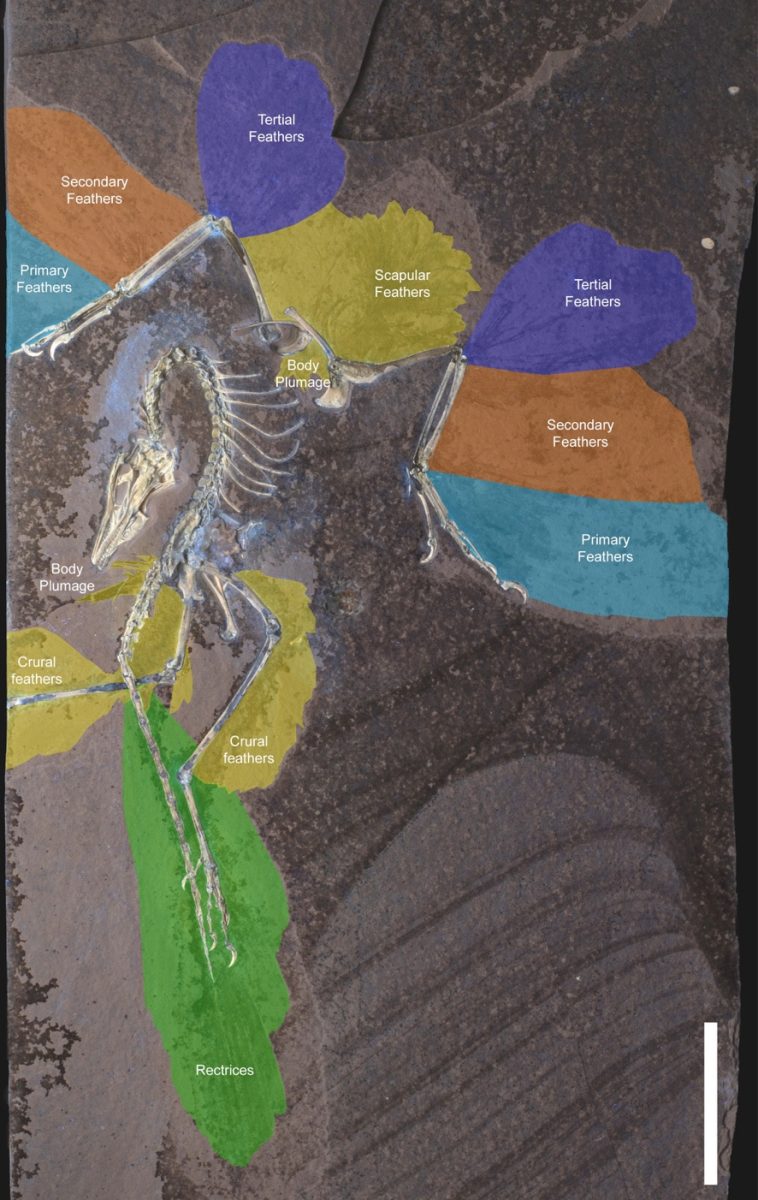
Significantly, the Chicago Archaeopteryx is also the first Archaeopteryx known to preserve tertials, which attach to the humerus and ulna and occupy the space between the wing and the body. These feathers are thought to contribute to a continuous aerodynamic surface during flight. Since such structures have never been observed in any non-avian feathered dinosaur, their presence in Archaeopteryx suggests they may represent a flight-related innovation, highlighting the evolutionary step toward powered flight.
The Chicago Archaeopteryx also marks a step forward in the application of advanced technological methods in paleontology, especially in 3D scanning and reconstruction, soft tissue identification, and ecological inference for extinct bird lineages.
Reference: “Chicago Archaeopteryx informs on the early evolution of the avian bauplan” by Jingmai O’Connor, Alexander Clark, Pei-Chen Kuo, Yosef Kiat, Matteo Fabbri, Akiko Shinya, Constance Van Beek, Jing Lu, Min Wang and Han Hu, 14 May 2025, Nature.
DOI: 10.1038/s41586-025-08912-4
This study was supported by the National Natural Science Foundation of China.
Never miss a breakthrough: Join the SciTechDaily newsletter.
Follow us on Google and Google News.
3 Comments
It is a perching bird. Nothing more. The assumptions are astounding.
Thoughtful readers will prefer to let scientists do their work of exploration and discovery.
Archaeopteryx is one remarkable creature.
I worked on evolution for 25 years, I got a result that archaeopteryx is the ancestor of recently birds. It’s not belong to Dinosaurs period.