
Close Menu
    Facebook X (Twitter) Instagram
    SciTechDaily
    • Biology
    • Chemistry
    • Earth
    • Health
    • Physics
    • Science
    • Space
    • Technology
    Facebook X (Twitter) Pinterest YouTube RSS
    SciTechDaily
    Home»Science»Newly Discovered Prehistoric Bird Fossil Sheds Light on Avian Evolution
    Science

    Newly Discovered Prehistoric Bird Fossil Sheds Light on Avian Evolution

    By Dr Fabien Knoll, University of ManchesterMarch 5, 2018No Comments4 Mins Read
    Facebook Twitter Pinterest Telegram LinkedIn WhatsApp Email Reddit
    Share
    Facebook Twitter LinkedIn Pinterest Telegram Email Reddit
    127 Million Years Old Baby Bird Fossil Sheds Light on Avian Evolution
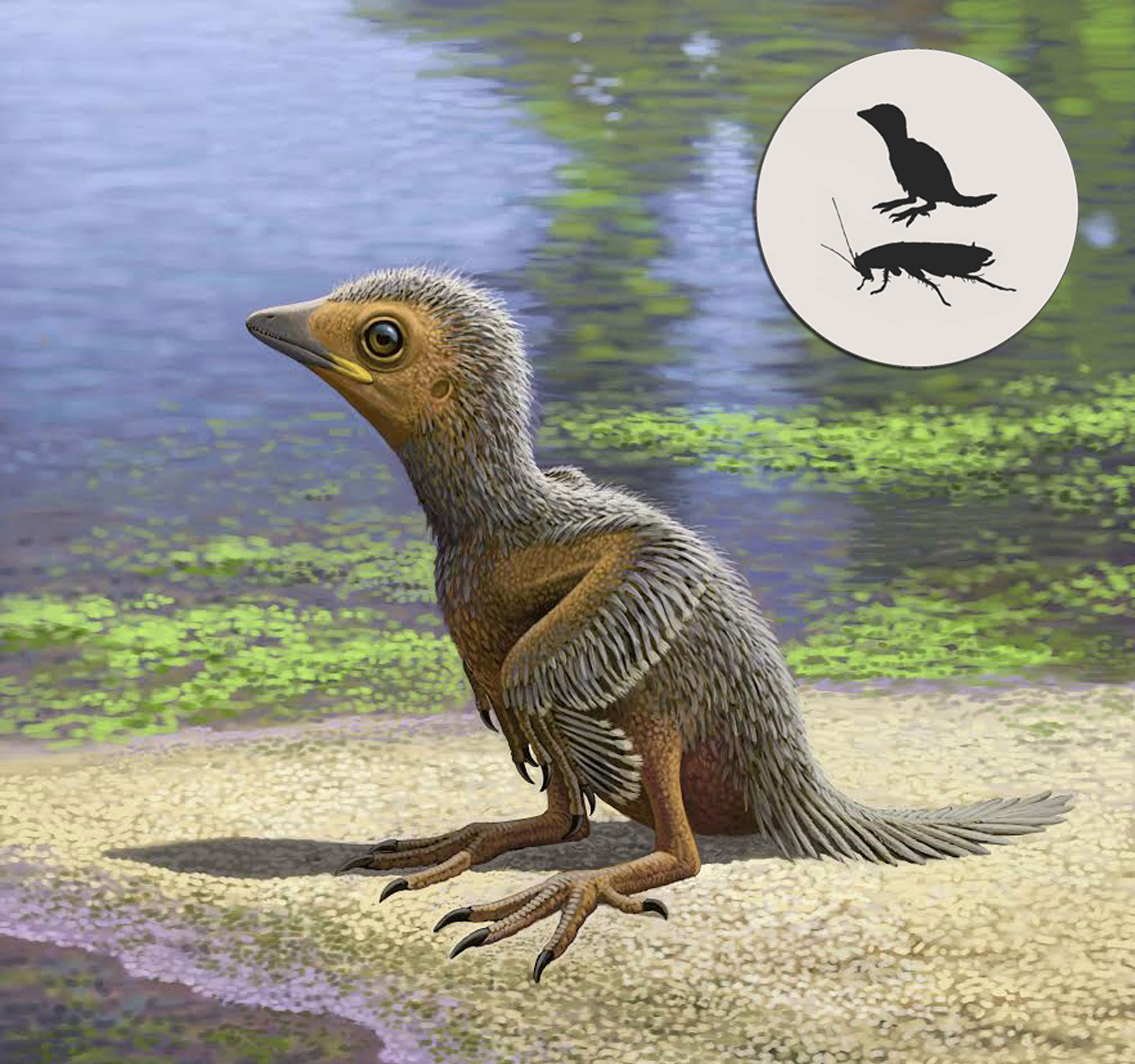
    Artist impression of Enantiornithes by artist Raúl Martín. Hypothetical fleshed-out reconstruction of MPCM-LH-26189. The fact that MPCM-LH-26189 is so well preserved and conserves some soft-tissue associated chemistry, while showing no feathers or chemical evidence for plumage suggest that the baby bird might have been largely featherless when it died. However, this cannot be confirmed, and so the individual was reconstructed with juvenile plumage hypothesized for perinate enantiornithines. The silhouettes inset are those of the juvenile bird and an unspecified sympatric cockroach to give a sense of scale.

    The tiny fossil of a prehistoric baby bird is helping scientists understand how early avians came into the world in the Age of Dinosaurs.

    The fossil, which dates back to the Mesozoic Era (250-65 million years ago), is a chick from a group of prehistoric birds called, Enantiornithes. Made up of a nearly complete skeleton, the specimen is amongst the smallest known Mesozoic avian fossils ever discovered.

    It measures less than five centimeters – smaller than the little finger on an average human hand – and would have weighed just three ounces when it was alive.

    What makes this fossil so important and unique is the fact it died not long after its birth. This is a critical stage in a bird’s skeletal formation. That means this bird’s extremely short life has given researchers a rare chance to analyze the species’ bone structure and development.

    Studying and analyzing ossification – the process of bone development – can explain a lot about a young bird’s life the researchers say. It can help them understand everything from whether it could fly or if it needed to stay with its parents after hatching or could survive on its own.
    Newly Discovered Prehistoric Bird Fossils Shed Light on Avian Evolution
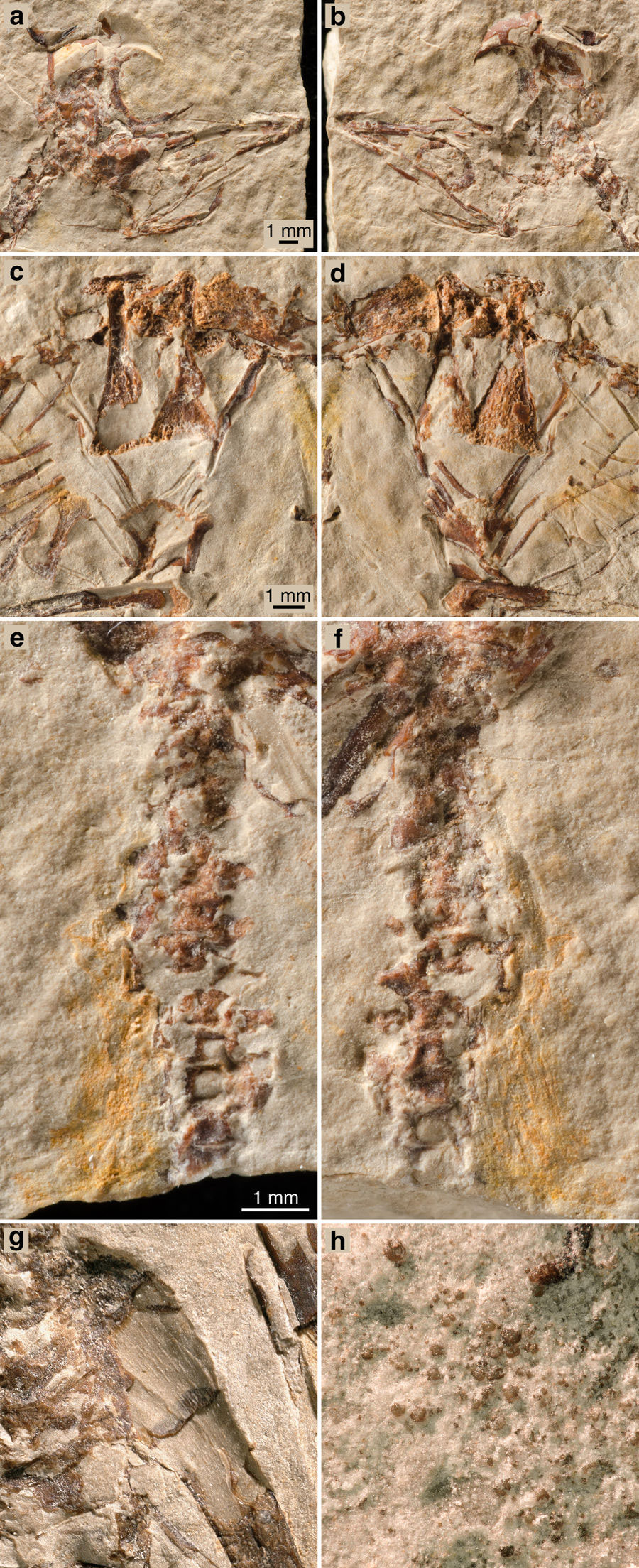
    Details of MPCM-LH-26189. a Skull on slab a. b Skull on slab b. c Sternum on slab a. d Sternum on slab b. e Tail on slab a. fTail on slab b. g Impression into the matrix of the pattern of longitudinal striation of the bone surface of the proximal humerus. h ‘Corpuscles’ in the pelvic area. Credit: Fabien Knoll, et al., Nature Communications; doi:10.1038/s41467-018-03295-9

    The lead author of the study, Dr. Fabien Knoll, from The University of Manchester’s Interdisciplinary Center for Ancient Life (ICAL), School of Earth and Environmental Sciences, explains: “The evolutionary diversification of birds has resulted in a wide range of hatchling developmental strategies and important differences in their growth rates. By analyzing bone development we can look at a whole host of evolutionary traits.”

    With the fossil being so small the team used synchrotron radiation to picture the tiny specimen at a ‘submicron’ level, observing the bones’ microstructures in extreme detail.

    Dr. Knoll said: “New technologies are offering paleontologists unprecedented capacities to investigate provocative fossils. Here we made the most of state-of-the-art facilities worldwide including three different synchrotrons in France, the UK, and the United States.”

    The researchers found the baby bird’s sternum (breastplate bone) was still largely made of cartilage and had not yet developed into hard, solid bone when it died, meaning it wouldn’t have been able to fly.

    The patterns of ossification observed in this and the other few very young enantiornithine birds known to date also suggest that the developmental strategies of this particular group of ancient avians may have been more diverse than previously thought.

    However, the team says that its lack of bone development doesn’t necessarily mean the hatchling was over-reliant on its parents for care and feeding, a trait known as being ‘altricial’. Modern-day species like love birds are highly dependent on their parents when born. Others, like chickens, are highly independent, which is known as ‘precocial’. Although, this is not a black-and-white issue, but rather a spectrum, hence the difficulty in clarifying the developmental strategies of long-gone bird species.

    Luis Chiappe, from the LA Museum of Natural History and study’s co-author added: “This new discovery, together with others from around the world, allows us to peek into the world of ancient birds that lived during the age of dinosaurs. It is amazing to realize how many of the features we see among living birds had already been developed more than 100 million years ago.”

    Enantiornithes Fossil Sheds Light on Avian Evolution
    Phosphorous mapping and photo of fossil. Credit: Fabien Knoll, et al., Nature Communications; doi:10.1038/s41467-018-03295-9

    Reference: “A diminutive perinate European Enantiornithes reveals an asynchronous ossification pattern in early birds” by Fabien Knoll, Luis M. Chiappe, Sophie Sanchez, Russell J. Garwood, Nicholas P. Edwards, Roy A. Wogelius, William I. Sellers, Phillip L. Manning, Francisco Ortega, Francisco J. Serrano, Jesús Marugán-Lobón, Elena Cuesta, Fernando Escaso and Jose Luis Sanz, 5 March 2018, Nature Communications.
    DOI: 10.1038/s41467-018-03295-9

    Never miss a breakthrough: Join the SciTechDaily newsletter.
    Follow us on Google and Google News.

    Archaeology Birds Evolutionary Biology Fossils University of Manchester
    Share. Facebook Twitter Pinterest LinkedIn Email Reddit

    Related Articles

    New 190-Million-Year-Old “Sword Dragon” Rewrites Ichthyosaur Evolution

    New Archaeopteryx Fossil Rewrites Early Bird Evolution

    Scientists Have Uncovered One of the Oldest Birds Ever – And It’s Unlike Anything We’ve Seen

    Hell Creek’s Deadly Predators: Newly Discovered Prehistoric Birds of Prey Hunted Baby Dinosaurs

    Extinct Animals From the Pleistocene Discovered in Mexico

    Exceptionally Preserved Brain Discovered Inside Waterlogged Pit

    Ash Preserved Fossils of Rangeomorphs Discovered in Newfoundland

    27-Foot Long Crocodylus Thorbjarnarsoni Roamed Kenya

    Cretaceous Period Sankofa Pyrenaica Fossilized Eggs Are Unusually Shaped

    Leave A Reply Cancel Reply

    • Facebook
    • Twitter
    • Pinterest
    • YouTube

    Don't Miss a Discovery

    Subscribe for the Latest in Science & Tech!

    Trending News

    New Research Shows Vitamin B12 May Hold the Key to Healthy Aging

    These Simple Daily Habits Can Quickly Improve Blood Pressure and Heart Risk Factors

    A Common Nutrient May Play a Surprising Role in Anxiety

    Doing This After 9 p.m. Could Double Your Risk of Gut Issues

    Scientists Discover How Coffee Impacts Memory, Mood, and Gut Health

    Why Did the Neanderthals Disappear? Scientists Reveal Humans Had a Hidden Advantage

    Physicists Propose Strange Experiment Where Time Goes Quantum

    Magnesium Magic: New Drug Melts Fat Even on a High-Fat, High-Sugar Diet

    Follow SciTechDaily
    • Facebook
    • Twitter
    • YouTube
    • Pinterest
    • Newsletter
    • RSS
    SciTech News
    • Biology News
    • Chemistry News
    • Earth News
    • Health News
    • Physics News
    • Science News
    • Space News
    • Technology News
    Recent Posts
    • This New Memory Technology Could Make Devices Last Months on One Charge
    • Scientists Turn Cancer’s Own Bacteria Against It in Breakthrough Therapy
    • Cannabis Can Make You Remember Things That Never Happened
    • Doctors Are Surprised by What This Vaccine Is Doing to the Heart
    • Quantum Breakthrough Turns Simple Forces Into Powerful New Interactions
    Copyright © 1998 - 2026 SciTechDaily. All Rights Reserved.
    • Science News
    • About
    • Contact
    • Editorial Board
    • Privacy Policy
    • Terms of Use

    Type above and press Enter to search. Press Esc to cancel.