
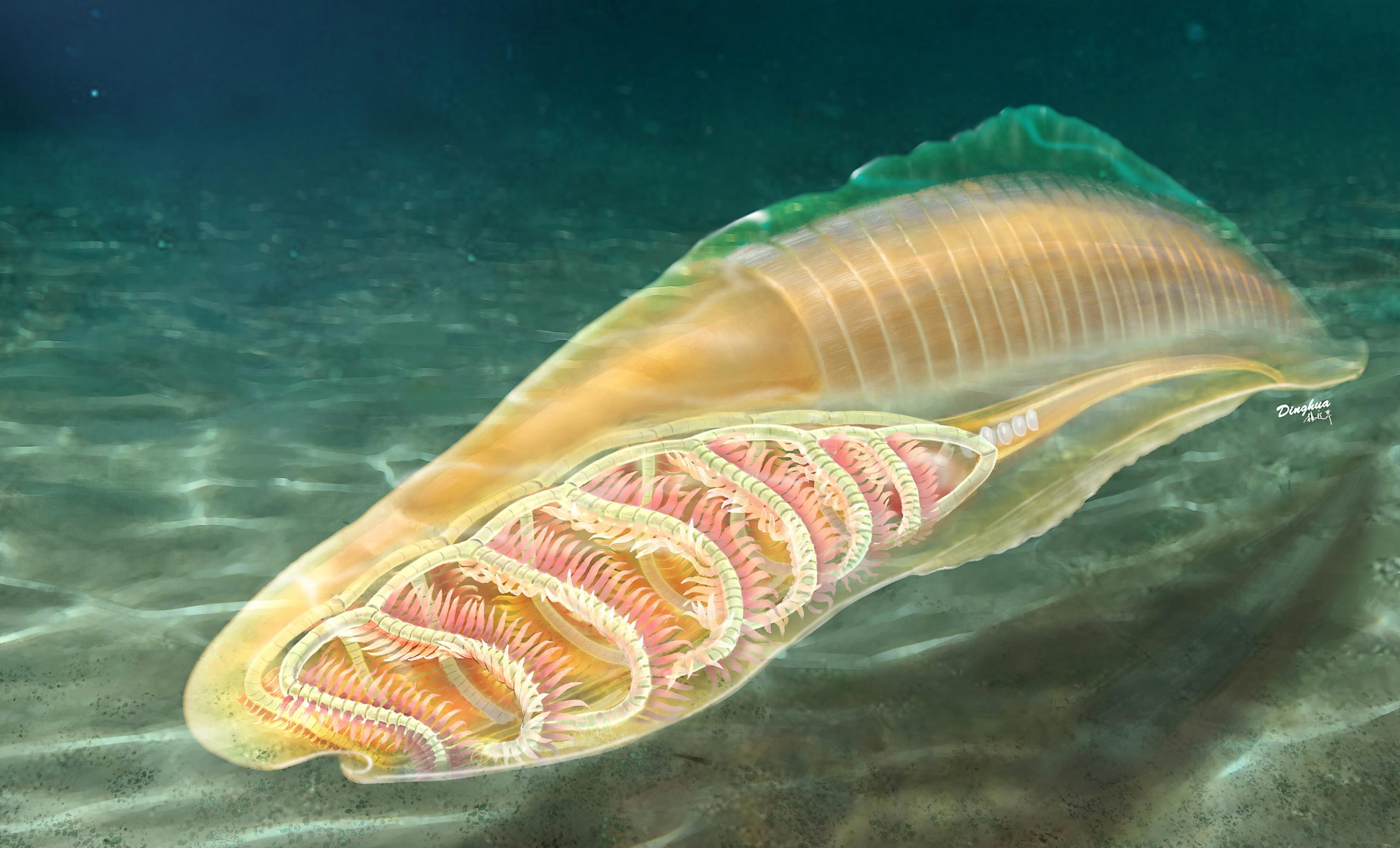
Research Reveals Yunnanozoans As the Oldest Known Stem Vertebrates
New findings answer questions in the fossil record.
The puzzling gap in the fossil record that would explain the evolution of invertebrates to vertebrates has long perplexed scientists. Vertebrates share unique features, such as a backbone and a skull, and include fishes, amphibians, reptiles, birds, mammals, and humans. Invertebrates, on the other hand, are animals without backbones.
The evolutionary process that moved invertebrates toward becoming vertebrates — and what those earliest vertebrates looked like — has been a mystery to scientists for centuries.
A team of scientists has now conducted a study of yunnanozoans, extinct creatures from the early Cambrian period (518 million years ago), and discovered evidence that they are the oldest known stem vertebrates. Stem vertebrate is a term that refers to those vertebrates that are extinct, but very closely related to living vertebrates.
The scientists, from Nanjing Institute of Geology and Paleontology, Chinese Academy of Sciences, and the Nanjing University, published their findings on July 7, 2022, in the journal Science.
Pharyngeal Arches in Vertebrate Evolution
Over the years, as researchers have studied how vertebrates evolved, a key focus of research has been the pharyngeal arches. These are structures that produce parts of the face and neck, such as the muscles, bone, and connective tissue. Scientists have hypothesized that the pharyngeal arch evolved from an unjointed cartilage rod in vertebrate ancestors, such as the chordate amphioxus, a close invertebrate relative of the vertebrates. However, whether such anatomy actually existed in the ancient ancestors has not been known for certain.
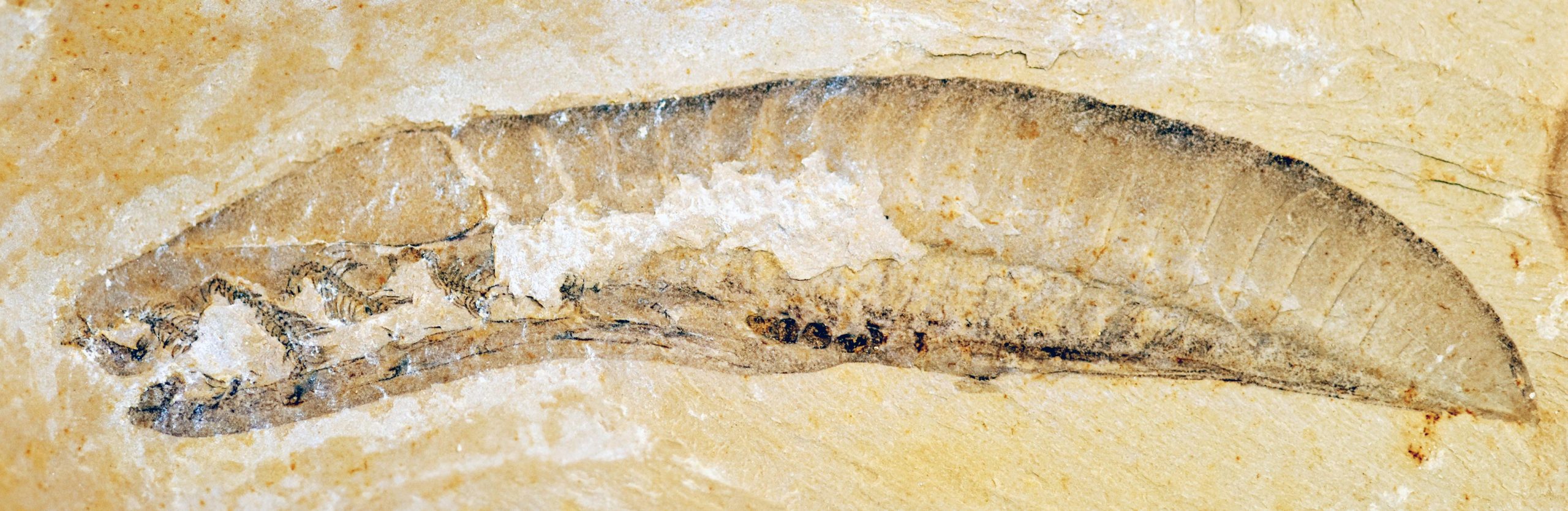
In an effort to better understand the role of the pharyngeal arch in ancient vertebrates, the research team studied the fossils of the soft-bodied yunnanozoans found in the Yunnan Province, China. For years, researchers have studied the yunnanozoans, with differing conclusions on how to interpret the creature’s anatomy. The affinity of yunnanozoans has been debated for around three decades, with multiple papers published supporting varying opinions, including four in Nature and Science.
The research team set out to examine newly collected yunnanozoan fossil specimens in previously unexplored ways, conducting a high-resolution anatomical and ultrastructural study. The 127 specimens they studied have well-preserved carbonaceous residues that allowed the team to conduct ultrastructural observations and detailed geochemical analyses.
The team applied X-ray microtomography, scanning electron microscopy, transmission electron microscopy, Raman spectrometry, Fourier-transform infrared spectroscopy, and energy-dispersive X-ray spectroscopy on the fossil specimens. Their study confirmed in multiple ways that yunnanozoans have cellular cartilages in the pharynx, a feature considered specific to vertebrates. The team’s findings support that yunnanozoans are stem vertebrates. The results of their study show that the yunnanozoans are the earliest and also the most primitive relatives of crown-group vertebrates.
Basket-Like Pharyngeal Skeletons
During their study, the team observed that all of the seven pharyngeal arches in the yunnanozoan fossils are similar to each other. The all arches have bamboo-like segments and filaments. Neighboring arches are all connected by dorsal and ventral horizontal rods, forming a basket. A basket-like pharyngeal skeleton is a feature found today in living jawless fishes, such as lampreys and hagfishes.
“Two types of pharyngeal skeletons—the basket-like and isolated types—occur in the Cambrian and living vertebrates. This implies that the form of pharyngeal skeletons has a more complex early evolutionary history than previously thought,” said TIAN Qingyi, the first author of the study, from Nanjing University and Nanjing Institute of Geology and Paleontology, Chinese Academy of Sciences.
Their research provided the team with new insights into the detailed structures of the pharyngeal arches. The new anatomical observations the team achieved in their study, support the evolutionary placement of yunnanozoans at the very basal part of the vertebrate tree of life.
Reference: “Ultrastructure reveals ancestral vertebrate pharyngeal skeleton in yunnanozoans” by Qingyi Tian, Fangchen Zhao, Han Zeng, Maoyan Zhu and Baoyu Jiang, 7 July 2022, Science.
DOI: 10.1126/science.abm2708
The research team includes Qingyi Tian from Nanjing University (NJU) and Nanjing Institute of Geology and Paleontology, Chinese Academy of Sciences (NIGPAS); Fangchen Zhao and Han Zeng from NIGPAS; Maoyan Zhu from NIGPAS and the University of Chinese Academy of Sciences; and Baoyu Jiang from NJU.
The Strategic Priority Research Program (B) of the Chinese Academy of Sciences and the National Science Foundation of China funded this research.
Never miss a breakthrough: Join the SciTechDaily newsletter.
Follow us on Google and Google News.
4 Comments
fascinating!
Romans 1:18-23
Romans 1:18-23 is an absolutely worthless reference. You could have at least chosen something that’s relevant to the article. Instead – you chose a stupid fearmonger’s verse. Big L to you, and an even bigger one to your diety for sending you such a stupid message.
Bingo. These guys are all morons.