
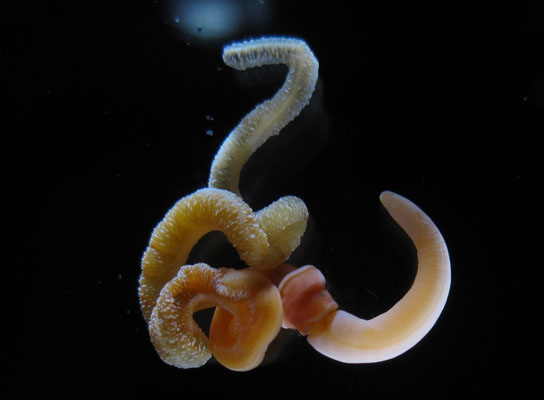
A new study shows that Saccoglossus kowalevskii, a sea-dwelling, bottom-feeding acorn worm, has a similarities to humans although the worms are separated from vertebrates by over 500 million years of evolution.
Biologists may need to rethink where to look for evolutionary changes responsible for the origin of vertebrates, including humans, as a result of research at Stanford University and the University of Chicago.
Chris Lowe and Ari Pani, biologists at Stanford’s Hopkins Marine Station, discovered some of the essential genetic machinery previously thought exclusive to vertebrate brains in a surprising place – a sea-dwelling, bottom-feeding acorn worm, Saccoglossus kowalevskii.
These worms lack vertebrate-like brains, and are, in fact, separated from vertebrates by over 500 million years of evolution. The worms are even classified in a different phylum, the hemichordates.
“The closer we looked, the more similarities we found between these strange worms and vertebrate brains in their underlying molecular blueprints,” said Lowe, an assistant professor of biology. “This suggests that essential parts of these blueprints, previously thought to be unique to complex brains, have much earlier evolutionary origins.” A research paper by Lowe, graduate student Pani, and collaborators was published this week in Nature.
The researchers say this discovery shows the need to consider that modern animals may have lost certain ancient processes and traits, and that biologists need to cast a wide net – including under-investigated and different-looking animals – in order to capture the entire evolutionary picture.
The research
As the brain develops in a vertebrate embryo, key genetic signaling centers lay the chemical foundation for brain development, like scaffolding for a building. Researchers previously thought that important elements of this scaffolding were exclusive to humans and other vertebrates, since they are absent elsewhere, even in close relatives of vertebrates.
In particular, most of the centers are lacking in a small, fishlike organism called amphioxus, commonly thought to be the best living example of the first chordates because they share many anatomical, developmental, and genetic characteristics with vertebrates.
That absence led to the theory that several brain signaling centers evolved in early vertebrates in conjunction with more advanced parts of the brain, like the forebrain, the region responsible for higher thought processes. However, the Lowe lab’s surprising finding shows that the scaffolding has much deeper roots in the tree of life – before humans, vertebrates, and acorn worms – in a mysterious common ancestor.
More broadly, because vertebrates share these essential, hidden, brain-making processes with squirming, spineless acorn worms, biologists need to search beyond looks to find common genetic and evolutionary similarities.
Searching for vertebrate origins
From the earliest days of evolutionary biology, when Charles Darwin compared the beaks of Galapagos finches, scientists compared animals to each other by looking at sizes, shapes, and arrangements of body parts.
Using those methods, many scientists theorized that amphioxus, also known as the lancelet, is a sort of living fossil that marks the transition from invertebrates to vertebrates. The small, fish-like lancelet looks more like vertebrates than any other invertebrate, sharing many anatomical similarities with vertebrates, including a central nervous system with a hollow nerve cord running down the back, a firm, supportive notochord beneath it, a true tail and segmented muscle blocks.
But anatomy is only part of the picture.
Over the past few decades, evolutionary biologists have capitalized on new biomedical technologies to peer beyond the surface of animals to the genetic “blueprints” that ultimately control the growth of anatomical structures. Using those tools, Lowe previously found that many important genes in acorn worm embryos were active in similar locations of the body as in mice and other vertebrates, despite their lack of anatomical similarities.
In this study, Lowe and Pani focused on brain origins – looking for the molecular signatures of three vertebrate brain-signaling centers. The signaling centers, like the scaffolding for a building, provide a framework for organizing proteins and cells.
The presence of these particular genetic signaling centers in a hemichordate was completely unexpected, based on previous studies from closer vertebrate relatives. These new results intriguingly indicate that amphioxus lost many of those genetic processes, even though it possesses a rather complex central nervous system more similar to vertebrates than hemichordates.
“No one thought hemichordates would be that informative in understanding the origin of vertebrates,” Lowe said.
“These findings remind us that modern animals are all at the ‘tips of the branches’ of the evolutionary tree,” Lowe said. “And when we are searching for evidence about what our common ancestors were like, we have to look at all the branches to find the right clues.”
Reference: “Marine worm rewrites theory of brain evolution” by Amy Maxmen, 14 March 2012, Nature.
DOI: 10.1038/nature.2012.10226
Never miss a breakthrough: Join the SciTechDaily newsletter.
Follow us on Google and Google News.