
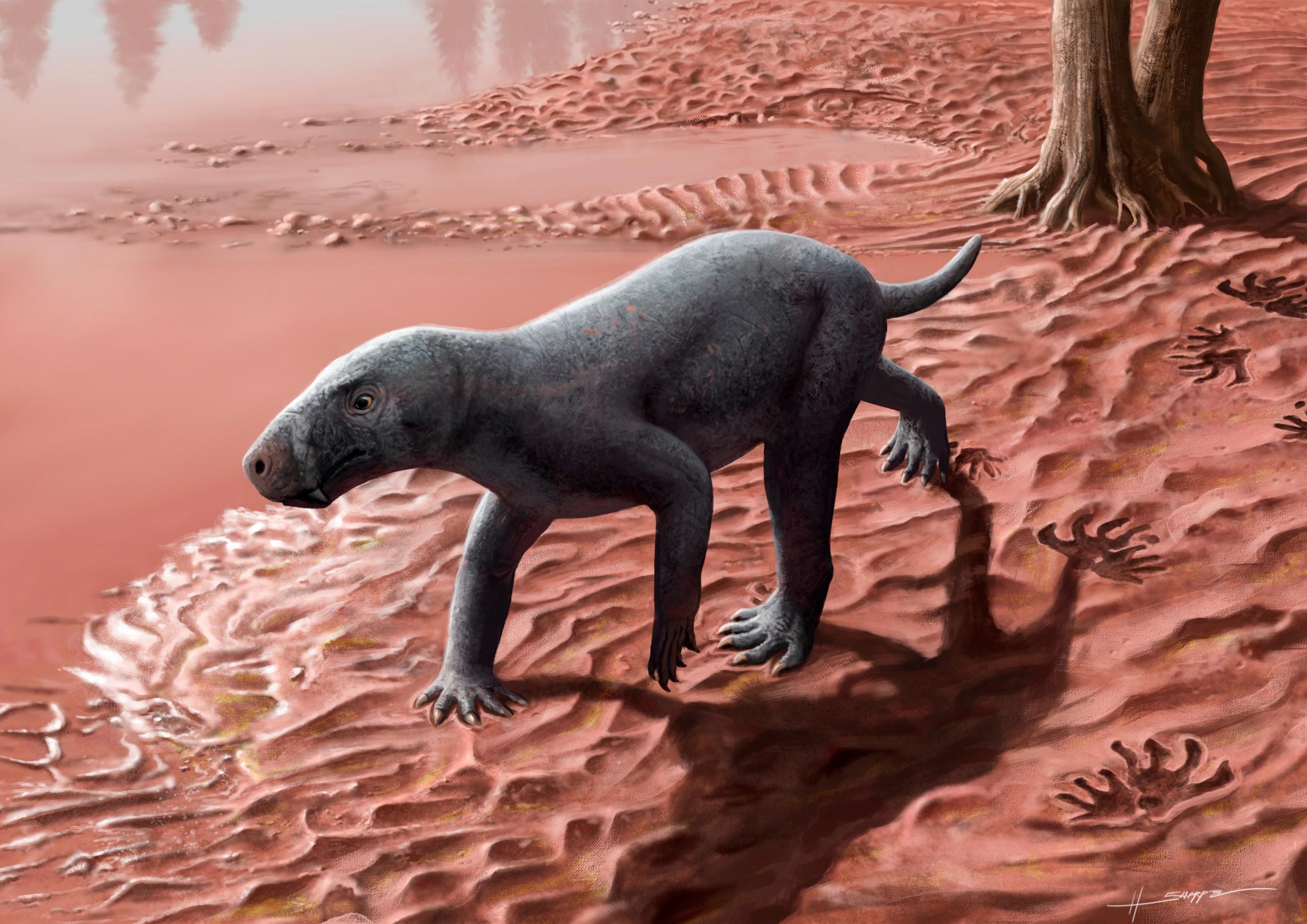
“Vaguely dog-like” animal is one of the oldest-known close cousins of modern mammals.
Researchers have discovered the oldest gorgonopsian fossil on Mallorca, dating from 270-280 million years ago. This therapsid, a saber-toothed predator, offers new insights into the evolutionary lineage leading to mammals.
Evolutionary Origins of Mammals
About 200 million years ago, the first true mammals emerged during the age of the dinosaurs. However, mammals trace their ancestry back even further to an ancient group called therapsids. While many therapsids didn’t look much like modern mammals, they shared key traits that would later define mammals. For example, they had openings on the sides of their skulls where jaw muscles attached and specialized jawbones that would eventually evolve into the distinctive middle ear bones found in mammals today.
In a new study published today (December 17) in Nature Communications, scientists announced the discovery of what could be the oldest known therapsid fossil. This ancient predator, resembling a dog with saber-like teeth, offers a new glimpse into the distant origins of mammal evolution.

Discovery of the Oldest Therapsid
The new fossil, which doesn’t have a species name yet, is a member of a group called the gorgonopsians. “Gorgonopsians are more closely related to mammals than they are to any other living animals,” says Ken Angielczyk, the Field Museum’s MacArthur Curator of Paleomammalogy in the Negaunee Integrative Research Center and a co-author of the paper. “They don’t have any modern descendants, and while they’re not our direct ancestors, they’re related to species that were our direct ancestors.”
Until now, the oldest known gorgonopsians lived roughly 265 million years ago. However, the new fossil is from 270-280 million years ago. “It is most likely the oldest gorgonopsian on the planet,” says Josep Fortuny, senior author of the article and head of the Computational Biomechanics and Evolution of Life History group at the Institut Català de Paleontologia Miquel Crusafont (ICP) in Spain.

Insights from the Mallorca Excavation
The fossils were found in Mallorca (also sometimes spelled Majorca), a Spanish island in the Mediterranean Sea. But in the time of the gorgonopsians, Mallorca was part of the supercontinent of Pangea.
“The large number of bone remains is surprising. We have found everything from fragments of skull, vertebrae, and ribs to a very well-preserved femur. In fact, when we started this excavation, we never thought we would find so many remains of an animal of this type in Mallorca,” explains Rafel Matamales, curator of the Museu Balear de Ciències Naturals (MUCBO | MBCN), research associate at the ICP, and first author of the article.
Anatomy and Lifestyle of the Newly Discovered Gorgonopsian
These bones allowed the researchers to reconstruct what the animal looked like and a little about its life. “If you saw this animal walking down the street, it would look a little bit like a medium-sized dog, maybe about the size of a husky, but it wouldn’t be quite right. It didn’t have any fur, and it wouldn’t have had dog-like ears,” says Angielczyk. “But it’s the oldest animal scientists have ever found with long, blade-like canine teeth.” These saber teeth suggest that this gorgonopsian was a top predator in its day.
Implications for Understanding Mammal Evolution
The fact that this gorgonopsian predates its closest relatives by tens of millions of years changes scientists’ understanding of when therapsids evolved, an important milestone on the way to the emergence of mammals, and in turn it tells us something about where we come from.
“Before the time of dinosaurs, there was an age of ancient mammal relatives. Most of those ancient mammal relatives looked really different from what we think of mammals looking like today,” says Angielczyk. “But they were really diverse and played lots of different ecological roles. The discovery of this new fossil is another piece of the puzzle for how mammals evolved.”
Reference: “Early–middle Permian Mediterranean gorgonopsian suggests an equatorial origin of therapsids” by Rafel Matamales-Andreu, Christian F. Kammerer, Kenneth D. Angielczyk, Tiago R. Simões, Eudald Mujal, Àngel Galobart and Josep Fortuny, 17 December 2024, Nature Communications.
DOI: 10.1038/s41467-024-54425-5
Never miss a breakthrough: Join the SciTechDaily newsletter.
Follow us on Google and Google News.
6 Comments
Wow
Mammal type reptile that should be modern crocodilian mesoeucrocodylia it has full palate it is nothing like other reptiles it’s more like a cat. On spinosauridae turbinates a mammal warmblooded feature only spinosaurus has it the foramen on the nasal because fossil was dimage the postnasal foramen only one theropod has it the none tetanuran syntarus not simular to modern crocodilian triceratop duckbill dinosaur sauropod Ankylosauridae turbinates they would have said so only one foramen it has to be 7
Gee did Noah forget to load another pair of animals on the ark?
Couldn’t afford to feed all of them.
Omg, i love this article. I always thought gorgonspians came around 265 to 260 million years ago, but reading this fasicnates me due to knowing how the gorgonspians evolved earlier and reminds me that techincally mammmals were around during the permian. Keep up the good work yall.
Thanks for your articles about the myriad strange designs of so many ancient creatures that God hath designed. Our dinosaur brethren lasted millions of years in diverse species. Will our present human race survive our own intelligence?