

Helmetia expansa was found to have walking legs and molting behavior, changing assumptions about its mobility and growth.
For more than a century, the Cambrian arthropod Helmetia expansa remained a mystery. Discovered in 1918 by paleontologist Charles Doolittle Walcott, it was initially identified as a crustacean. Although frequently mentioned in scientific literature, the species had never been formally described, and only a single specimen had been illustrated.
In a new study published in the Journal of Systematic Palaeontology, a team of Harvard researchers led by Sarah Losso, a postdoctoral fellow in the Department of Organismic and Evolutionary Biology, has now provided a formal description of Helmetia expansa. Their findings offer new details about the animal’s anatomy, behavior, and evolutionary connections.
Helmetia expansa is part of a rare group of early arthropods known as concilitergans, which are closely related to trilobites. Unlike trilobites, concilitergans lacked hard, calcified exoskeletons, meaning their fossils could only form under exceptional conditions—such as those found in the 508-million-year-old Burgess Shale in Canada, where even delicate features like guts, legs, and gills were preserved.
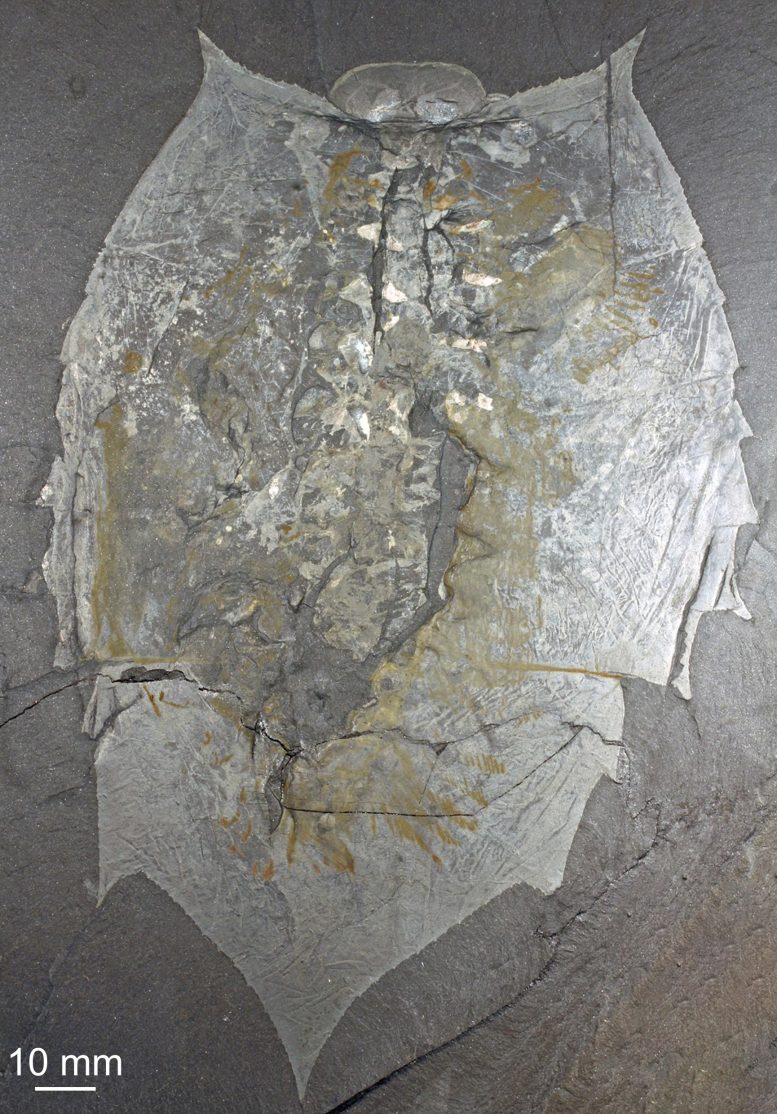
Although more specimens were collected, only one individual of Helmetia expansa had been figured and no study examined additional material in detail to formally describe the species or clarify concilitergan evolution. “We need to study more than one specimen to see the species’ full range of morphology and preservation,” said Losso.
Uncovering walking legs and molting behavior
The team examined 36 specimens, at the Smithsonian Institution and the Royal Ontario Museum, from the Cambrian Period of the Burgess Shale of Canada. They photographed the specimens, both wet and dry, using a polarizing filter that can better reveal subtle features and extinction phases, and compared them to related species found in the Chengjiang biota in China, and one from the early Cambrian Sirius Passet in Greenland.
Helmetia had a leaf-like exoskeleton, with some specimens preserving eyes, medial eyes, digestive systems, and limbs. Early arthropods had limbs with a walking leg for locomotion and food capture, and a gill used for respiration.
On the holotype, only the gills are visible – leading past researchers to believe Helmetia lacked legs and swam exclusively. But, the team found broad gills and walking legs in several specimens, showing it likely walked like trilobites.
Even more surprising were two specimens caught in the early stages of molting, a behavior never before documented in concilitergans.
Growth, classification, and evolutionary significance
“Molting strategies have never been known in any concilitergan,” said Losso. “All arthropods molt their hard exoskeletons to grow, but no one had seen this behavior before in a concilitergan because you have to catch a specimen in the act of molting, and it’s difficult to get just the right timing.”
The molting specimens show the new exoskeleton closer to the edge of the head, suggesting the animal exited front the front of the body – similar to horseshoe crabs, which use an anterior exit strategy, unlike most crabs that exit from the rear of the body.
The researchers also discovered a wide range of adult body sizes as Helmetia grew. While the smallest specimen was only 92 millimeters long, one exceeded over 180 millimeters. “These patterns tell us not only how these 508-million-year-old animals grew, but how big they could get,” Losso said.
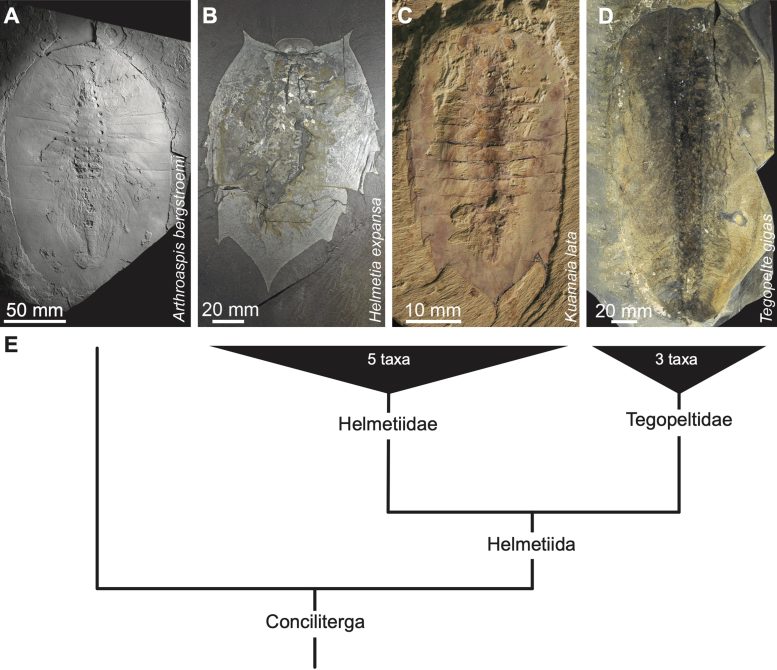
Based on updated interpretations of Helmetia expansa’s morphology, the researchers confirmed two main helmetiids groups: the Helmediidae, which includes Helmetia expansa and is characterized by segment boundaries and side spines, and Tegopeltidae, which is marked by segment fusion and a lack of spines. The researchers also assigned Arthroaspis bergstroemi, known from Greenland since 2013, to the group Conciliterga.
“Our findings give a much fuller picture of what Helmetia looked like, how it lived, and how concilitergans are related to each other,” Losso said, “which is very important for future studies on Conciliterga and other early arthropods.”
Reference: ” Helmetia expansa Walcott, 1918 revisited – new insights into the internal anatomy, moulting and phylogeny of Conciliterga” by Sarah R. Losso, Jean-Bernard Caron and Javier Ortega-Hernández, 4 April 2025, Journal of Systematic Palaeontology.
DOI: 10.1080/14772019.2025.2468195
Never miss a breakthrough: Join the SciTechDaily newsletter.
Follow us on Google and Google News.
2 Comments
100 year old mystery is solved? It’s no mystery that the environment of the Cambrian Burgess Shale allowed the excellent fossilization of rare and never-seen-again invertebrates…like this one. Museums are filled with many specimens, most are not on display.. What’s the real mystery is what that physical and chemical environment actually was before and during their time at burial.
My understanding is that most of the deposits are submarine turbidites coming down the Continental slope from the Continental shelf. The evidence for this comes from the existence of several distinct fuanal groups which have different degrees of preservation including placement and and articulation with creatures associated with shallower waters being jumbled up, disarticulated and broken. The high quality preservation is mostly of deeper water species which were likely buried in situ.