
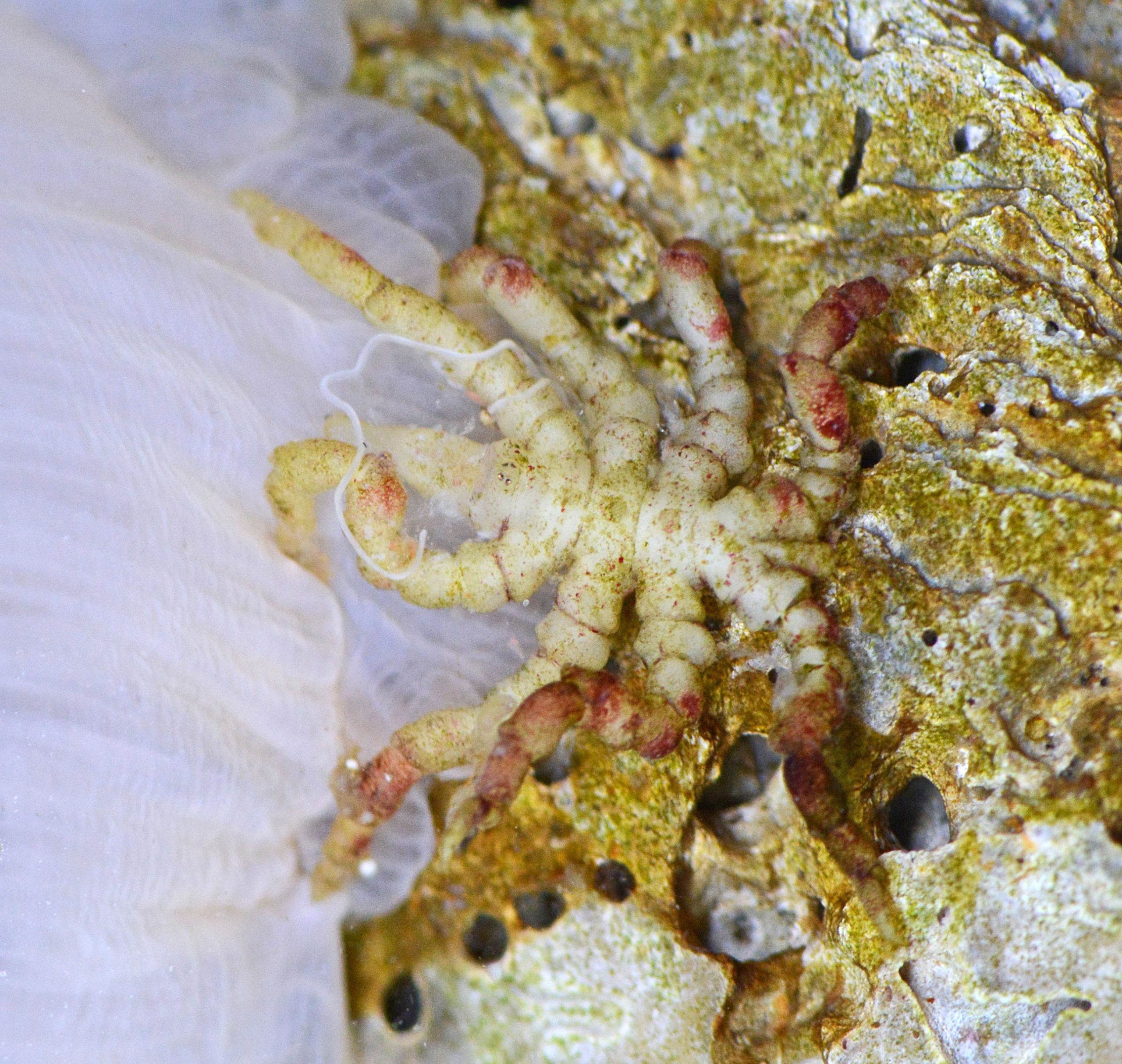
In a scientific first, researchers have mapped the sea spider’s entire genome in high resolution, uncovering a fascinating link between its unusual body and a missing gene.
Unlike its arachnid cousins, the sea spider has no real abdomen and even keeps some of its organs inside its legs. Scientists found that this strange anatomy may be tied to the disappearance of a key developmental gene. The discovery also sheds light on how ancient relatives of spiders and scorpions evolved, offering new clues about the origins of some of Earth’s weirdest creatures.
First Sea Spider Genome Revealed
Sea spiders (Pycnogonida) are some of the strangest creatures in the ocean. These marine arthropods have an extremely narrow, short trunk and almost no visible abdomen. Their internal organs even extend into their long, spindly legs. Despite their name, sea spiders are not true spiders, but they are related. They belong to a group called chelicerates, which includes spiders, scorpions, mites, and horseshoe crabs. Chelicerates are named for their claw-like mouthparts, known as chelicerae.
The sea spider’s unusual body plan has long puzzled scientists. How does such a strange structure form? And what does it reveal about the evolution of chelicerates? To answer these questions, researchers turned to the sea spider’s DNA.
Cutting-Edge Sequencing Exposes DNA Secrets
To decode the sea spider genome, researchers used advanced sequencing technologies. First, they extracted DNA from a single Pycnogonum litorale individual using a method called long-read sequencing. This approach captures large, continuous sections of DNA, which helps scientists piece together tricky and repetitive parts of the genome.
Next, they studied a second individual to see how different parts of the genome are arranged inside the cell nucleus. This helped determine the correct order of the DNA fragments.
By combining these two methods, the team assembled 57 pseudochromosomes, nearly the entire genome of the sea spider, in remarkable detail. They also analyzed gene activity at various stages of development, providing deeper insights into how this creature grows and forms.
“The genomes of many non-canonical laboratory organisms are challenging to assemble, and Pycnogonum is no exception. Only the combination of modern high-throughput data sources made a high-quality genome possible,” says the study’s first author Nikolaos Papadopoulos from the Department of Evolutionary Biology at the University of Vienna. “This can now serve as a stepping stone for further research.”

Lost Genes, Visible effects
The research team paid special attention to the so-called Hox cluster – a gene family that is evolutionarily conserved across the animal kingdom. “In arthropods, Hox genes play a central role in the correct specification of the different body segments; but also in many other animal groups they are essential ‘master controllers’ during body plan development,” explains Andreas Wanninger, one of the project leads at the Department for Evolutionary Biology at the University of Vienna.
The exciting secret of Pycnogonum litorale: a part of the Hox cluster is missing completely from the genome, namely abdominal-A (Abd-A), a gene typically involved in specification and development of the posterior part of the body. Its absence could be linked to the extreme reduction of the pycnogonid abdomen. Similar conditions have been observed in other arthropods with reduced posteriors, such as certain mites and barnacles. Thus, sea spiders offer another example for the well-documented evolutionary relationship between Hox gene loss and body part reduction.
The genome also offers insights into broader evolutionary patterns. Unlike spiders and scorpions, whose genomes show clear signs of ancient whole-genome duplications, no such traces can be found in the genome of P. litorale. As pycnogonids are considered the sister taxon to all chelicerates, this suggests that the genome of the chelicerate ancestor did not already have these duplications; rather, they must have happened much later in evolution, for certain chelicerate sub-groups.
A New Reference Genome
This newly assembled high-quality genome paves the way for further comparative studies. P. litorale thus becomes a novel valuable reference species regarding questions about the interrelationships between chelicerates and the evolution of their body plans, as well as the genetic mechanisms that underlie the diversity of arthropods.
“From an evolutionary developmental perspective, sea spiders are very interesting: their mode of development may be ancestral for arthropods, but at the same time they boast multiple body plan innovations unique to themselves. Beyond this, they also possess remarkable regenerative abilities,” explains last author Georg Brenneis of the Department of Evolutionary Biology at the University of Vienna. He adds: “Now that we have the genome and comprehensive datasets on gene activities during development, we can systematically study all of these aspects on the molecular level.”
The researchers will use the novel reference genome for further studies on gene regulation, development, and regeneration in chelicerates, aiming to better understand the processes underlying the evolutionary success of this group.
Reference: “The genome of a sea spider corroborates a shared Hox cluster motif in arthropods with a reduced posterior tagma” by Nikolaos Papadopoulos, Siddharth S. Kulkarni, Christian Baranyi, Bastian Fromm, Emily V. W. Setton, Prashant P. Sharma, Andreas Wanninger and Georg Brenneis, 2 July 2025, BMC Biology.
DOI: 10.1186/s12915-025-02276-x
Never miss a breakthrough: Join the SciTechDaily newsletter.
Follow us on Google and Google News.