
Close Menu
    Facebook X (Twitter) Instagram
    SciTechDaily
    • Biology
    • Chemistry
    • Earth
    • Health
    • Physics
    • Science
    • Space
    • Technology
    Facebook X (Twitter) Pinterest YouTube RSS
    SciTechDaily
    Home»Biology»Genetic Variability Helps Sea Urchins Cope with Environmental Changes
    Biology

    Genetic Variability Helps Sea Urchins Cope with Environmental Changes

    By SciTechDailySeptember 26, 2012No Comments2 Mins Read
    Facebook Twitter Pinterest Telegram LinkedIn WhatsApp Email Reddit
    Share
    Facebook Twitter LinkedIn Pinterest Telegram Email Reddit
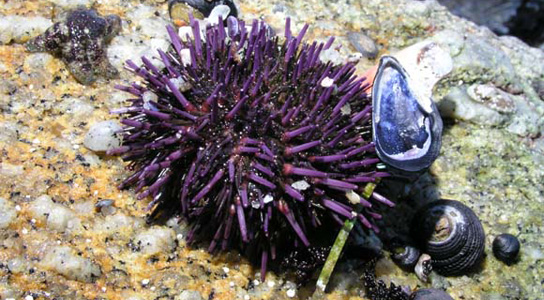
    purple-sea-urchin
    Purple sea urchin

    The current rising acidity in the ocean is supposed to have dire consequences for organisms like coral, but there are some sea urchins that have the genetic tools to adapt to inhospitable conditions.

    The results were presented at the Third International Symposium on the Ocean in a High CO2 World in Monterey, California, and are among the few that suggest that some organisms are more resilient than others to changes in ocean acidity.
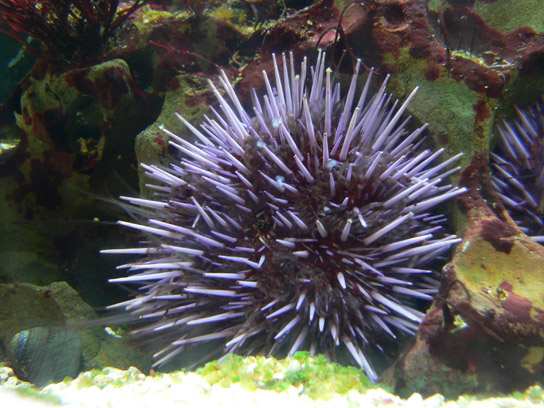
    strongylocentrotus-purpuratus

    As the oceans absorb the growing concentration of atmospheric carbon dioxide, lowering their pH levels, corals and plankton will experience trouble maintaining their calcium carbonate skeletons in the more acidic waters because there is less carbonate available in low pH waters. However, it’s unclear how this will affect the food chain and other organisms.

    Gretchen Hofmann, an evolutionary biologist at the University of California, Santa Barbara, found that Purple sea urchins (Strongylocentrotus purpuratus) have the potential to adapt to variations in pH because of the standing genetic variation that exists in the population.

    Hofmann et al. took advantage of the natural variability in coastal pH in the eastern Pacific Ocean to study how organisms would respond to more acidic conditions. In central Oregon, sites can drop from a pH of 8.1 to 7.6 during to periods of “upwelling,” when wind drives acidic waters high in carbon dioxide to the surface, but this low pH isn’t expected elsewhere until the year 2100.

    The sea urchins were bred under normal and upwelled carbon dioxide conditions. Then, the gene expression of the population was examined. The researchers discovered that the 150 genes that were turned on in the low pH population were largely related to calcium transport and help promote calcification in acidic oceans.

    These genes aren’t present in the coral Acropora millepora, so the systems react very differently. Researchers are concentrating on the metabolic costs of increased pH tolerance. Red abalone (Haliotis rufescens) has more than 1 million genetic variants in 19,000 expressed genes in locations of varying pH along the North American West Coast.

    Never miss a breakthrough: Join the SciTechDaily newsletter.
    Follow us on Google and Google News.

    Acidification DNA Evolutionary Biology Genetics Marine Biology Sea Urchins
    Share. Facebook Twitter Pinterest LinkedIn Email Reddit

    Related Articles

    Sea Spider Shock: Missing Gene, Vanishing Body, Evolution’s Strangest Plot Twist

    Harvard Study Offers New Insight on Height and Arthritis

    DNA Study Reveals Clues about Primate Evolution

    Ancient DNA Reveals Link between Early Humans & Present-Day Asians and Native Americans

    Researchers Calculate That DNA Has a 521 Year Half-Life

    DNA Could Predate Existence of Life As We Know It

    Rare Example of Bacterial Gene Transfer Providing Evolutionary Benefit

    Human Y-Chromosome Has Enough Genes to Stay for Millions of Years

    Researchers Complete Genome Sequence of a Denisovan Human Finger Bone

    Leave A Reply Cancel Reply

    • Facebook
    • Twitter
    • Pinterest
    • YouTube

    Don't Miss a Discovery

    Subscribe for the Latest in Science & Tech!

    Trending News

    Scientists Discover 132-Million-Year-Old Dinosaur Tracks on South Africa’s Coast

    Scientists Uncover the Secret Ingredient Behind the Spark That May Have Started Life on Earth

    Physicists Observe Matter in Two Places at Once in Mind-Bending Quantum Experiment

    Stanford Scientists Discover Hidden Brain Circuit That Fuels Chronic Pain

    New Study Reveals Why Ozempic Works Better for Some People Than Others

    Climate Change Is Altering a Key Greenhouse Gas in a Way Scientists Didn’t Expect

    New Study Suggests Gravitational Waves May Have Created Dark Matter

    Scientists Discover Why the Brain Gets Stuck in Schizophrenia

    Follow SciTechDaily
    • Facebook
    • Twitter
    • YouTube
    • Pinterest
    • Newsletter
    • RSS
    SciTech News
    • Biology News
    • Chemistry News
    • Earth News
    • Health News
    • Physics News
    • Science News
    • Space News
    • Technology News
    Recent Posts
    • Researchers Discover Long-Lost Words of Ancient Greek Philosopher After 2,000 Years
    • New Study Warns: Asia’s Lifeline Water Source Is Rapidly Draining
    • 100 Times Worse? Thawing Permafrost May Be More Dangerous Than Previously Thought
    • “Pretty Close to Home”: The Hidden Earthquake Threat Beneath Seattle
    • The Surprising Reason You Might Want To Sleep Without a Pillow
    Copyright © 1998 - 2026 SciTechDaily. All Rights Reserved.
    • Science News
    • About
    • Contact
    • Editorial Board
    • Privacy Policy
    • Terms of Use

    Type above and press Enter to search. Press Esc to cancel.