
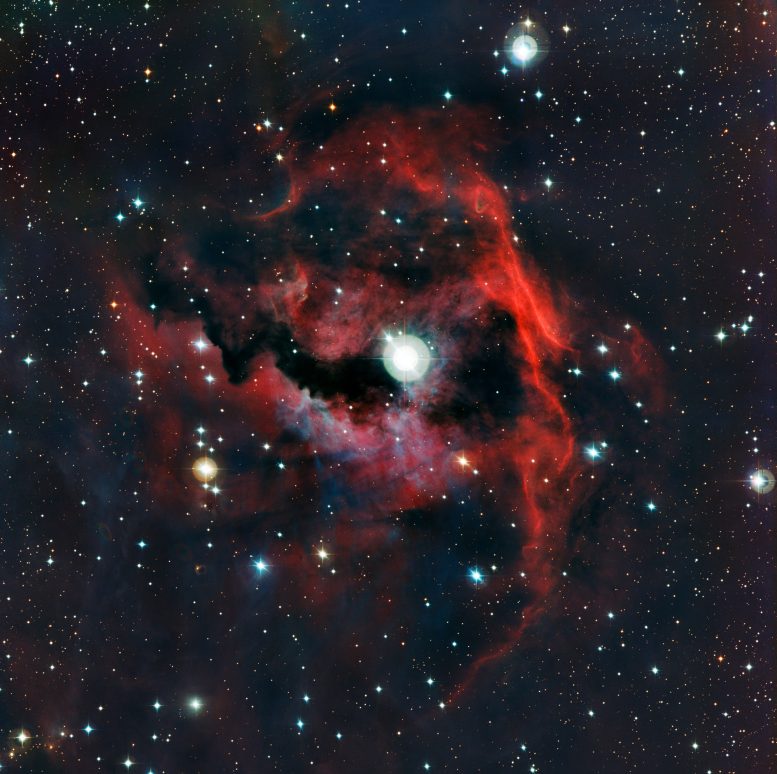
A close-up view of the head of the Seagull Nebula, which is located roughly 3,700 light-years away from Earth, was captured in this new image from ESO’s La Silla Observatory.
Nebulae are among the most visually impressive objects in the night sky. They are interstellar clouds of dust, molecules, hydrogen, helium and other ionized gases where new stars are being born. Although they come in different shapes and colors many share a common characteristic: when observed for the first time, their odd and evocative shapes trigger astronomers’ imaginations and lead to curious names. This dramatic region of star formation, which has acquired the nickname of the Seagull Nebula, is no exception.
This new image from the Wide Field Imager on the MPG/ESO 2.2-meter telescope at ESO’s La Silla Observatory in Chile shows the head part of the Seagull Nebula.[1] It is just one part of the larger nebula known more formally as IC 2177, which spreads its wings with a span of over 100 light-years and resembles a seagull in flight. This cloud of gas and dust is located about 3,700 light-years away from Earth. The entire bird shows up best in wide-field images.
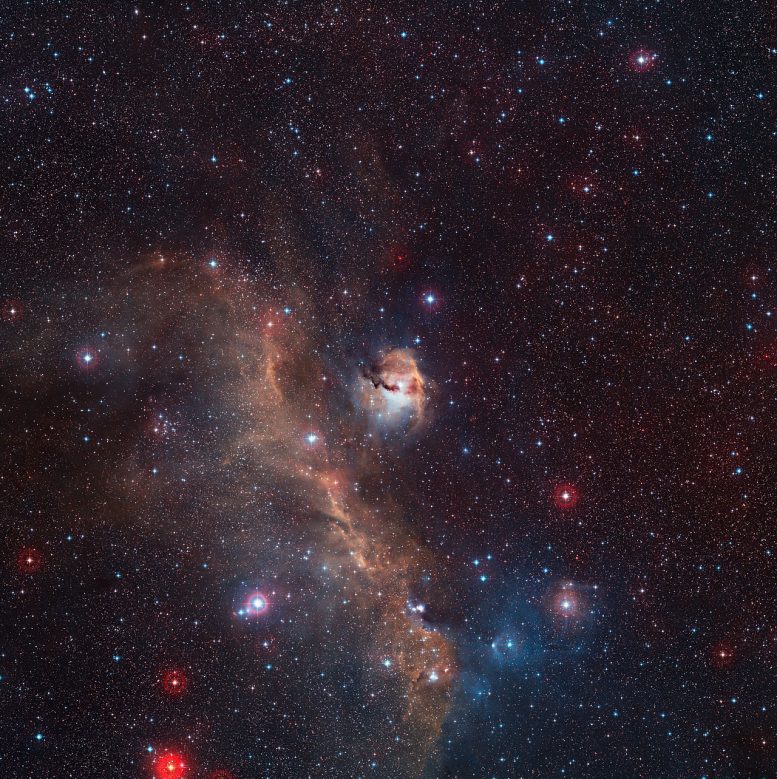
The Seagull Nebula lies just on the border between the constellations of Monoceros (The Unicorn) and Canis Major (The Great Dog) and is close to Sirius, the brightest star in the night sky. The nebula lies more than four hundred times further away than the famous star.
The complex of gas and dust that forms the head of the seagull glows brightly in the sky due to the strong ultraviolet radiation coming mostly from one brilliant young star — HD 53367[2] — that can be spotted in the center of the image and could be taken to be the seagull’s eye.
This video gives a close-up view of a new image from ESO’s La Silla Observatory showing part of a stellar nursery nicknamed the Seagull Nebula. This cloud of gas, known as Sh 2-292, RCW 2, and Gum 1, seems to form the head of the seagull and glows brightly due to the energetic radiation from a very hot young star lurking at its heart. The detailed view was produced by the Wide Field Imager on the MPG/ESO 2.2-meter telescope. Credit: ESO. Music: Disasterpeace
The radiation from the young stars causes the surrounding hydrogen gas to glow with a rich red color and become an HII region.[3] Light from the hot blue-white stars is also scattered off the tiny dust particles in the nebula to create a contrasting blue haze in some parts of the picture.
Although a small bright clump in the Seagull Nebula complex was observed for the first time by the German-British astronomer Sir William Herschel back in 1785, the part shown here had to await photographic discovery about a century later.
By chance, this nebula lies close in the sky to the Thor’s Helmet Nebula (NGC 2359), which was the winner of ESO’s recent Choose what the VLT Observes contest (ann12060). This nebula, with its distinctive shape and unusual name, was picked as the first ever object selected by members of the public to be observed by ESO’s Very Large Telescope. These observations are going to be part of the celebrations on the day of ESO’s 50th anniversary, 5 October 2012. The observations will be streamed live from the VLT on Paranal. Stay tuned!
Notes
- This object has received many other names through the years — it is known as Sh 2-292, RCW 2, and Gum 1. The name Sh 2-292 means that the object is the #292 in the second Sharpless catalog of HII regions, published in 1959. The RCW number refers to the catalog compiled by Rodgers, Campbell and Whiteoak and published in 1960. This object was also the first in an earlier list of southern nebulae compiled by Colin Gum, and published in 1955.
- HD 53367 is a young star with twenty times the mass of our Sun. It is classified as a Be star, which are a type of B star with prominent hydrogen emission lines in its spectrum. This star has a five solar mass companion in a highly elliptical orbit.
- HII regions are so named as they consist of ionized hydrogen (H) in which the electrons are no longer bound to protons. HI is the term used for un-ionized, or neutral, hydrogen. The red glow from HII regions occurs because the protons and electrons recombine and in the process emit energy at certain well-defined wavelengths or colors. One such prominent transition (called hydrogen alpha, or H-alpha) leads to the strong red color.
Never miss a breakthrough: Join the SciTechDaily newsletter.
Follow us on Google and Google News.