
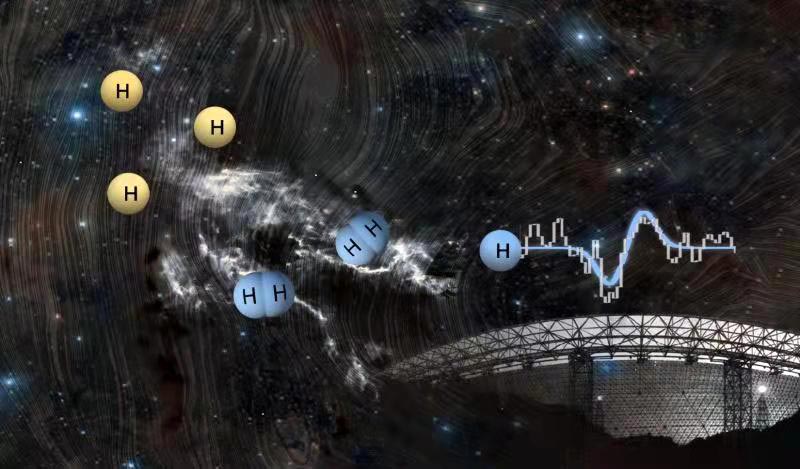
Researchers employing the FAST telescope have detected crucial magnetic field strengths in the L1544 molecular cloud using the HINSA technique. This discovery suggests the cloud is primed for collapse earlier than standard theories suggest, underscoring the significant role of magnetic fields in star formation.
Magnetic fields are the essential, but often “secret” ingredients of the interstellar medium and the process of making stars. The secrecy shrouding interstellar magnetic fields can be attributed to the lack of experimental probes.
While Michael Faraday was already probing the link between magnetism and electricity with coils in the early 19th century in the basement of the Royal Institution, astronomers nowadays still cannot deploy coils light-years away.
Using the Five-hundred-meter Aperture Spherical radio Telescope (FAST), an international team led by Dr. LI Di from National Astronomical Observatories of Chinese Academy of Sciences (NAOC) has obtained accurate magnetic field strength in molecular cloud L1544 — a region of the interstellar medium that seems ready to form stars.
Implementing HINSA Technique for Measuring Magnetic Fields
The team employed the so-called HI Narrow Self-Absorption (HINSA) technique, first conceived by LI Di and Paul Goldsmith based on Arecibo data in 2003. FAST’s sensitivity facilitated a clear detection of the HINSA’s Zeeman effect. The results suggest that such clouds achieve a supercritical state, i.e., are primed for collapse, earlier than standard models suggest.
“FAST’s design of focusing radio waves on a cable-driven cabin results in clean optics, which has been vital to the success of the HINSA Zeeman experiment,” said Dr. LI.
The study was published today (January 5, 2022) in the journal Nature.
Zeeman Effect in Interstellar Context
The Zeeman effect — the splitting of a spectral line into several components of frequency in the presence of a magnetic field — is the only direct probe of interstellar magnetic field strength. The interstellar Zeeman effect is small. The frequency shift originating in the relevant clouds is only a few billionths of the intrinsic frequencies of the emitting lines.
In 2003, the spectra of molecular clouds were found to contain an atomic-hydrogen feature called HINSA, which is produced by hydrogen atoms cooled through collisions with hydrogen molecules. Since this detection was made by the Arecibo telescope, the Zeeman effect for HINSA has been deemed a promising probe of the magnetic field in molecular clouds.
HINSA has a line strength 5–10 times higher than that of molecular tracers. HINSA also has a relatively strong response to magnetic fields and, unlike most molecular tracers, is robust against astrochemical variations.
FAST’s HINSA measurements put the magnetic field strength in L1544 at about 4 µGauss, i.e., 6 million times weaker than that of Earth. A combined analysis with quasar (active supermassive blackhole) absorption and hydroxyl emission also revealed a coherent magnetic field structure throughout the cold neutral medium, the molecular envelope, and the dense core, with similar orientation and magnitude.
Implications for Star Formation and Magnetic Field Dissipation
Therefore, the transition from magnetic subcriticality to supercriticality — i.e., when the field can and cannot support the cloud against gravity, respectively — occurs in the envelope instead of the core, in contrast with the conventional picture.
How the interstellar magnetic field dissipates to enable cloud collapse remains an unsolved problem in star formation. The main proposed solution has long been ambipolar diffusion — the decoupling of neutral particles from plasma — in cloud cores.
The coherence of the magnetic field revealed by the HINSA Zeeman effect means that dissipation of the field occurs during the formation of the molecular envelope, possibly through a different mechanism than ambipolar diffusion.
Reference: “An Early Transition to Magnetic Supercriticality in Star Formation” by T.-C. Ching, D. Li, C. Heiles, Z.-Y. Li, L. Qian, Y. L. Yue, J. Tang and S. H. Jiao, 5 January 2022, Nature.
DOI: 10.1038/s41586-021-04159-x
Never miss a breakthrough: Join the SciTechDaily newsletter.
Follow us on Google and Google News.
4 Comments
If this is a Filled-Aperture Radio Telescope, then wouldn’t a better acronym have been FART?
Filled-Aperture Radio Telescope is the type of telescope but the specific telescope is the Five-hundred-meter Aperture Spherical radio Telescope. So, it may be a FART but it is the FAST FART.
😂 🤣 Made me chuckle
We’ve been telling you knot heads for decades that this a Electric Magnetic Universe, not a gravity centric one. This is nothing new except still having to tell you ” You can’t have one without the other”. So this is a dumb article.