
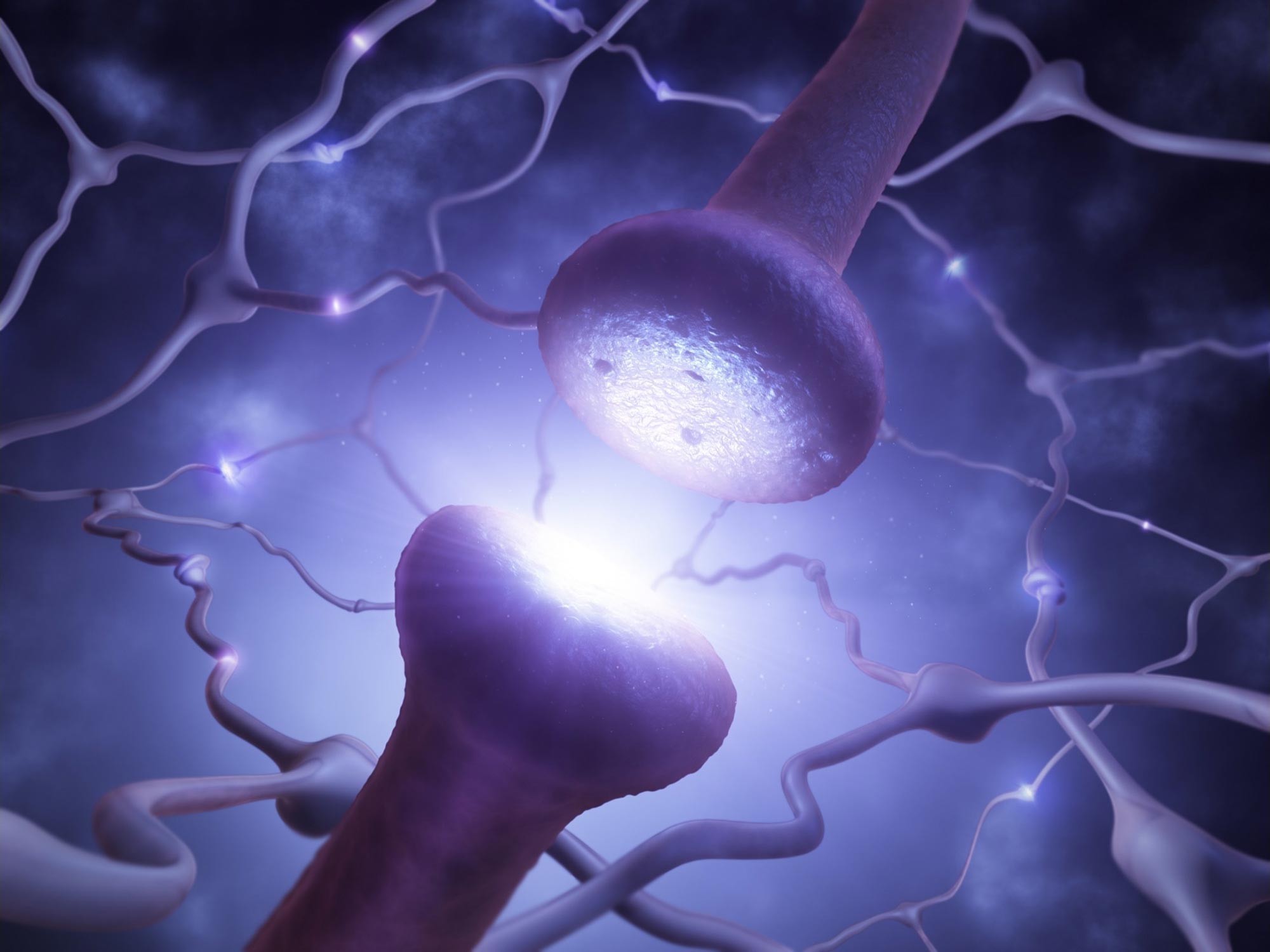
Researchers in optics and brain and cognitive science are investigating whether neurons can transmit light in a manner similar to fiber-optic communication channels.
Neurons, specialized cells in the brain and spinal cord that form the central nervous system, are known to communicate through electrical impulses. But scientists have found hints that neurons might also transmit light, a discovery that could significantly reshape our understanding of how the nervous system functions.
Researchers at the University of Rochester have launched a groundbreaking study to investigate whether living neurons can conduct light through their axons, the elongated, fiber-like extensions that resemble optical fibers. The project is supported by a three-year, $1.5 million grant from the John Templeton Foundation.
Searching for Evidence of Light in the Brain
“There are scientific papers offering indications that light transport could happen in neuron axons, but there’s still not clear experimental evidence,” says the principal investigator, Pablo Postigo, a professor at Rochester’s Institute of Optics. “Scientists have shown that there is ultra-weak photon emission in the brain, but no one understands why the light is there.”
If light is at play and scientists can understand why, it could have major implications for medically treating brain diseases and drastically change the way physicians heal the brain. But measuring optical transport between neurons would be no easy task.
A Technical Challenge
“A neuron’s axon is less than two microns wide, so if you want to measure the optical properties, you need to use nanophotonic techniques,” says Postigo. “If there is light transmission, it may happen with very tiny amounts of light, even a single photon at a time.”
Postigo, an expert in nanophotonics, will design probes that are able to interact optically with living neurons. He is partnering with Michel Telias, an assistant professor of ophthalmology and of neuroscience and a member of the Center for Visual Science, who specializes in measuring the electrical properties of neurons and their action potentials.
Using the photonic nanoprobes, the researchers will inject light into the neuron axon and detect the outcoming photons. If the neuron’s axon can transmit light, they will measure the light’s wavelengths and intensities.
The research was funded by the John Templeton Foundation.
Never miss a breakthrough: Join the SciTechDaily newsletter.
Follow us on Google and Google News.
6 Comments
Absurd. This would have been known many thousands of years ago if it had even a grain of truth.
Lol absurd, how would it have possibly been known thousands of years ago?
So, are these photons a part of the process or a by-product? The first answer would make them important; the second answer, less so.
They are a part of the process
https://doi.org/10.5281/zenodo.15251636
Robert Welch,
There are a number of possibilities that have been discussed in the literature. Three suggestion that photons may be involved in communication within the brain was suggested in 2016. Unlike some more recent literature the following article seems to have garnered more than a few citations
Kumar, Sourabh, et al. “Possible existence of optical communication channels in the brain.” Scientific reports 6.1 (2016): 36508.
https://www.nature.com/articles/srep36508
There has been the suggestion that in addition to communication they perform a function in repair.
In terms of information processing, like LLMs, they might serve a function in terms of backpropagation which iteratively adjusts weights involved in pattern recognition as the result of predictive errors. There has even been the recent suggestion in Physical Review E that myelin sheaths may generate entangled photon pairs that could serve to coordinate brain activity.
Please see:
Liu, Z., Chen, Y. C., & Ao, P. (2024). Entangled biphoton generation in the myelin sheath. Physical Review E, 110(2), 024402..
I believe some of the ideas in this area are certainly interesting, but as of yet I don’t think that there is a great deal of support for photons serving a biological or information-processing role in the brain. We will have to see where the evidence leads.
RIght!