

A molecular reinterpretation of Alice in Wonderland reveals an ancient protein with a surprising function.
In a groundbreaking discovery, researchers have found that an ancient protein still works even when its molecular structure is flipped like a reflection in a mirror. This rare and unexpected finding offers exciting new clues about how proteins that interact with DNA and RNA may have evolved.
A team of international scientists has revealed that a simple, ancient protein—used by all forms of life to attach to DNA and RNA—remains functional even when its “handedness” is reversed. This marks the first time a nucleic acid-binding protein has been shown to operate in what researchers call a “mirror world,” and it challenges long-standing beliefs about the strict one-way design of life’s molecular machinery.
The study, led by scientists at the Earth-Life Science Institute (ELSI) in Tokyo, in collaboration with researchers from the Hebrew University of Jerusalem and the Weizmann Institute of Science, found that this ancient protein motif is functionally “ambidextrous.” In other words, it can bind to both natural and mirror-image versions of DNA and RNA. This remarkable flexibility has never been seen before in proteins that interact with nucleic acids, and it opens a window into the early evolution of life on Earth.
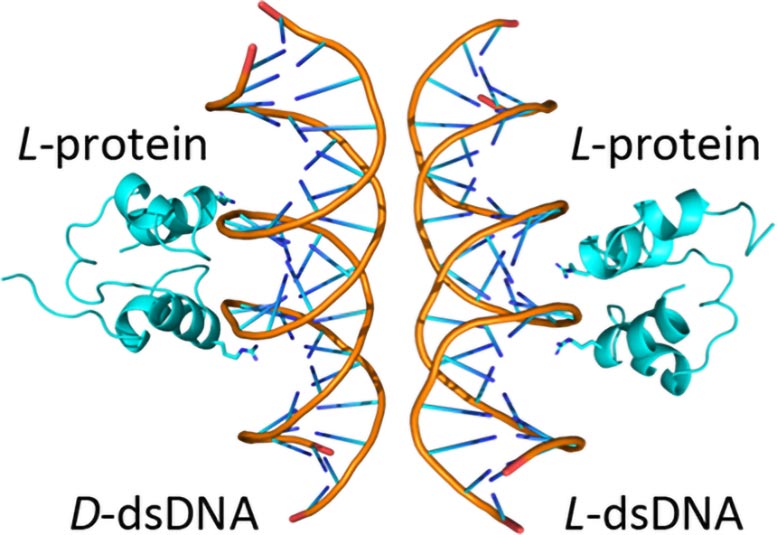
Like the human hand, many molecules exist in “right-handed” and “left-handed” forms that are mirror images of each other. Life on Earth has a strong preference for molecular handedness: proteins are made up of left-handed amino acids, while nucleic acids are made up of right-handed sugars. This phenomenon, called homochirality, is a fundamental feature of biology as we know it.
With few exceptions, flipping the handedness of a complex molecule causes it to fall out of step with Earth life and to stop functioning. It is kind of like Alice stepping through the looking glass into a world quite unlike her own. This fact has led to a long-standing view that mirror-image proteins cannot perform their normal biological function.
A Surprising Finding: Functional Ambidexterity
New research led by Prof. Liam M. Longo, Specially Appointed Associate Professor and Master’s student Tatsuya Corlett at ELSI, in collaboration with Prof. Norman Metanis and Dr. Orit Weil-Ktorza at the Hebrew University of Jerusalem and Prof. Yaakov (Koby) Levy, PhD. Student Segev Naveh-Tassa, Dr. Yael Fridmann-Sirkis, Dr. Dragana Despotović, and Dr. Kesava Phaneendra Cherukuri at the Weizmann Institute of Science, has challenged this assumption.
In the study, published in the journal Angewandte Chemie, the researchers reported that a primordial and widely conserved protein structure called the helix-hairpin-helix (HhH) motif is capable of functioning in both left- and right-handed forms.
In its natural state, the HhH motif binds to DNA and RNA. Surprisingly, the researchers found that a chemically synthesized mirror image of the motif is also functional—a phenomenon the authors refer to as functional ambidexterity. In simple terms, the HhH motif is like a glove that fits snuggly on both hands. No such nucleic-acid binding protein has been reported before.
Testing and Simulation: Unexpected Similarities
Double-stranded DNA has a right-handed twist, so the reasonable expectation was that a mirror-image protein would be unable to bind.
“I was looking at the motif – just playing around on the computer – and I suddenly thought: This motif can bind mirror-DNA!” said Longo. “It was a crazy idea,” said Metanis, a peptide chemist, ‘but the more we looked at the structure, the more we thought that maybe we were on to something.” To investigate whether the mirrored HhH motif-containing proteins bind to double-stranded DNA, they synthesized the mirror-image protein and measured its binding in the lab. Sure enough, binding was detected.
But was binding of the mirror-image protein similar to the natural protein? To test this, the researchers analyzed the kinetics of un-binding, as well as the effect of several mutations. And both approaches suggested surprising similarities.
Encouraged by these results, Longo reached out to Levy, a computational chemist who could use molecular simulations to paint a detailed molecular picture of the binding process. What the researchers found surprised them: Although there were differences in how the natural and mirror-image proteins bound to DNA, similar regions of the protein were responsible for binding in each case. In other words, these two binding modes were linked to each other at the molecular level.
This study is an exciting first example of ambidextrous proteins binding to nucleic acids, and raises more questions than it answers. What forces caused this protein to be ambidextrous in the first place? “We still don’t know,” says Metanis. “Perhaps it reflects the need for this domain to bind multiple types of DNA structures, or to slide along the DNA molecule.” Or, perhaps it is pointing to an even greater evolutionary mystery: “The most intriguing explanation is that functional ambidexterity was once under selective pressure, perhaps due to ancient mirror-image life!” said Longo with a smile. But the authors caution that we are still a long way away from being able to draw such provocative conclusions. For now, the hunt for other ambidextrous proteins begins!
Never miss a breakthrough: Join the SciTechDaily newsletter.
Follow us on Google and Google News.