
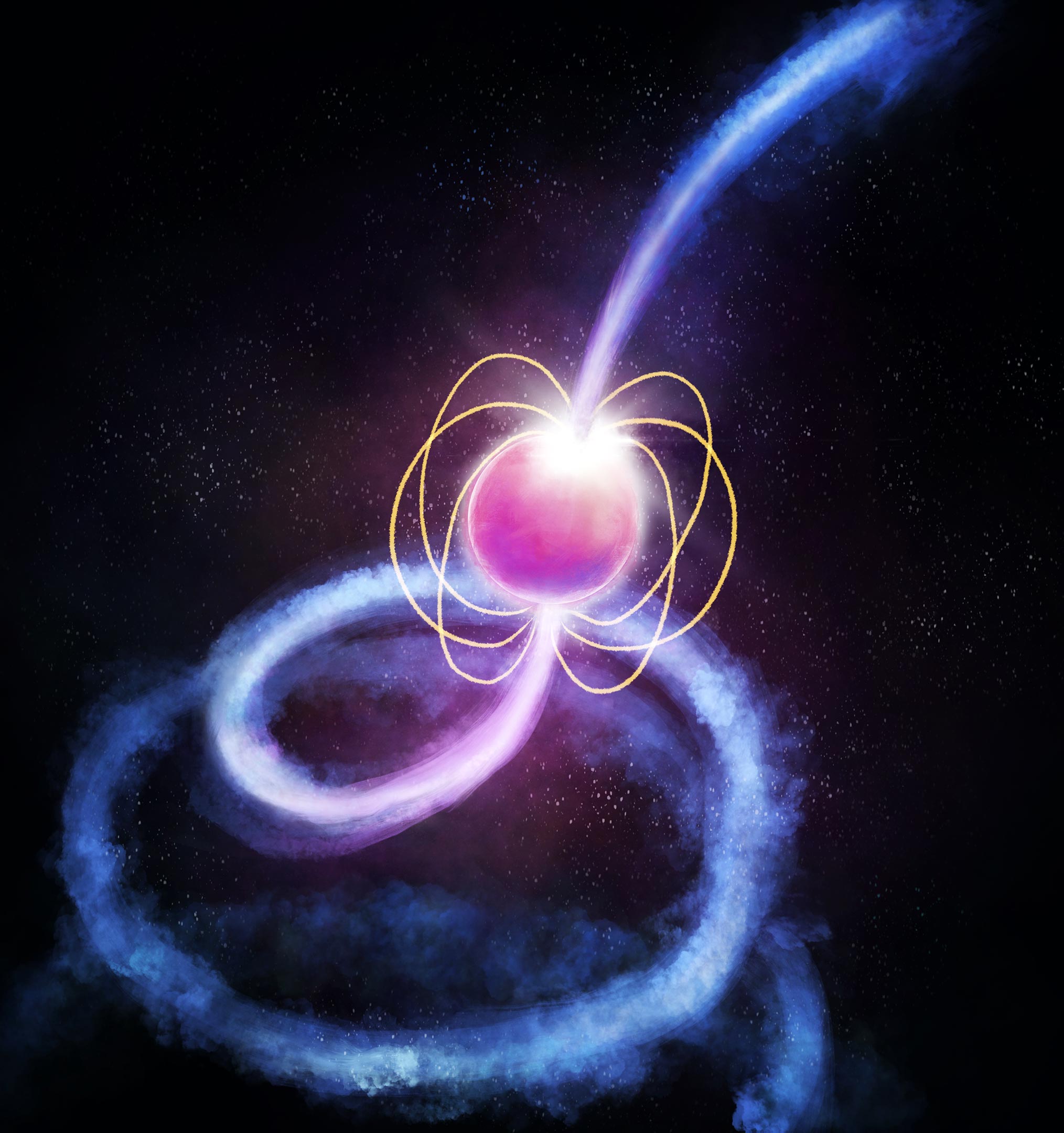
A new pulsar found using the MWA telescope hints at a wealth of undiscovered neutron stars.
Astronomers have discovered a pulsar—a dense and rapidly spinning neutron star sending radio waves into the cosmos—using a low-frequency radio telescope in outback Australia.
The pulsar was detected with the Murchison Widefield Array (MWA) telescope, in Western Australia’s remote Mid-West region.
It’s the first time scientists have discovered a pulsar with the MWA but they believe it will be the first of many.
The finding is a sign of things to come from the multi-billion-dollar Square Kilometer Array (SKA) telescope. The MWA is a precursor telescope for the SKA.
Nick Swainston, a PhD student at the Curtin University node of the International Center for Radio Astronomy Research (ICRAR), made the discovery while processing data collected as part of an ongoing pulsar survey.
“Pulsars are born as a result of supernovae—when a massive star explodes and dies, it can leave behind a collapsed core known as a neutron star,” he said. “They’re about one and a half times the mass of the Sun, but all squeezed within only 20 kilometers, and they have ultra-strong magnetic fields.”
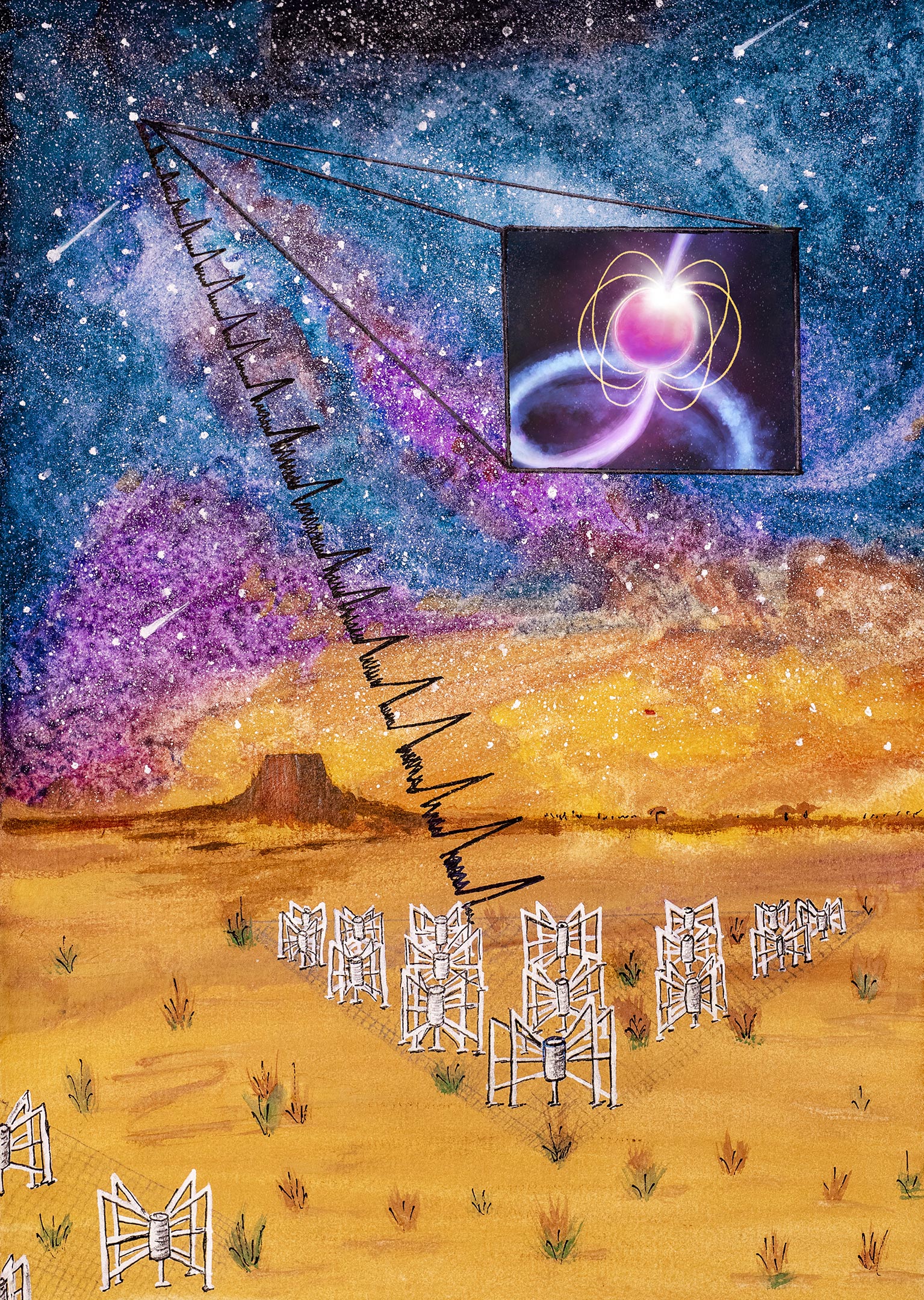
Mr. Swainston said pulsars spin rapidly and emit electromagnetic radiation from their magnetic poles.
“Every time that emission sweeps across our line of sight, we see a pulse—that’s why we call them pulsars,” he said. “You can imagine it like a giant cosmic lighthouse.”
ICRAR-Curtin astronomer Dr. Ramesh Bhat said the newly discovered pulsar is located more than 3000 light-years from Earth and spins about once every second.
“That’s incredibly fast compared to regular stars and planets,” he said. “But in the world of pulsars, it’s pretty normal.”
Pulsar Survey Potential
Dr. Bhat said the finding was made using about one percent of the large volume of data collected for the pulsar survey.
“We’ve only scratched the surface,” he said. “When we do this project at full-scale, we should find hundreds of pulsars in the coming years.”
Pulsars are used by astronomers for several applications including testing the laws of physics under extreme conditions.
“A spoonful of material from a neutron star would weigh millions of tonnes,” Dr. Bhat said.
“Their magnetic fields are some of the strongest in the Universe—about 1000 billion times stronger than that we have on Earth.”
“So we can use them to do physics that we can’t do in any of the Earth-based laboratories.”

Finding pulsars and using them for extreme physics is also a key science driver for the SKA telescope.
MWA Director Professor Steven Tingay said the discovery hints at a large population of pulsars awaiting discovery in the Southern Hemisphere.
“This finding is really exciting because the data processing is incredibly challenging, and the results show the potential for us to discover many more pulsars with the MWA and the low-frequency part of the SKA.”
“The study of pulsars is one of the headline areas of science for the multi-billion-dollar SKA, so it is great that our team is at the forefront of this work,” he said.
Reference: “Discovery of a Steep-spectrum Low-luminosity Pulsar with the Murchison Widefield Array” by N. A. Swainston, N. D. R. Bhat, M. Sokolowski, S. J. McSweeney, S. Kudale, S. Dai, K. R. Smith, I. S. Morrison, R. M. Shannon, W. van Straten, M. Xue, S. M. Ord, S. E. Tremblay, B. W. Meyers, A. Williams, G. Sleap, M. Johnston-Hollitt, D. L. Kaplan, S. J. Tingay and R. B. Wayth, 21 April 2021, The Astrophysical Journal Letters.
DOI: 10.3847/2041-8213/abec7b
Never miss a breakthrough: Join the SciTechDaily newsletter.
Follow us on Google and Google News.
1 Comment
In space-time Pulsers aŕe created and their magnetic fields correspond añd represent to the set of all the neutron stars (neutròn star-black hoĺès) present near by in order Space-Time to.This order foĺlows strength of magnetic fields,mass like parameters,distance of different neutron stars is anòther parameter.Ofcourse,set of supernova and large srars to become supernòva arranged in right order in space-time related with before mentioned parameters govern the pulses.Other set of governiñg bodies are the Black holes pesentin in simillar order and parameters for each puĺsars.Different kinds of pulsers can also possibĺe.