
Close Menu
    Facebook X (Twitter) Instagram
    SciTechDaily
    • Biology
    • Chemistry
    • Earth
    • Health
    • Physics
    • Science
    • Space
    • Technology
    Facebook X (Twitter) Pinterest YouTube RSS
    SciTechDaily
    Home»Space»Astronomers See a “Space Jellyfish” – Stunning Cosmic Phenomenon
    Space

    Astronomers See a “Space Jellyfish” – Stunning Cosmic Phenomenon

    By International Centre for Radio Astronomy ResearchApril 3, 20213 Comments4 Mins Read
    Facebook Twitter Pinterest Telegram LinkedIn WhatsApp Email Reddit
    Share
    Facebook Twitter LinkedIn Pinterest Telegram Email Reddit
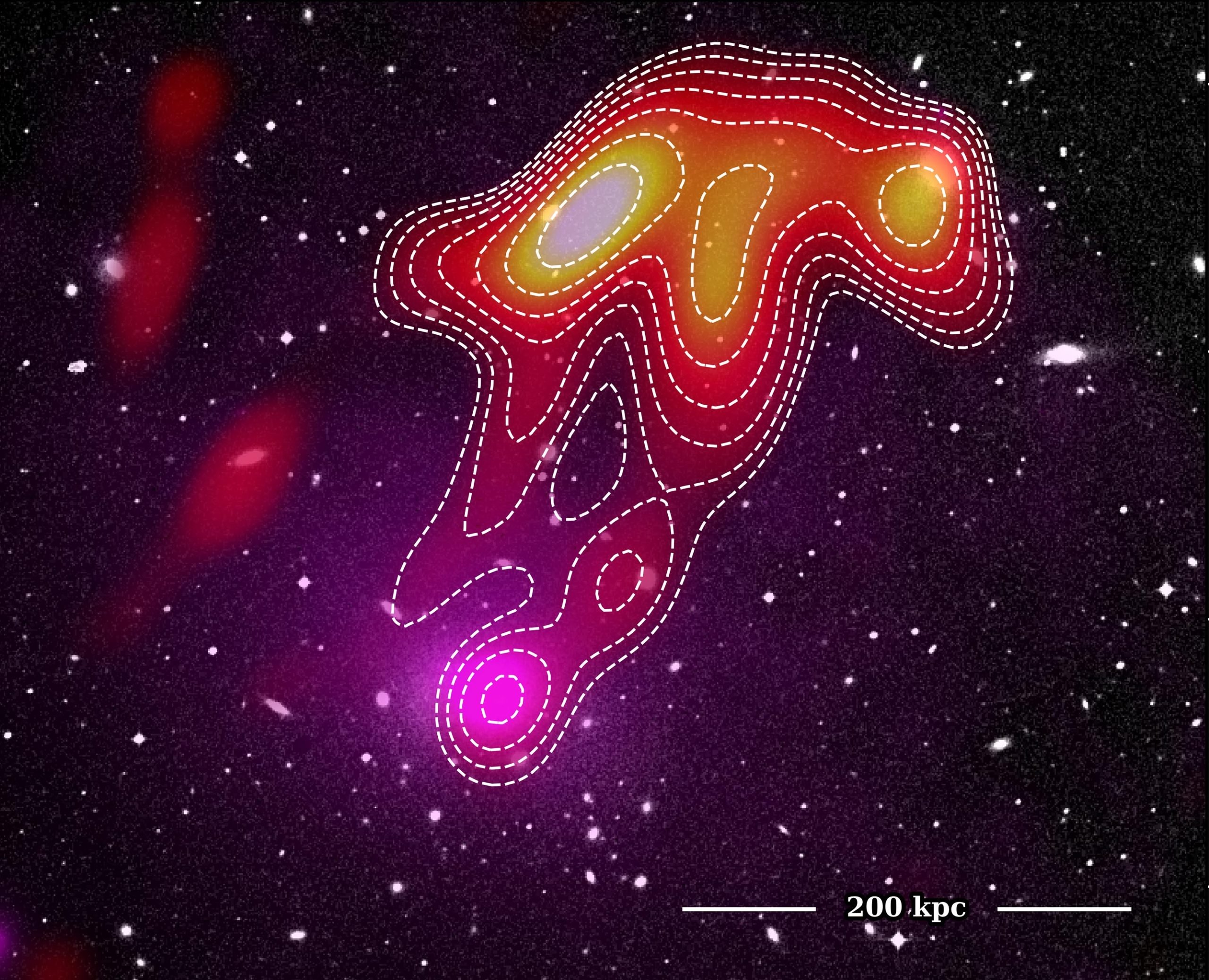
    USS Jellyfish in Abell 2877
    A composite image of the USS Jellyfish in Abell 2877 showing the optical Digitised Sky Survey (background) with XMM X-ray data (magenta overlay) and MWA 118 MHz radio data (red-yellow overlay). Credit: Torrance Hodgson, ICRAR/Curtin University

    A Cosmic Jellyfish Emerges in Deep Space

    A radio telescope located in outback Western Australia has observed a cosmic phenomenon with a striking resemblance to a jellyfish.

    Published today in The Astrophysical Journal, an Australian-Italian team used the Murchison Widefield Array (MWA) telescope to observe a cluster of galaxies known as Abell 2877.

    Lead author and PhD candidate Torrance Hodgson, from the Curtin University node of the International Center for Radio Astronomy Research (ICRAR) in Perth, said the team observed the cluster for 12 hours at five radio frequencies between 87.5 and 215.5 megahertz.

    “We looked at the data, and as we turned down the frequency, we saw a ghostly jellyfish-like structure begin to emerge,” he said.

    A Record-Breaking Steep Radio Spectrum

    “This radio jellyfish holds a world record of sorts. Whilst it’s bright at regular FM radio frequencies, at 200 MHz the emission all but disappears.

    MWA Tile 107 Outlier
    Tile 107, or “the Outlier” as it is known, is one of 256 tiles of the MWA located 1.5km from the core of the telescope. The MWA is a precursor instrument to the SKA. Credit: Pete Wheeler, ICRAR

    “No other extragalactic emission like this has been observed to disappear anywhere near so rapidly.”

    This uniquely steep spectrum has been challenging to explain. “We’ve had to undertake some cosmic archaeology to understand the ancient background story of the jellyfish,” said Hodgson.

    “Our working theory is that around 2 billion years ago, a handful of supermassive black holes from multiple galaxies spewed out powerful jets of plasma. This plasma faded, went quiet, and lay dormant.

    Dormant Black Hole Jets Reignite

    “Then quite recently, two things happened—the plasma started mixing at the same time as very gentle shock waves passed through the system.

    “This has briefly reignited the plasma, lighting up the jellyfish and its tentacles for us to see.”
    The jellyfish is over a third of the Moon’s diameter when observed from Earth, but can only be seen with low-frequency radio telescopes.
    “Most radio telescopes can’t achieve observations this low due to their design or location,” said Hodgson.

    The MWA—a precursor to the Square Kilometer Array (SKA)—is located at CSIRO’s Murchison Radio-astronomy Observatory in remote Western Australia.

    The site has been chosen to host the low-frequency antennas for the SKA, with construction scheduled to begin in less than a year.

    SKA-Low Telescope in Western Australia
    Composite image of the SKA-Low telescope in Western Australia. The image blends a real photo (on the left) of the SKA-Low prototype station AAVS2.0 which is already on site, with an artists impression of the future SKA-Low stations as they will look when constructed. These dipole antennas, which will number in their hundreds of thousands, will survey the radio sky in frequencies as low at 50Mhz. Credit: ICRAR and SKAO

    Professor Johnston-Hollitt, Mr. Hodgson’s supervisor and co-author, said the SKA will give us an unparalleled view of the low-frequency Universe.

    “The SKA will be thousands of times more sensitive and have much better resolution than the MWA, so there may be many other mysterious radio jellyfish waiting to be discovered once it’s operational.

    “We’re about to build an instrument to make a high resolution, fast frame-rate movie of the evolving radio Universe. It will show us from the first stars and galaxies through to the present day,” she said.

    “Discoveries like the jellyfish only hint at what’s to come, it’s an exciting time for anyone seeking answers to fundamental questions about the cosmos.”

    Reference: “Ultra-Steep Spectrum Radio Jellyfish Uncovered in Abell 2877” by Torrance Hodgson, Iacopo Bartalucci, Melanie Johnston-Hollitt, Benjamin McKinley, Franco Vazza and Denis Wittor, 17 March 2021, The Astrophysical Journal.
    DOI: 10.3847/1538-4357/abe384

    Never miss a breakthrough: Join the SciTechDaily newsletter.
    Follow us on Google and Google News.

    Astronomy Astrophysics International Centre for Radio Astronomy Research Murchison Widefield Array Popular
    Share. Facebook Twitter Pinterest LinkedIn Email Reddit

    Related Articles

    Astronomers Discover 49 New Galaxies in Under Three Hours

    Astronomers Discover Mysterious Object in Our “Galactic Backyard” – Unlike Anything Seen Before

    Astronomers Capture Supermassive Black Hole Eruption Near Earth Spanning 16 Times the Full Moon in the Sky

    Dense, Spinning, Dead Star Discovered by Outback Radio Telescope

    First Black Hole Ever Detected – Cygnus X-1 – Is Much More Massive Than We Thought

    Testing Whether Einstein’s Theory of General Relativity Is Right With a Record-Breaking Laser Link

    Astronomers Turn Up the Heavy Metal to Shed Light on Star Formation – “It’s Absolutely Mind-Blowing Stuff”

    Massive Hunt for Extraterrestrial Life Completed: What Astronomers Found in Search of 10 Million Star Systems for Alien Technology

    Biggest Explosion in the History of the Universe Detected by Astronomers – “Really, Really Massive”

    3 Comments

    1. xABBAAA on April 4, 2021 12:14 am

      … I wonder if entanglement and Schrödinger’s equation could give some signals coming from the place where the star is now, or where it was, but not where it is observed by its late light…

      Reply
    2. Madhu on April 4, 2021 2:38 pm

      Jelly fish like body moving around my site last year. We have pics of them but no one believed and disc shape like aircraft also seen in pic.

      Reply
    3. Dov I Elyada on April 5, 2021 7:44 am

      I’m disappointed with SciTechDaily for making such a big fuss over the jellyfish resemblance of the object discussed. That’s not unlike attributing oncological significance to the Cancer constellation, and that’s unlike science. I’ve been so far satisfied with your coverage—please keep it up.

      Reply
    Leave A Reply Cancel Reply

    • Facebook
    • Twitter
    • Pinterest
    • YouTube

    Don't Miss a Discovery

    Subscribe for the Latest in Science & Tech!

    Trending News

    Scientists Discover How Coffee Impacts Memory, Mood, and Gut Health

    Why Did the Neanderthals Disappear? Scientists Reveal Humans Had a Hidden Advantage

    Physicists Propose Strange Experiment Where Time Goes Quantum

    Magnesium Magic: New Drug Melts Fat Even on a High-Fat, High-Sugar Diet

    Weight-Loss Drugs Like Ozempic May Come With an Unexpected Cost

    Mezcal “Worm” in a Bottle Mystery: DNA Testing Reveals a Surprise

    New Research Reveals That Your Morning Coffee Activates an Ancient Longevity Switch

    This Is What Makes You Irresistible to Mosquitoes

    Follow SciTechDaily
    • Facebook
    • Twitter
    • YouTube
    • Pinterest
    • Newsletter
    • RSS
    SciTech News
    • Biology News
    • Chemistry News
    • Earth News
    • Health News
    • Physics News
    • Science News
    • Space News
    • Technology News
    Recent Posts
    • Harvard Scientists Reveal Secret Structure Behind How You Smell
    • Scientists Just Discovered the Hidden Trick That Keeps Your Cells Alive
    • This Simple Movement Could Be Secretly Cleaning Your Brain
    • Male Birth Control Breakthrough: Scientists Find Way To Turn Sperm Production Off and Back On
    • A Common Vitamin Could Hold the Key to Treating Fatty Liver Disease
    Copyright © 1998 - 2026 SciTechDaily. All Rights Reserved.
    • Science News
    • About
    • Contact
    • Editorial Board
    • Privacy Policy
    • Terms of Use

    Type above and press Enter to search. Press Esc to cancel.