
Close Menu
    Facebook X (Twitter) Instagram
    SciTechDaily
    • Biology
    • Chemistry
    • Earth
    • Health
    • Physics
    • Science
    • Space
    • Technology
    Facebook X (Twitter) Pinterest YouTube RSS
    SciTechDaily
    Home»Space»Biggest Explosion in the History of the Universe Detected by Astronomers – “Really, Really Massive”
    Space

    Biggest Explosion in the History of the Universe Detected by Astronomers – “Really, Really Massive”

    By International Centre for Radio Astronomy ResearchFebruary 27, 20201 Comment4 Mins Read
    Facebook Twitter Pinterest Telegram LinkedIn WhatsApp Email Reddit
    Share
    Facebook Twitter LinkedIn Pinterest Telegram Email Reddit
    Biggest Explosion in the History of the Universe
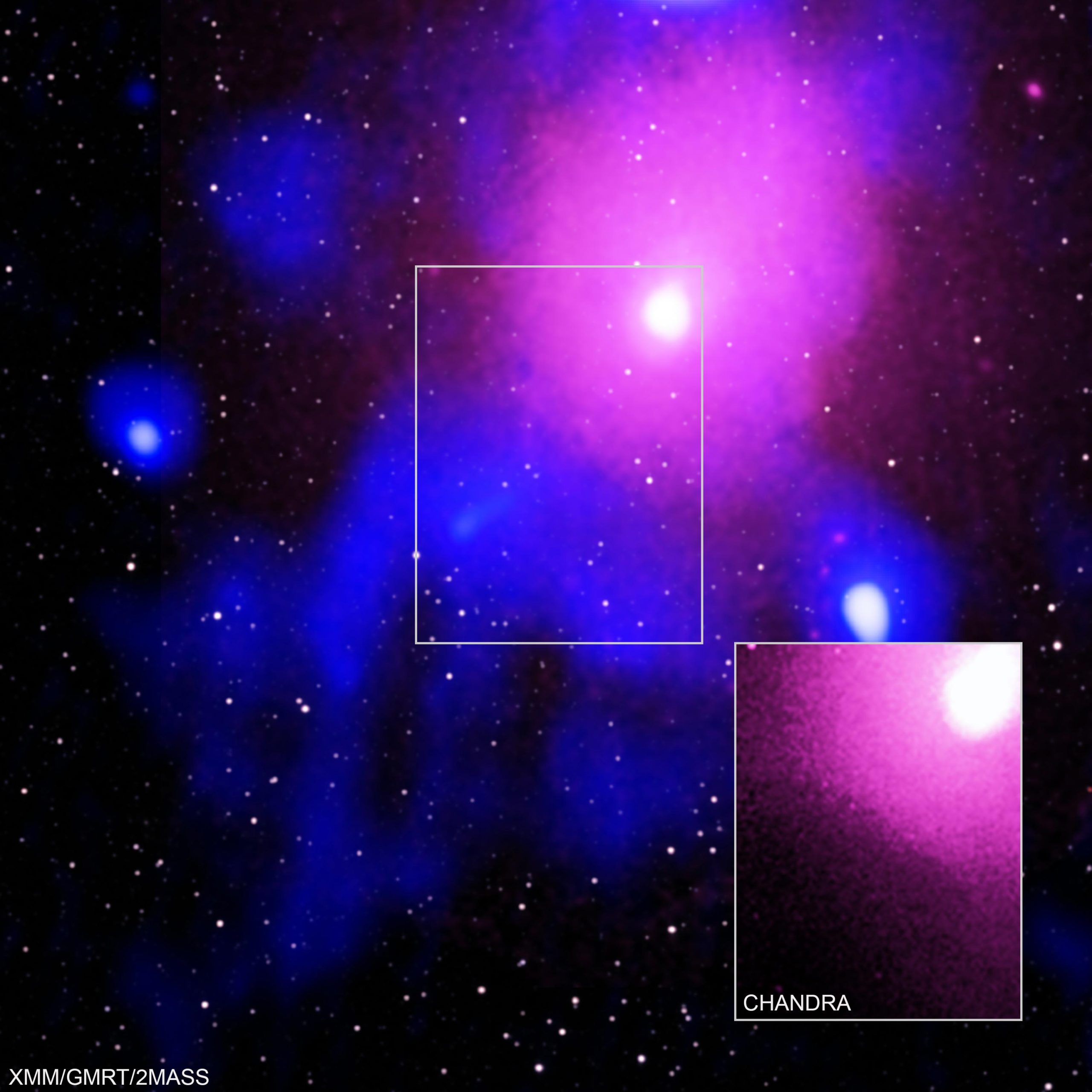
    This extremely powerful eruption occurred in the Ophiuchus galaxy cluster, which is located about 390 million light-years from Earth. Galaxy clusters are the largest structures in the Universe held together by gravity, containing thousands of individual galaxies, dark matter, and hot gas. Credit: X-ray: NASA/CXC/Naval Research Lab/Giacintucci, S.; XMM:ESA/XMM; Radio: NCRA/TIFR/GMRTN; Infrared: 2MASS/UMass/IPAC-Caltech/NASA/NSF

    Scientists studying a distant galaxy cluster have discovered the biggest explosion seen in the Universe since the Big Bang.

    The blast came from a supermassive black hole at the center of a galaxy hundreds of millions of light-years away. It released five times more energy than the previous record holder.

    Professor Melanie Johnston-Hollitt, from the Curtin University node of the International Center for Radio Astronomy Research, said the event was extraordinarily energetic.

    “We’ve seen outbursts in the centers of galaxies before but this one is really, really massive,” she said. “And we don’t know why it’s so big. But it happened very slowly — like an explosion in slow motion that took place over hundreds of millions of years.”
    Ophiuchus Galaxy Cluster
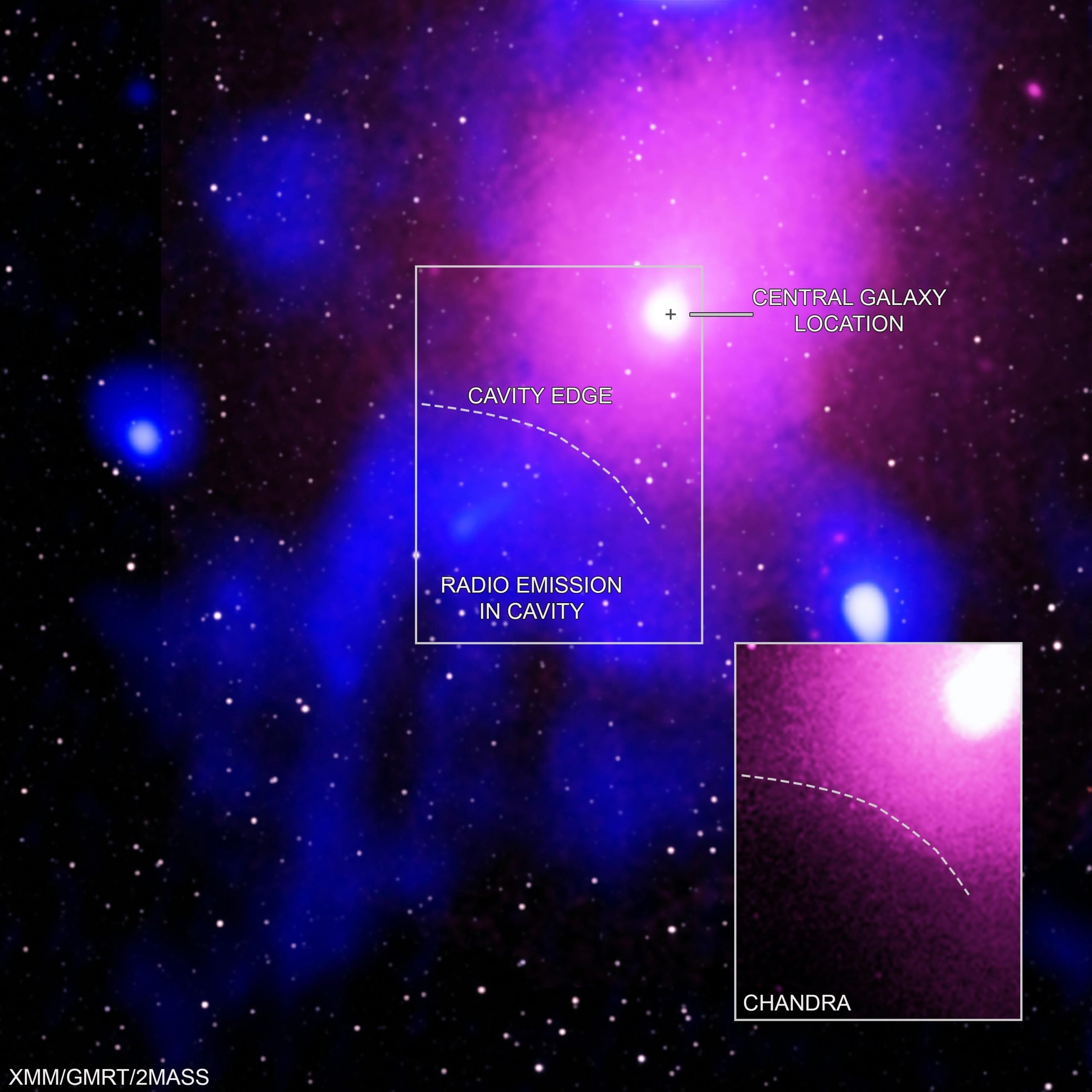
    This extremely powerful eruption occurred in the Ophiuchus galaxy cluster, which is located about 390 million light-years from Earth. Galaxy clusters are the largest structures in the Universe held together by gravity, containing thousands of individual galaxies, dark matter, and hot gas. Credit: X-ray: NASA/CXC/Naval Research Lab/Giacintucci, S.; XMM:ESA/XMM; Radio: NCRA/TIFR/GMRTN; Infrared: 2MASS/UMass/IPAC-Caltech/NASA/NSF

    The explosion occurred in the Ophiuchus galaxy cluster, about 390 million light-years from Earth.

    It was so powerful it punched a cavity in the cluster plasma — the super-hot gas surrounding the black hole.

    Lead author of the study Dr. Simona Giacintucci, from the Naval Research Laboratory in the United States, said the blast was similar to the 1980 eruption of Mount St. Helens, which ripped the top off the mountain.

    MWA Tile 107 Outlier
    Tile 107, or “the Outlier” as it is known, is one of 256 tiles of the MWA, located 1.5km from the core of the telescope. Lighting the tile and the ancient landscape is the Moon. Credit: Pete Wheeler, ICRAR

    “The difference is that you could fit 15 Milky Way galaxies in a row into the crater this eruption punched into the cluster’s hot gas,” she said.

    Professor Johnston-Hollitt said the cavity in the cluster plasma had been seen previously with X-ray telescopes.

    But scientists initially dismissed the idea that it could have been caused by an energetic outburst, because it would have been too big.

    “People were skeptical because of the size of the outburst,” she said. “But it really is that. The Universe is a weird place.”

    The researchers only realized what they had discovered when they looked at the Ophiuchus galaxy cluster with radio telescopes.

    “The radio data fit inside the X-rays like a hand in a glove,” said co-author Dr. Maxim Markevitch, from NASA’s Goddard Space Flight Center. “This is the clincher that tells us an eruption of unprecedented size occurred here.”

    The discovery was made using four telescopes; NASA’s Chandra X-ray Observatory, ESA’s XMM-Newton, the Murchison Widefield Array (MWA) in Western Australia, and the Giant Metrewave Radio Telescope (GMRT) in India.

    Professor Johnston-Hollitt, who is the director of the MWA and an expert in galaxy clusters, likened the finding to discovering the first dinosaur bones.

    “It’s a bit like archaeology,” she said. “We’ve been given the tools to dig deeper with low-frequency radio telescopes so we should be able to find more outbursts like this now.”

    The finding underscores the importance of studying the Universe at different wavelengths, Professor Johnston-Hollitt said.

    “Going back and doing a multi-wavelength study has really made the difference here,” she said.

    Professor Johnston-Hollitt said the finding is likely to be the first of many. “We made this discovery with Phase 1 of the MWA, when the telescope had 2048 antennas pointed towards the sky,” she said.”We’re soon going to be gathering observations with 4096 antennas, which should be ten times more sensitive.”

    “I think that’s pretty exciting.”

    Read Record-Breaking, Gargantuan Black Hole Eruption for more on this discovery.

    Reference: “Discovery of a Giant Radio Fossil in the Ophiuchus Galaxy Cluster” by S. Giacintucci, M. Markevitch, M. Johnston-Hollitt, D. R. Wik, Q. H. S. Wang and T. E. Clarke, 27 February 2020, The Astrophysical Journal.
    DOI: 10.3847/1538-4357/ab6a9d
    arXiv: 2002.01291

    Never miss a breakthrough: Join the SciTechDaily newsletter.
    Follow us on Google and Google News.

    Astronomy Astrophysics Black Hole International Centre for Radio Astronomy Research Popular
    Share. Facebook Twitter Pinterest LinkedIn Email Reddit

    Related Articles

    Astronomers Capture Supermassive Black Hole Eruption Near Earth Spanning 16 Times the Full Moon in the Sky

    First Black Hole Ever Detected – Cygnus X-1 – Is Much More Massive Than We Thought

    Ripples in the Fabric of Space and Time Offer New Clues to the Shape of Black Holes

    “Echo Mapping” Light Bursts From Supermassive Black Holes in Faraway Galaxies to Measure Vast Cosmic Distances

    Einstein’s Theory of General Relativity Tested Using Black Hole Shadow

    Galaxies Trapped in the Web of a Supermassive Black Hole – Cosmic “Spider’s Web” of Gas Extends Over 300 Times the Size of the Milky Way

    Event Horizon Telescope Reveals Turbulent Black Hole Evolution: Wobbling Shadow of the M87 Black Hole

    Cosmic X-Rays Reveal a Distinctive Signature of Black Hole Event Horizons

    Massive Hunt for Extraterrestrial Life Completed: What Astronomers Found in Search of 10 Million Star Systems for Alien Technology

    1 Comment

    1. Gadfly Giznot on February 27, 2020 6:51 pm

      When in doubt, just say a black hole did it. No real evidence needed. It’s really amazing how these guys attribute pretty much everything they encounter in the universe to undetectable supernatural forces, oh, and call it science of all things.

      Reply
    Leave A Reply Cancel Reply

    • Facebook
    • Twitter
    • Pinterest
    • YouTube

    Don't Miss a Discovery

    Subscribe for the Latest in Science & Tech!

    Trending News

    289-Million-Year-Old Reptile Mummy Reveals Origin of Human Breathing System

    New Brain Discovery Challenges Long-Held Theory of Teenage Brain Development

    Scientists Discover Plants “Scream” – We Just Couldn’t Hear Them Until Now

    Scientists Discover a Surprising Reason Intermittent Fasting Extends Life

    This Simple Fruit Wash Could Make Produce Safer and Last Days Longer

    Scientists Say Adding This Unusual Seafood to Your Diet Could Reverse Signs of Aging

    Scientists Say a Hidden Structure May Exist Inside Earth’s Core

    Doctors Surprised by the Power of a Simple Drug Against Colon Cancer

    Follow SciTechDaily
    • Facebook
    • Twitter
    • YouTube
    • Pinterest
    • Newsletter
    • RSS
    SciTech News
    • Biology News
    • Chemistry News
    • Earth News
    • Health News
    • Physics News
    • Science News
    • Space News
    • Technology News
    Recent Posts
    • Scientists Just Discovered Light Can Actually Slow Plant Growth
    • Scientists Finally Solved One of Water’s Biggest Mysteries
    • 7,000-Year-Old DNA Rewrites the Story of the “Neolithic Revolution”
    • Missing Medieval Relic of Legendary English King Found After Being Missing for 40 Years
    • New Study Challenges Long-Held Assumptions About Cancer and Aging
    Copyright © 1998 - 2026 SciTechDaily. All Rights Reserved.
    • Science News
    • About
    • Contact
    • Editorial Board
    • Privacy Policy
    • Terms of Use

    Type above and press Enter to search. Press Esc to cancel.