
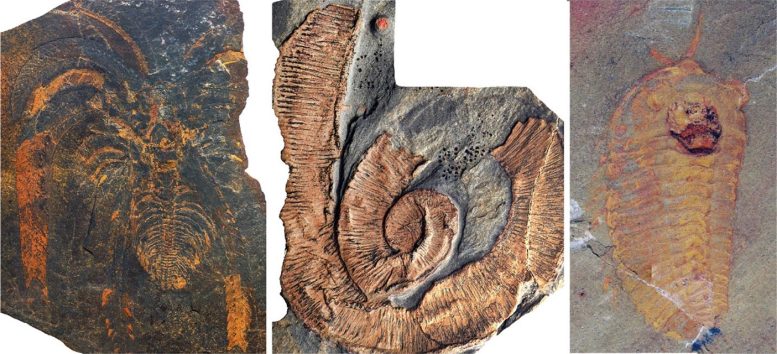
New fossil site in Taichoute, Morocco, suggests giant arthropods, up to 2 meters long, dominated the seas 470 million years ago. The site offers new insights into the Fezouata Biota and early life on Earth.
A new fossil site in Taichoute, Morocco, reveals that giant arthropods dominated the seas 470 million years ago. The site, part of the wider Fezouata Biota, contains numerous large free-swimming arthropods, some potentially up to 2 meters long. The findings are distinct from other previously studied Fezouata Shale sites and offer new insights into paleontological and ecological research. The Fezouata Shale has been recognized as one of the 100 most important geological sites worldwide for understanding evolution during the Early Ordovician period.
Discoveries at a major new fossil site in Morocco suggest giant arthropods – relatives of modern creatures including shrimps, insects, and spiders – dominated the seas 470 million years ago.
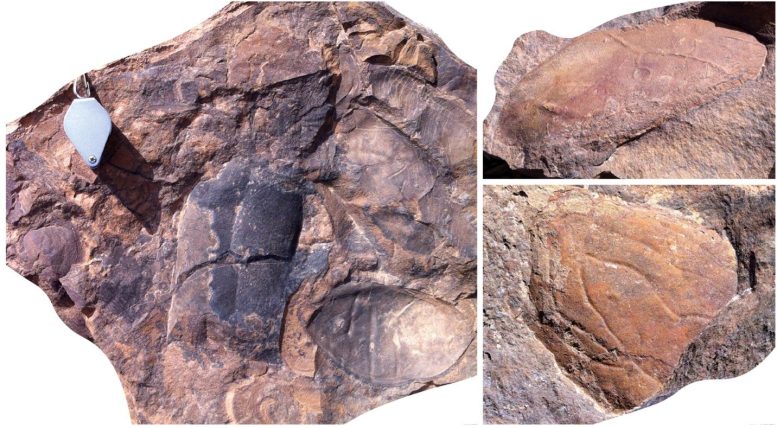
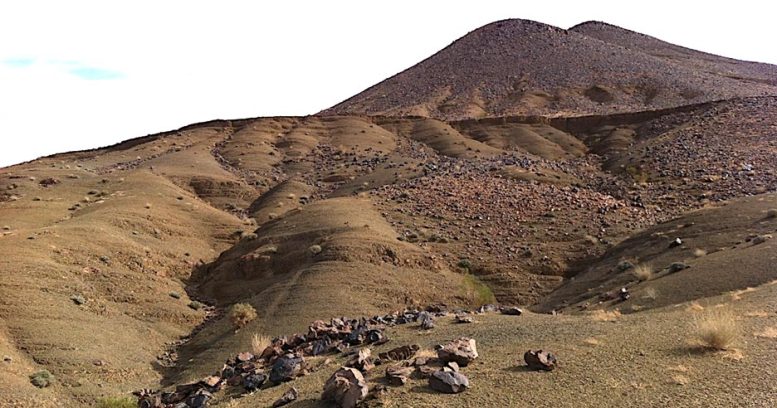
Early evidence from the site at Taichoute, once undersea but now a desert, records numerous large “free-swimming” arthropods.
Giant Arthropods of the Early Ordovician Period
More research is needed to analyze these fragments, but based on previously described specimens, the giant arthropods could be up to 2 meters (6.5 feet) long.
An international research team says the site and its fossil record are very different from other previously described and studied Fezouata Shale sites from 80 km (50 mi) away.
They say Taichoute (considered part of the wider “Fezouata Biota”) opens new avenues for paleontological and ecological research.
“Everything is new about this locality – its sedimentology, paleontology, and even the preservation of fossils – further highlighting the importance of the Fezouata Biota in completing our understanding of past life on Earth,” said lead author Dr. Farid Saleh, from the University of Lausanne and Yunnan University.
Dr. Xiaoya Ma, from the University of Exeter and Yunnan University, added: “While the giant arthropods we discovered have not yet been fully identified, some may belong to previously described species of the Fezouata Biota, and some will certainly be new species.
“Nevertheless, their large size and free-swimming lifestyle suggest they played a unique role in these ecosystems.”
Exceptional Preservation of Fossilized Life Forms
The Fezouata Shale was recently selected as one of the 100 most important geological sites worldwide because of its importance for understanding the evolution during the Early Ordovician period, about 470 million years ago.
Fossils discovered in these rocks include mineralized elements (eg shells), but some also show exceptional preservation of soft parts such as internal organs, allowing scientists to investigate the anatomy of early animal life on Earth.
Animals of the Fezouata Shale, in Morocco’s Zagora region, lived in a shallow sea that experienced repeated storm and wave activities, which buried the animal communities and preserved them in place as exceptional fossils.
However, nektonic (or free-swimming) animals remain a relatively minor component overall in the Fezouata Biota.
The new study reports the discovery of the Taichoute fossils, preserved in sediments that are a few million years younger than those from the Zagora area and are dominated by fragments of giant arthropods.
Arthropods are a large group of invertebrate animals that includes insects, spiders, crustaceans, and related organisms. They are characterized by their jointed limbs and cuticle made of chitin, often mineralized with calcium carbonate. Arthropods are also known for their segmented bodies, which are organized into distinct parts, such as the head, thorax, and abdomen seen in insects. They have a hard exoskeleton that provides protection and support, which they must molt in order to grow. With more than a million described species, arthropods make up over 80% of all known living animal species, making them the most diverse group of animals on the planet.
Contributions to Ecology and Evolutionary Understanding
“Carcasses were transported to a relatively deep marine environment by underwater landslides, which contrasts with previous discoveries of carcass preservation in shallower settings, which were buried in place by storm deposits,” said Dr. Romain Vaucher, from the University of Lausanne.
Professor Allison Daley, also from the University of Lausanne, added: “Animals such as brachiopods are found attached to some arthropod fragments, indicating that these large carapaces acted as nutrient stores for the seafloor dwelling community once they were dead and lying on the seafloor.”
Dr. Lukáš Laibl, from the Czech Academy of Sciences, who had the opportunity to participate in the initial fieldwork, said: “Taichoute is not only important due to the dominance of large nektonic arthropods.
“Even when it comes to trilobites, new species so far unknown from the Fezouata Biota are found in Taichoute.”
Dr. Bertrand Lefebvre, from the University of Lyon, who is the senior author on the paper, and who has been working on the Fezouata Biota for the past two decades, concluded: “The Fezouata Biota keeps surprising us with new unexpected discoveries.”
The paper, published in the journal Scientific Reports, is entitled: “New fossil assemblages from the Early Ordovician Fezouata Biota.”
Reference: “New fossil assemblages from the Early Ordovician Fezouata Biota” by Farid Saleh, Romain Vaucher, Muriel Vidal, Khadija El Hariri, Lukáš Laibl, Allison C. Daley, Juan Carlos Gutiérrez-Marco, Yves Candela, David A. T. Harper, Javier Ortega-Hernández, Xiaoya Ma, Ariba Rida, Daniel Vizcaïno and Bertrand Lefebvre, 13 December 2022, Scientific Reports.
DOI: 10.1038/s41598-022-25000-z
Never miss a breakthrough: Join the SciTechDaily newsletter.
Follow us on Google and Google News.
3 Comments
“dominated the seas 470 million years ago.” A bit of hype? If they dominated the seas they wouldn’t be rare. Trilobites were dominant at that time, small or large.
Why are ammonites not represented here?
I did find Martin life as stromatolite meteorites.