

The Arthropods have been among the most successful animals on Earth since the Cambrian Period, about 520 million years ago. They are the most familiar and ubiquitous, and constitute nearly 80 percent of all animal species today, far more than any other animals.
But how did arthropods evolve and what did their ancestors look like? These have been a major conundrum in animal evolution puzzling generations of scientists for more than a century.
Now researchers from the Nanjing Institute of Geology and Palaeontology of the Chinese Academy of Sciences (NIGPAS) have discovered a shrimp-like fossil with five eyes, which has provided important insights into the early evolutionary history of arthropods. The study was published in Nature on November 4, 2020.
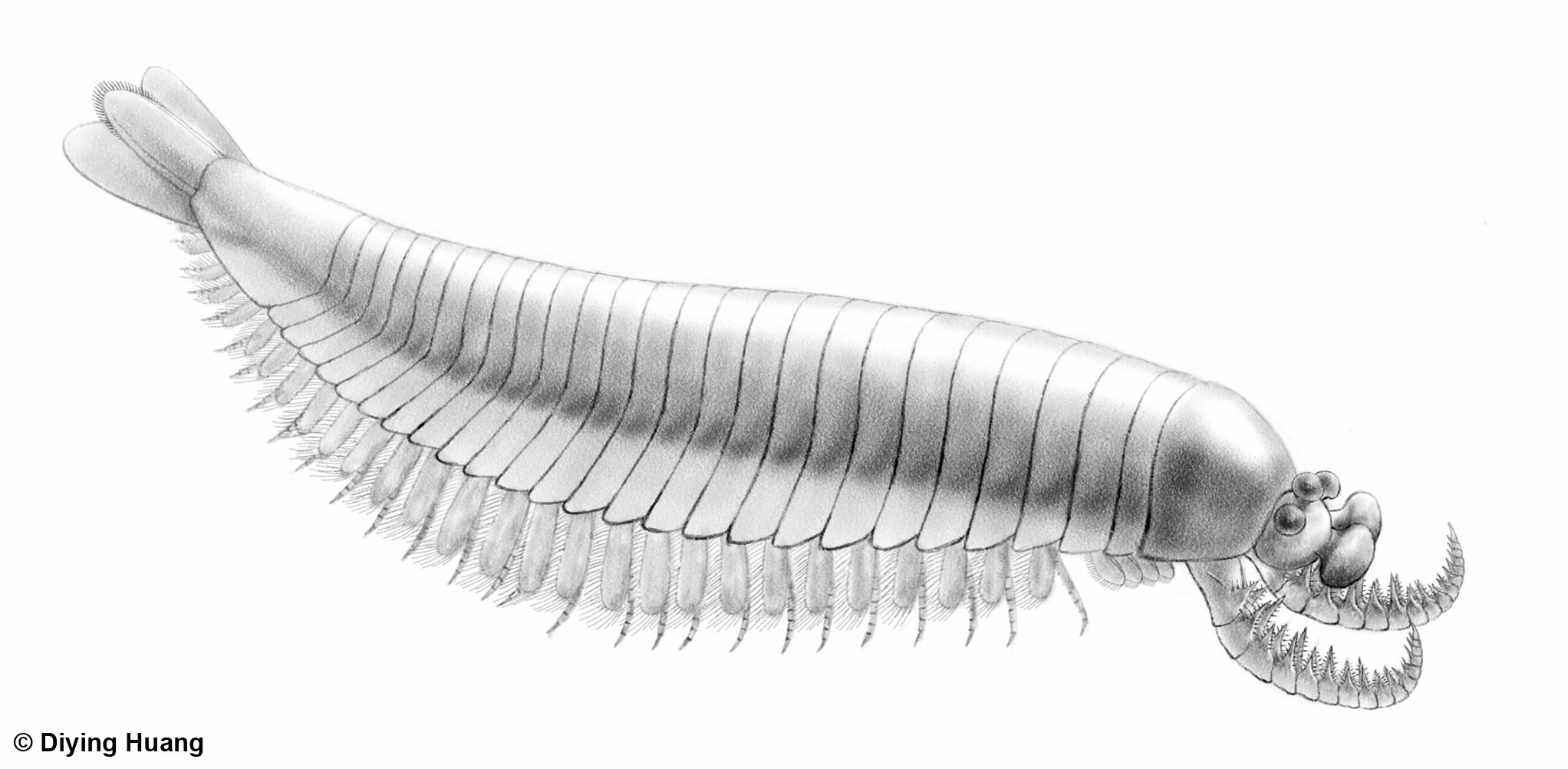
The fossil species, Kylinxia, was collected from the Chengjiang fauna in southwest China’s Yunnan Province. The fauna documents the most complete early animal fossils in the Cambrian time.
Prof. HUANG Diying, corresponding author for the study from NIGPAS, said, “Kylinxia is a very rare chimeric species. It combines morphological features from different animals, which is analogous to ‘kylin,’ a chimeric creature in traditional Chinese mythology.”
“Owing to very special taphonomic conditions, the Kylinxia fossils exhibit exquisite anatomical structures. For example, nervous tissue, eyes, and digestive system — these are soft body parts we usually cannot see in conventional fossils,” said Prof. ZHAO Fangchen, co-corresponding author of the study.
Kylinxia shows distinctive features of true arthropods, such as a hardened cuticle, a segmented trunk, and jointed legs. However, it also integrates the morphological characteristics present in very ancestral forms, including the bizarre five eyes of Opabinia, known as the Cambrian “weird wonder,” as well as the iconic raptorial appendages of Anomalocaris, the giant apex predator in the Cambrian ocean.
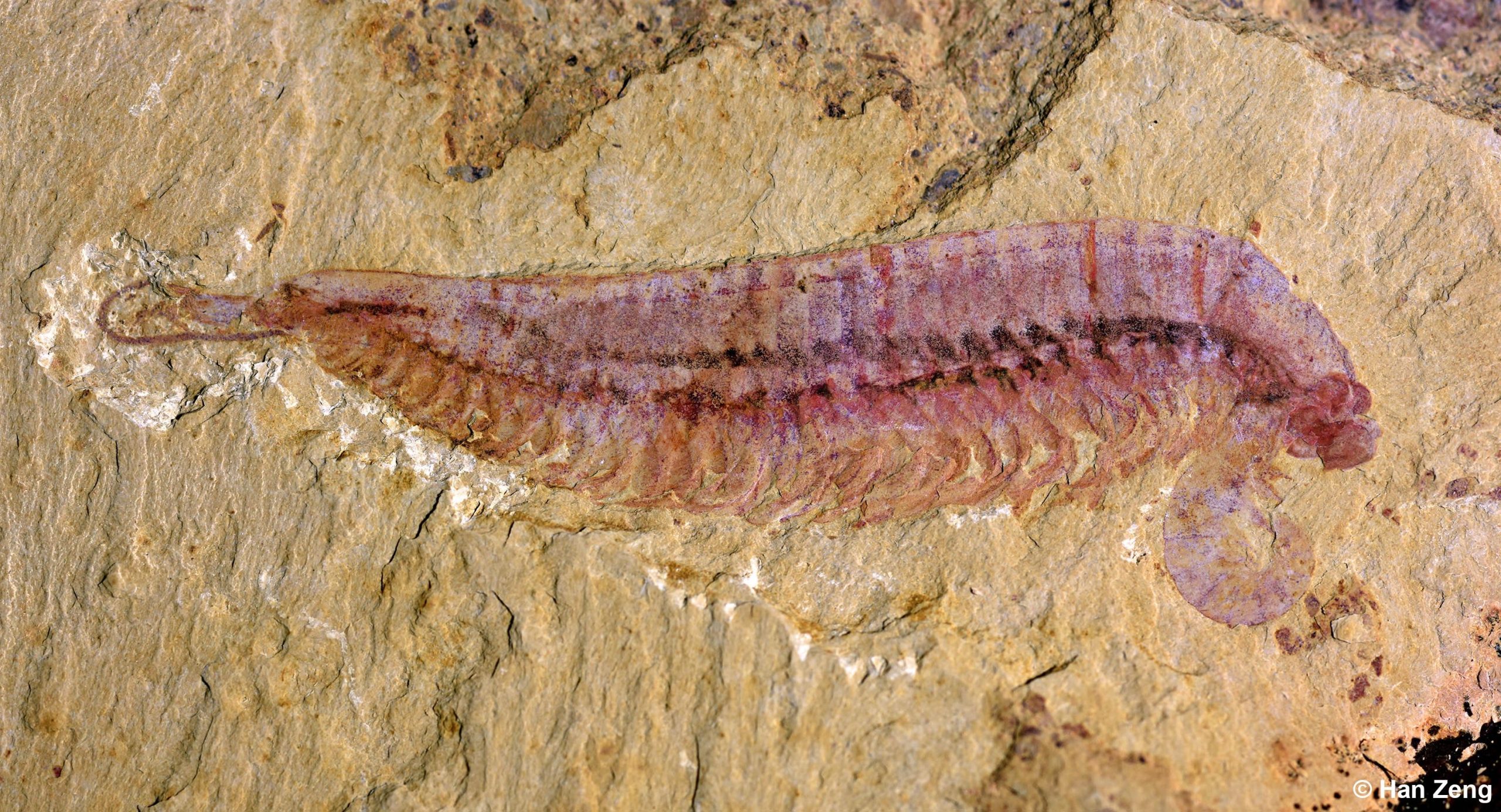
Among the Chengjiang fauna, Anomalocaris is a top predator that can reach two meters in body length, and has been regarded as an ancestral form of arthropod. But huge morphological differences exist between Anomalocaris and true arthropods. There is a great evolutionary gap between the two that can hardly be bridged. This gap has become a crucial “missing link” in the origin of arthropods.
The research team conducted detailed anatomical examinations of the fossils of Kylinxia. They demonstrated that the first appendages in Anomalocaris and true arthropods were homologous. The phylogenetic analyses suggested that there was affinity between the front appendages of Kylinxia, small predatory appendages in front of the mouth of Chelicerata (a group that includes spiders and scorpions), and the antennae of Mandibulata (a subdivision of arthropods including insects such as ants and bees).
“Our results indicate that the evolutionary placement of Kylinxia is right between Anomalocaris and the true arthropods. Therefore, our finding reached the evolutionary root of the true arthropods,” said Prof. ZHU Maoyan, a co-author of the study.
“Kylinxia represents a crucial transitional fossil predicted by Darwin’s evolutionary theory. It bridges the evolutionary gap from Anomalocaris to true arthropods and forms a key “missing link” in the origin of arthropods, contributing strong fossil evidence for the evolutionary theory of life,” said Dr. ZENG Han, first author of the study.
Reference: “An early Cambrian euarthropod with radiodont-like raptorial appendages” by Han Zeng, Fangchen Zhao, Kecheng Niu, Maoyan Zhu and Diying Huang, 4 November 2020, Nature.
DOI: 10.1038/s41586-020-2883-7
The research was funded by the Chinese Academy of Sciences and the National Natural Science Foundation of China.
Never miss a breakthrough: Join the SciTechDaily newsletter.
Follow us on Google and Google News.