
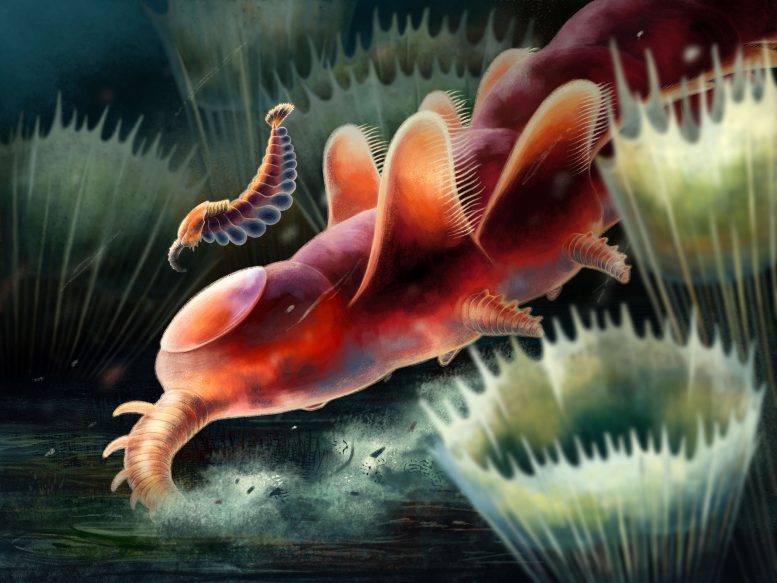
Welsh “weird wonder” fossils provide new clues to the history of arthropod evolution.
The most famous fossils from the Cambrian explosion of animal life, which occurred over half a billion years ago, stand in stark contrast to their modern counterparts. These “weird wonders,” such as the five-eyed Opabinia with its distinctive frontal proboscis, and the fearsome apex predator Anomalocaris with its radial mouthparts and spiny feeding appendages, have become icons in popular culture. However, they were only quite recently recognized as extinct stages of evolution that are crucial for understanding the origins of one of the largest and most important animal phyla, the arthropods (a group that includes modern crabs, spiders, and millipedes).
Two new specimens with striking similarities to Opabinia are described in an article published recently in the journal Nature Communications. They were discovered in a new fossil deposit recording life in the Ordovician Period, which was 40 million years after the Cambrian explosion. Located in a sheep field near Llandrindod Wells in mid Wales (UK), this deposit was discovered during the COVID-19 lockdowns by independent researchers and Llandrindod residents Dr. Joseph Botting and Dr. Lucy Muir, Honorary Research Fellows at Amgueddfa Cymru – National Museum Wales.
The Cambrian explosion, or the biological big bang, refers to an interval of time around 530 million years ago in the Cambrian Period when nearly all major animal phyla began to appear in the fossil record.
The quarry is well known as one of several local sites yielding new species of fossil sponges. “When the lockdown started, I thought I’d make one more trip to collect some last sponges before finally writing them up,” said Botting, “of course, that was the day that I found something sticking its tentacles out of a tube instead.”
“This is the sort of thing that paleontologists dream of, truly soft-body preservation,” said Muir, “we didn’t sleep well, that night.” That was the beginning of an extensive and ongoing investigation that grew into an international collaboration, with lead author Dr. Stephen Pates (University of Cambridge) and senior author Dr. Joanna Wolfe (The Department of Organismic and Evolutionary Biology at Harvard University).
Detailed Insights Into Mieridduryn bonniae
Among the fossils unearthed so far are two very unexpected leftovers from the Cambrian “weird wonders.” Pates met with Botting and Muir to study the specimens using microscopes purchased through crowd-funding to examine the tiny specimens. The larger specimen measured 13 mm (0.5 inches), while the smaller measured a minuscule 3 mm (0.12 inches). For comparison, Opabinia specimens can be 20 times as long).
Exhaustive studies during this visit revealed additional details in the new specimens. Some of these features are also found in Opabinia, such as triangular, squishy lobopod ‘legs’ for interacting with the sediment, and—in the smaller specimen – a tail fan with blades similar in shape to Opabinia’s recently described sister, Utaurora. However other features recognized in the material, such as sclerites covering the head as well as the presence of spines on the proboscis, were not known from any opabiniid and instead hinted at possible radiodont (including Anomalocaris) affinities. The differences between the two specimens led the researchers to wonder were these due to changes during the growth of one species, or did they instead suggest that two distinct species were present in this new deposit?
The Ordovician periond spans 41.6 million years from the end of the Cambrian Period 485.4 million years ago (Mya) to the start of the Silurian Period 443.8 Mya.
The authors describe the new taxon, Mieridduryn bonniae, with the larger specimen designated the holotype. The status of the smaller specimen was left open, reflecting these different possibilities. “The size of the smaller specimen is comparable to some modern arthropod larvae – we had to take into account this possibility in our analyses,” said Wolfe.
The genus name Mieridduryn is derived from the Welsh language, and translates as “bramble-snout,” reflecting the spiny proboscis in the new material. It is pronounced like “me-airy-theerin.” “Many scientific names are made using Latin or Greek words,” Muir said, “but we really wanted to honor Wales, where the specimens were discovered, and so chose to use the Welsh language.” The species name bonniae pays tribute to the niece of the landowners, Bonnie. “The landowners have been very supportive of our research, and Bonnie has been avidly following our progress, even attending some of our Zoom updates,” said Botting.
Evolutionary Implications of the New Fossils
The researchers used phylogenetic analyses, comparing the new fossils with 57 other living and fossil arthropods, radiodonts, and panarthropods, to determine their place in the history of arthropod evolution. “The best-supported position for our Welsh specimens, whether considered as one or two species, were more closely related to modern arthropods than to opabiniids. These analyses suggested that Mieridduryn and the smaller specimen were not “true” opabiniids,” said Pates.
Crucially, these results suggested that a proboscis—thought to represent a fused pair of head appendages—was not unique to opabiniids, but instead was present in the common ancestor of radiodonts and deuteropods (more derived, modern arthropods), and through evolutionary time may have reduced to become the labrum that covers the mouth in modern arthropods. However, the second-best-supported position for these specimens was as true opabiniids, so the authors enquired a bit further to test the robustness of this first result.
“These Welsh animals are 40 million years younger than Opabinia and Utaurora” said Wolfe, “so it was important to assess the implications of some features, such as spines on the appendages or a carapace, evolving convergently with radiodonts in our analyses.” If some, or all, the features shared between the Welsh animals and radiodonts were instead considered to have evolved convergently, the analyses strongly favored these specimens being considered true opabiniids, the first from outside North America and the youngest by 40 million years. Whatever the eventual conclusion, the fossils are an important new piece in the arthropod evolutionary jigsaw.
These small but scientifically mighty fossils are some of the first findings from this important new Ordovician fauna. Botting and Muir continue their work in the small quarry in the sheep field with more still to come. Muir added, “Even the sheep know we are on to something special here, they usually come to watch.”
Reference: “Ordovician opabiniid-like animals and the role of the proboscis in euarthropod head evolution” by Stephen Pates, Joseph P. Botting, Lucy A. Muir and Joanna M. Wolfe, 15 November 2022, Nature Communications.
DOI: 10.1038/s41467-022-34204-w
Contributors to the crowdfunding appeal to purchase the microscopes (including a Holloway Bursary from the Warwickshire Geological Conservation Society) are gratefully acknowledged. Additional funding was provided by a University of Cambridge Herchel Smith Postdoctoral Fellowship, Chinese Academy of Sciences PIFI fellowships (2020VCB0014 and 2018VCB0014). This work was also supported by the National Science Foundation DEB #1856679.
The specimen is accessioned at Amgueddfa Cymru—National Museum Wales.
Never miss a breakthrough: Join the SciTechDaily newsletter.
Follow us on Google and Google News.
4 Comments
Evolution is bs and never happened. It’s a pseudoscience (like most fields of science) meant to distract people so that people don’t praise YHWH for his creative power. If you’ve been scammed into studying evolution or even getting a degree in a field concerning evolution, just cut your losses now and accept that loss. Learn from it and move on. Don’t insist that evolution is true just because you’ve spent time and money on it. Praise be to YHWH the almighty and all-powerful God above all false gods.
You are basing your criticism of science on a non-scientific belief. You appear to be unacquainted with the Scientific Method. Why should anyone take your advice?
Will, Don’t suppose you wondered how bacterial infections that were once treatable by vaccines are no longer the case?
Dear Henry Clinke – if you mean bacterial resistance to antibiotics, (vaccines are more commonly used against viruses than bacteria) this is a fine example of natural selection (among other possible factors like horizontal gene transfer)