
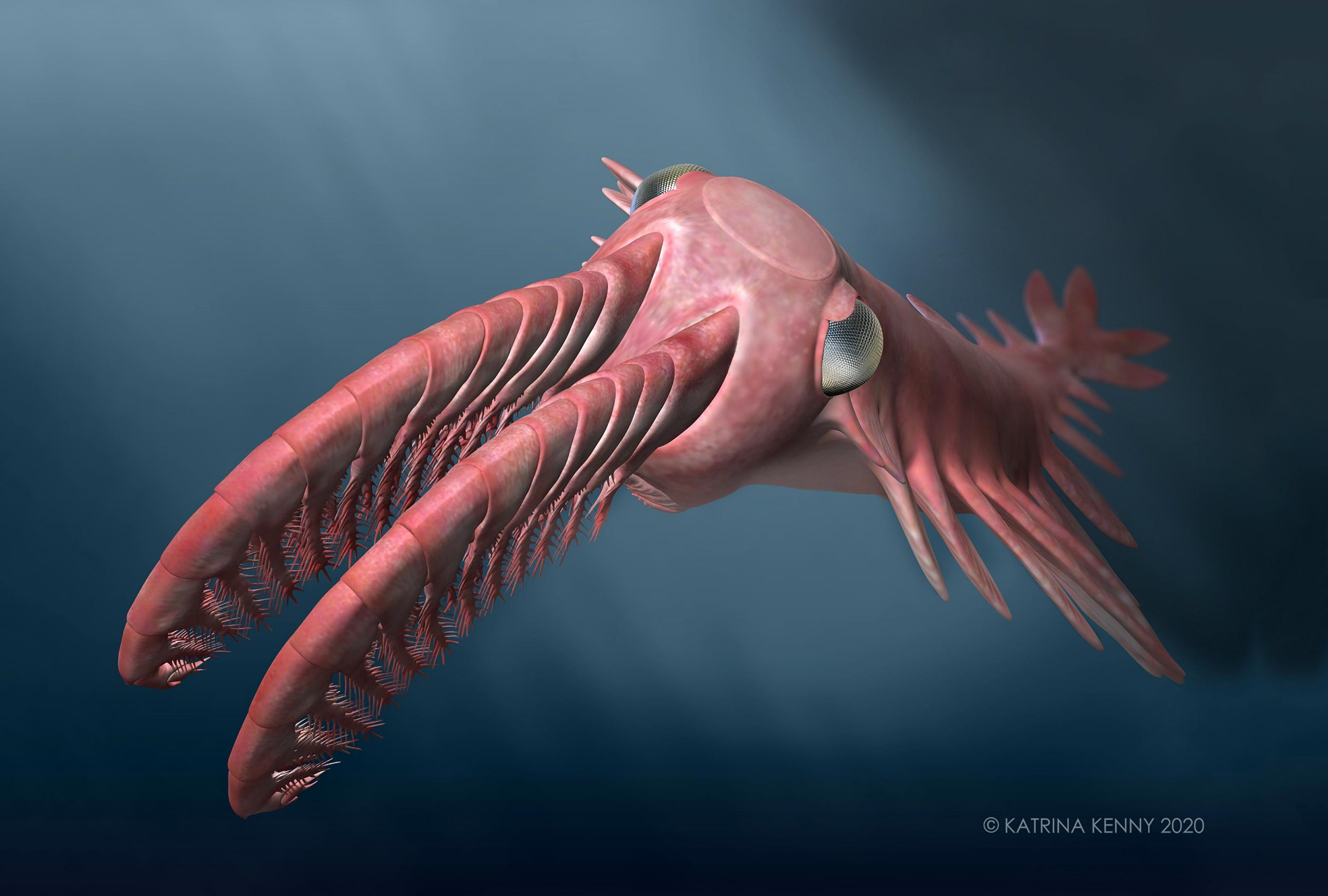
Ancient marine creatures called radiodonts had incredible vision that likely drove an evolutionary arms race according to new research published on December 2, 2020.
The international study, led by Professor John Paterson from the University of New England’s Palaeoscience Research Centre, in collaboration with the University of Adelaide, the South Australian Museum, and The Natural History Museum (UK), found that radiodonts developed sophisticated eyes over 500 million years ago, with some adapted to the dim light of deep water.
“Our study provides critical new information about the evolution of the earliest marine animal ecosystems,” Professor Paterson said. “In particular, it supports the idea that vision played a crucial role during the Cambrian Explosion, a pivotal phase in history when most major animal groups first appeared during a rapid burst of evolution over half a billion years ago.”
Radiodonts, meaning “radiating teeth,” are a group of arthropods that dominated the oceans around 500 million years ago. The many species share a similar body layout comprising of a head with a pair of large, segmented appendages for capturing prey, a circular mouth with serrated teeth, and a squid-like body. It now seems likely that some lived at depths down to 1000 meters (3,300 feet) and had developed large, complex eyes to compensate for the lack of light in this extreme environment.
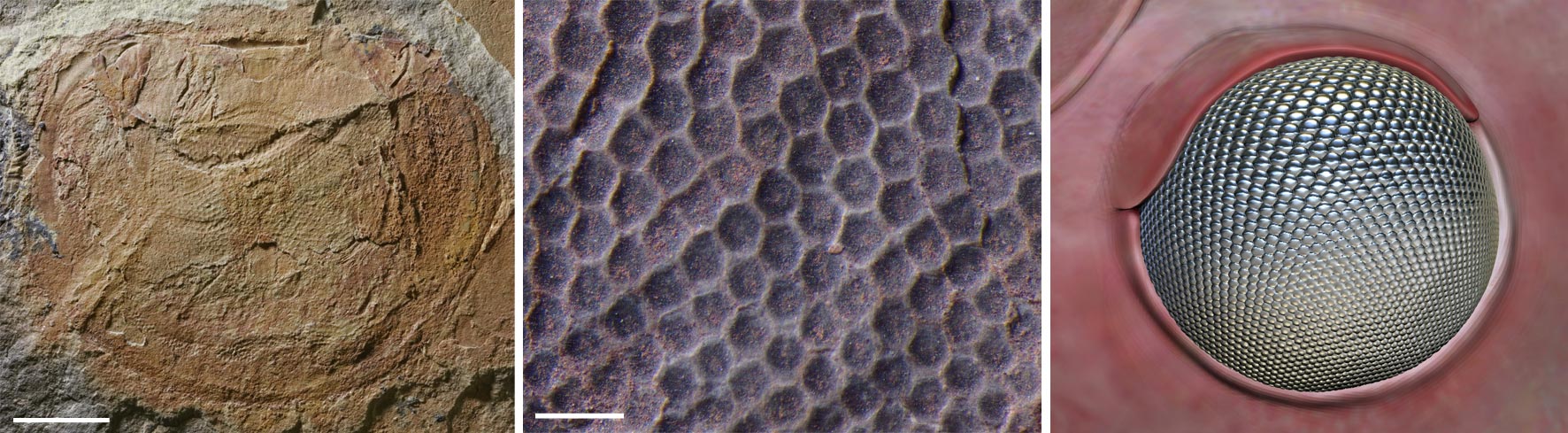
“When complex visual systems arose, animals could better sense their surroundings,” Professor Paterson explained. “That may have fuelled an evolutionary arms race between predators and prey. Once established, vision became a driving force in evolution and helped shape the biodiversity and ecological interactions we see today.”
Some of the first radiodont fossils discovered over a century ago were isolated body parts, and initial attempts at reconstructions resulted in “Frankenstein’s monsters.”
But over the past few decades many new discoveries — including whole radiodont bodies — have given a clearer picture of their anatomy, diversity, and possible lifestyles.
Co-author, Associate Professor Diego García-Bellido from the University of Adelaide and South Australian Museum, said the rich treasure trove of fossils at Emu Bay Shale on South Australia’s Kangaroo Island in particular has helped to build a clearer picture of Earth’s earliest animals.
“The Emu Bay Shale is the only place in the world that preserves eyes with lenses of Cambrian radiodonts. The more than thirty specimens of eyes we now have, have shed new light on the ecology, behavior, and evolution of these, the largest animals alive half-a-billion years ago,” A/Prof. García-Bellido said.
In 2011, the team published two papers in the journal Nature on fossil compound eyes from the 513-million-year-old Emu Bay Shale on Kangaroo Island.
The first paper on this subject documented isolated eye specimens of up to one centimeter in diameter, but the team were unable to assign them to a known arthropod species. The second paper reported the stalked eyes of Anomalocaris, a top predator up to one meter in length, in great detail.
“Our new study identifies the owner of the eyes from our first 2011 paper: ‘Anomalocaris’ briggsi — representing a new genus that is yet to be formally named,” Prof. Paterson said.
“We discovered much larger specimens of these eyes of up to four centimeters in diameter that possess a distinctive ‘acute zone’, which is a region of enlarged lenses in the center of the eye’s surface that enhances light capture and resolution.”
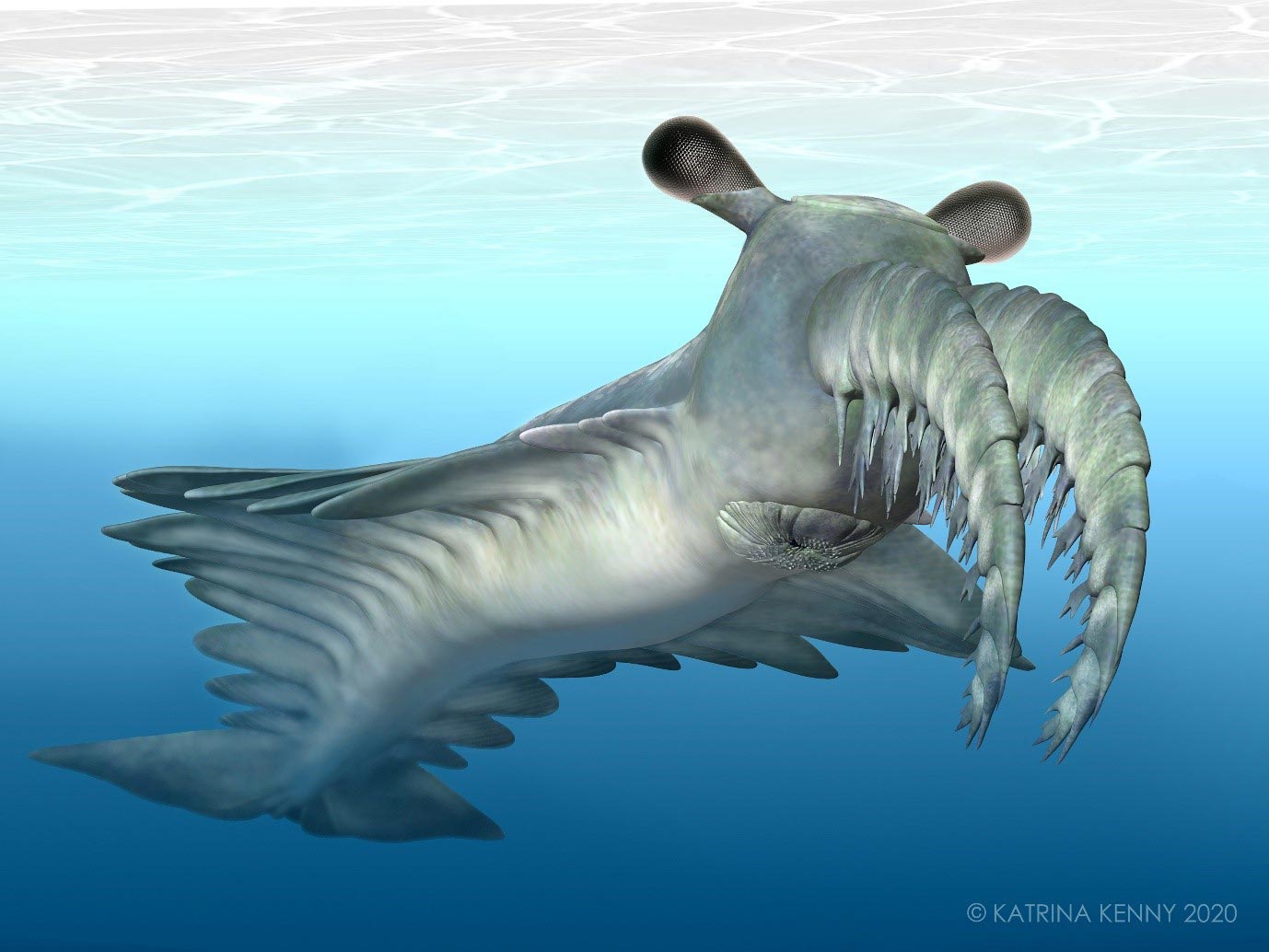
The large lenses of ‘Anomalocaris’ briggsi suggest that it could see in very dim light at depth, similar to amphipod crustaceans, a type of prawn-like creature that exists today. The frilly spines on its appendages filtered plankton that it detected by looking upwards.
Dr. Greg Edgecombe, a researcher at The Natural History Museum, London and co-author of the study, added that the South Australian radiodonts show the different feeding strategies previously indicated by the appendages — either for capturing or filtering prey — are paralleled by differences in the eyes.
“The predator has the eyes attached to the head on stalks but the filter feeder has them at the surface of the head. The more we learn about these animals the more diverse their body plan and ecology is turning out to be,” Dr. Edgecombe said.
“The new samples also show how the eyes changed as the animal grew. The lenses formed at the margin of the eyes, growing bigger and increasing in numbers in large specimens — just as in many living arthropods. The way compound eyes grow has been consistent for more than 500 million years.”
Reference: “Disparate compound eyes of Cambrian radiodonts reveal their developmental growth mode and diverse visual ecology” by John R. Paterson, Gregory D. Edgecombe and Diego C. García-Bellido, 2 December 2020, Science Advances.
DOI: 10.1126/sciadv.abc6721
Never miss a breakthrough: Join the SciTechDaily newsletter.
Follow us on Google and Google News.
4 Comments
I’d like to take a moment to express my appreciation to some of the horrible ancient creatures of the great deep, for paving the way for today rocket flight.
Everything went great except the landing. Did manage to hit the pad. That’s something.
Extremely interesting.
Here are some thoughts for cross functional teams to explore and take forward the gift of vision”. Somein lighter vein and some which require serious consideration and further research.
1. Light is the key. In India we are celebrating the festival of karthika, when the people light a oil lamp to brighten the night and to drive away the darkness.May the light we drive to drive away darkness and light up the light of wisdom in all humans. This is my earnest prayer.
2. The vision the sighted have are for thee blessed among us to see the beauty of Gods creation with thesixth to ninth senses from sight to seeing theworld , solar system, galaxy, Milky way and unviverse and Multivere with eyes of God!
3. Vision may indeed be a blessing . However those vision may easily get caughtup in the beauty and wonderous creations of the Lord and be caught up in the world of Maya.
4. Once they are caught up in the joy of enjoying sight. they may be ataully cursed as they are unable to “see” at all — as the only two eyes overshadow the other senses and gross senses and depress their ability to develop other senses to anextraordinary extent and the blind who get back sight, can probably see far better.
5. The Eyes are indeed the windows of the soul. Using radiating teeth to see in poor lighting and deep in the ocean extreme environment is a great innovation of mother nature. These creatures remind me of little red riding hood and the big bad wolf!. ” What big Eyes you have Grandma…… The better to see you with replied the wolf dressed up as grandma. What lovely shiny teet you have…. The better to eat you with said the big bad wolf as he gobbled her up!”
Now coming to the scientific aspects of this article.
(1) Artificial vision for use in deep space extreme environment by the deep space traveler in the future.\ is the Vision for vision. \
(2) These creatures have 13,000 to 24,00 lenses. Humans only have two. One for each eye. In ancient “Hindu Mythology” the tales describe the Lord in his Hiranyagarbha Form with countless number of infinite eyes .
(3) With 10 billion humans we could have 20 billion eye with consciousness observing the planet on which we reside in the not too distant future.
(4) We are not the only creatures in he planet with vision. Many are blessed with vision and can “See” probably better. Many have many more sets of eye than humans. Always wondered why we use watchdogs.
(5) If we can use artificial intelligence to capture this”vision” in a database and process the data live we would have reached a base level of “vision” of the “Lord”. Creating Artificial Eyes with a trillion lenses and ability to generate light and ‘See” in little light or even no light environment — should be the target ,with the ability to “see” in the entire spectrum of light from Infra Red, Visible to Ultra Vi olet and beyond in both ends of the speectrum!!
(6) Look forward to further developments in this very interesting field of vision.
(7) Finally, a interesting thought . Looks like scientists need to have the “Vision” to create a better vision and “See” the past , present and the future in the eternal march of time. Always wondered if time is a straight line or actually cyclical/spherical 3-D ( not a perfect sphere) and can this be proven mathematically for whatever level of dimensionals we can “See”.
(8) Leave you with this thought and creative field of music. ” Every breath you take, Every move you make,I am watching you. I don’t thin the creative genius was thinking of the satellite eye in the sky!. Add ” Every Thought you think! ” to the lyrics!
Name it after me because **** it, why not?
This is not necessarily a new idea, Andrew Parker proposed this idea in 2004 in his interesting book, In The Blink Of An Eye:
https://books.google.com/books/about/In_The_Blink_Of_An_Eye.html?id=R7nUkQEACAAJ
https://en.wikipedia.org/wiki/Andrew_Parker_%28zoologist%29?wprov=sfla1