
Close Menu
    Facebook X (Twitter) Instagram
    SciTechDaily
    • Biology
    • Chemistry
    • Earth
    • Health
    • Physics
    • Science
    • Space
    • Technology
    Facebook X (Twitter) Pinterest YouTube RSS
    SciTechDaily
    Home»Science»Night of the Living Algae: To Survive Asteroid Impact, Algae Learned to Hunt
    Science

    Night of the Living Algae: To Survive Asteroid Impact, Algae Learned to Hunt

    By University of California - RiversideOctober 30, 2020No Comments4 Mins Read
    Facebook Twitter Pinterest Telegram LinkedIn WhatsApp Email Reddit
    Share
    Facebook Twitter LinkedIn Pinterest Telegram Email Reddit
    Algal Plankton Developed a Spooky Ability to Survive
    K/Pg, or Cretaceous-Paleogene extinction event, refers to the aftermath of the asteroid hitting Earth 66 million years ago. Credit: Odysseus Archontikis/University of Oxford

    Tiny, seemingly harmless ocean plants survived the darkness of the asteroid strike that killed the dinosaurs by learning a ghoulish behavior — eating other living creatures.

    Vast amounts of debris, soot, and aerosols shot into the atmosphere when an asteroid slammed into Earth 66 million years ago, plunging the planet into darkness, cooling the climate, and acidifying the oceans. Along with the dinosaurs on the land and giant reptiles in the ocean, the dominant species of marine algae were instantly wiped out — except for one rare type.

    A team of scientists, including researchers at UC Riverside, wanted to understand how these algae managed to thrive while the mass extinction rippled throughout the rest of the global food chain.

    “This event came closest to wiping out all multicellular life on this planet, at least in the ocean,” said UCR geologist and study co-author Andrew Ridgwell. “If you remove algae, which form the base of the food chain, everything else should die. We wanted to know how Earth’s oceans avoided that fate, and how our modern marine ecosystem re-evolved after such a catastrophe.”

    To answer their questions, the team examined well-preserved fossils of the surviving algae and created detailed computer models to simulate the likely evolution of the algae’s feeding habits over time. Their findings were published today (October 30, 2020) in the journal Science Advances.
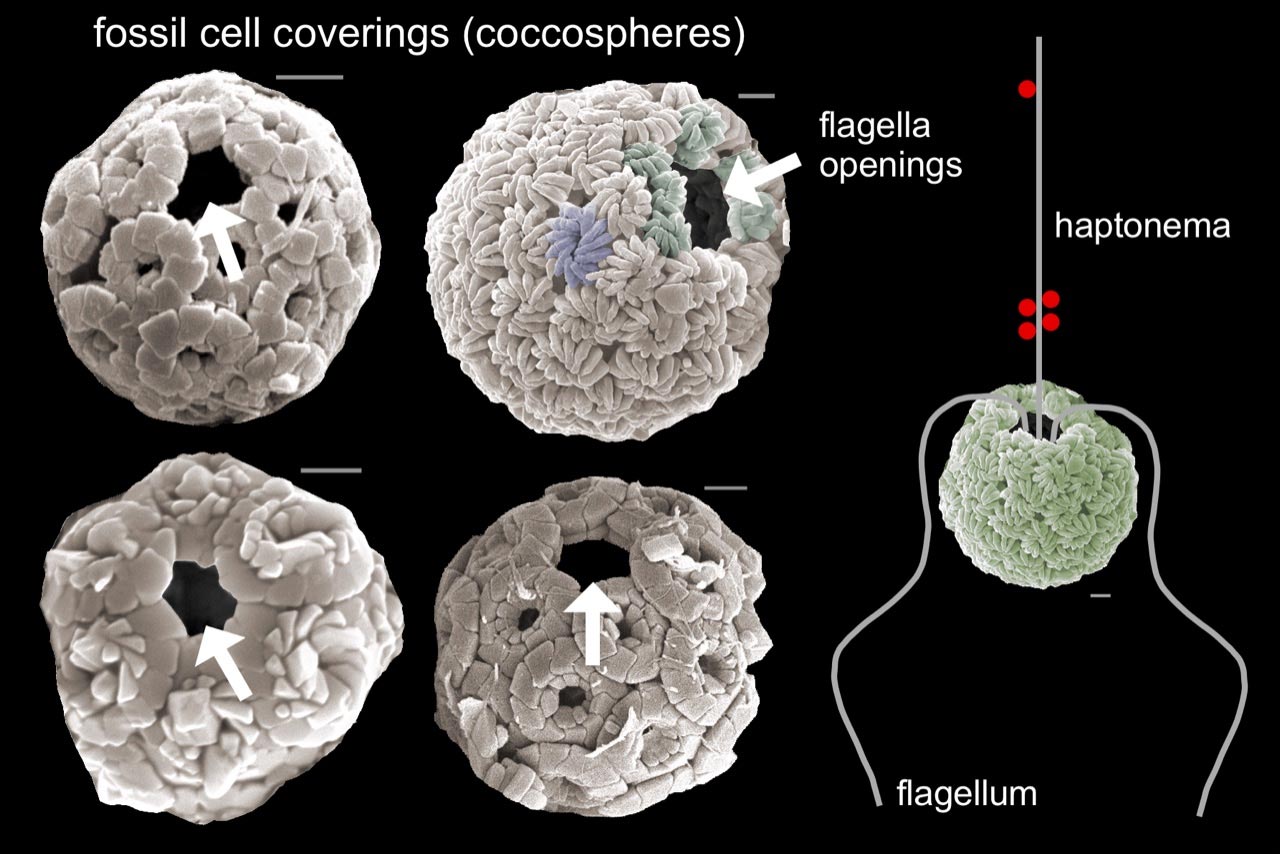
    SEM of Fossil Cell Coverings
    High-resolution scanning electron microscope images of fossil cell coverings of nannoplankton highlighting holes that would have allowed flagella and haptonema to emerge from the cell and draw in food particles. Credit: Paul Brown/University College London

    According to Ridgwell, scientists were a bit lucky to find the nano-sized fossils in the first place. They were located in fast-accumulating and high-clay-content sediments, which helped preserve them in the same way the La Brea tar pits provide a special environment to help preserve mammoths.

    Most of the fossils had shields made of calcium carbonate, as well as holes in their shields. The holes indicate the presence of flagella — thin, tail-like structures that allow tiny organisms to swim.

    “The only reason you need to move is to get your prey,” Ridgwell explained.

    Modern relatives of the ancient algae also have chloroplasts, which enable them to use sunlight to make food from carbon dioxide and water. This ability to survive both by feeding on other organisms and through photosynthesis is called mixotrophy. Examples of the few land plants with this ability include Venus flytraps and sundews.

    Researchers found that once the post-asteroid darkness cleared, these mixotrophic algae expanded from coastal shelf areas into the open ocean where they became a dominant life form for the next million years, helping to quickly rebuild the food chain. It also helped that larger creatures who would normally feed on these algae were initially absent in the post-extinction oceans.

    “The results illustrate both the extreme adaptability of ocean plankton and their capacity to rapidly evolve, yet also, for plants with a generation time of just a single day, that you are always only a year of darkness away from extinction,” Ridgwell said.

    Only much later did the algae evolve, losing the ability to eat other creatures and re-establishing themselves to become one of the dominant species of algae in today’s ocean.

    “Mixotrophy was both the means of initial survival and then an advantage after the post-asteroid darkness lifted because of the abundant small pretty cells, likely survivor cyanobacteria,” Ridgwell said. “It is the ultimate Halloween story — when the lights go out, everyone starts eating each other.”

    Reference: “Algal plankton turn to hunting to survive and recover from end-Cretaceous impact darkness” by Samantha J. Gibbs, Paul R. Bown, Ben A. Ward, Sarah A. Alvarez, Hojung Kim, Odysseas A. Archontikis, Boris Sauterey, Alex J. Poulton, Jamie Wilson and Andy Ridgwell, 30 October 2020, Science Advances.
    DOI: 10.1126/sciadv.abc9123

    Never miss a breakthrough: Join the SciTechDaily newsletter.
    Follow us on Google and Google News.

    Algae Climate Change Evolution Marine Biology Paleontology Popular UC Riverside
    Share. Facebook Twitter Pinterest LinkedIn Email Reddit

    Related Articles

    The Oldest Leech Ever Found Is Nothing Like Today’s Bloodsuckers

    Giant Ancient Shark Discovered in Australia Stuns Scientists

    Textbooks Were Wrong: 249-Million-Year-Old Fossil Discovery Upends Timeline of Evolution

    The Megalodon Makeover: How Science Just Flipped the Script on the Ancient Shark

    Giant Ambush-Predator Worms May Have Colonized the Seafloor Around 20 Million Years Ago

    Mysterious Prehistoric “Sea Dragon” Discovered on English Channel Coast Is Identified As New Species

    Incredible Vision in Ancient “Radiating Teeth” Deep Sea Creatures Drove an Evolutionary Arms Race

    Some Like It Hot: Global Warming Triggered the Evolution of Giant Dinosaurs

    “Enigmatic and Strange” – 300-Million-Year-Old Fish Resembles a Sturgeon, but With Key Differences

    Leave A Reply Cancel Reply

    • Facebook
    • Twitter
    • Pinterest
    • YouTube

    Don't Miss a Discovery

    Subscribe for the Latest in Science & Tech!

    Trending News

    The Universe Is Expanding Too Fast and Scientists Can’t Explain Why

    “Like Liquid Metal”: Scientists Create Strange Shape-Shifting Material

    Early Warning Signals of Esophageal Cancer May Be Hiding in Plain Sight

    Common Blood Pressure Drug Shows Surprising Power Against Deadly Antibiotic-Resistant Superbug

    Scientists Uncover Dangerous Connection Between Serotonin and Heart Valve Disease

    Scientists Discover a “Protector” Protein That Could Help Reverse Hair Loss

    Bone-Strengthening Discovery Could Reverse Osteoporosis

    Scientists Uncover Hidden Trigger Behind Stem Cell Aging

    Follow SciTechDaily
    • Facebook
    • Twitter
    • YouTube
    • Pinterest
    • Newsletter
    • RSS
    SciTech News
    • Biology News
    • Chemistry News
    • Earth News
    • Health News
    • Physics News
    • Science News
    • Space News
    • Technology News
    Recent Posts
    • A Common Diabetes Drug May Hold the Key to Stopping HIV From Coming Back
    • Ancient “Syphilis-Like” Disease in Vietnam Challenges Key Scientific Assumptions
    • Drinking Alcohol To Cope in Your 20s Could Damage Your Brain for Life
    • Scientists Crack Alfalfa’s Chromosome Mystery After Decades of Debate
    • Ancient Ant-Plant Alliance Collapses As Predatory Wasps Move In
    Copyright © 1998 - 2026 SciTechDaily. All Rights Reserved.
    • Science News
    • About
    • Contact
    • Editorial Board
    • Privacy Policy
    • Terms of Use

    Type above and press Enter to search. Press Esc to cancel.