
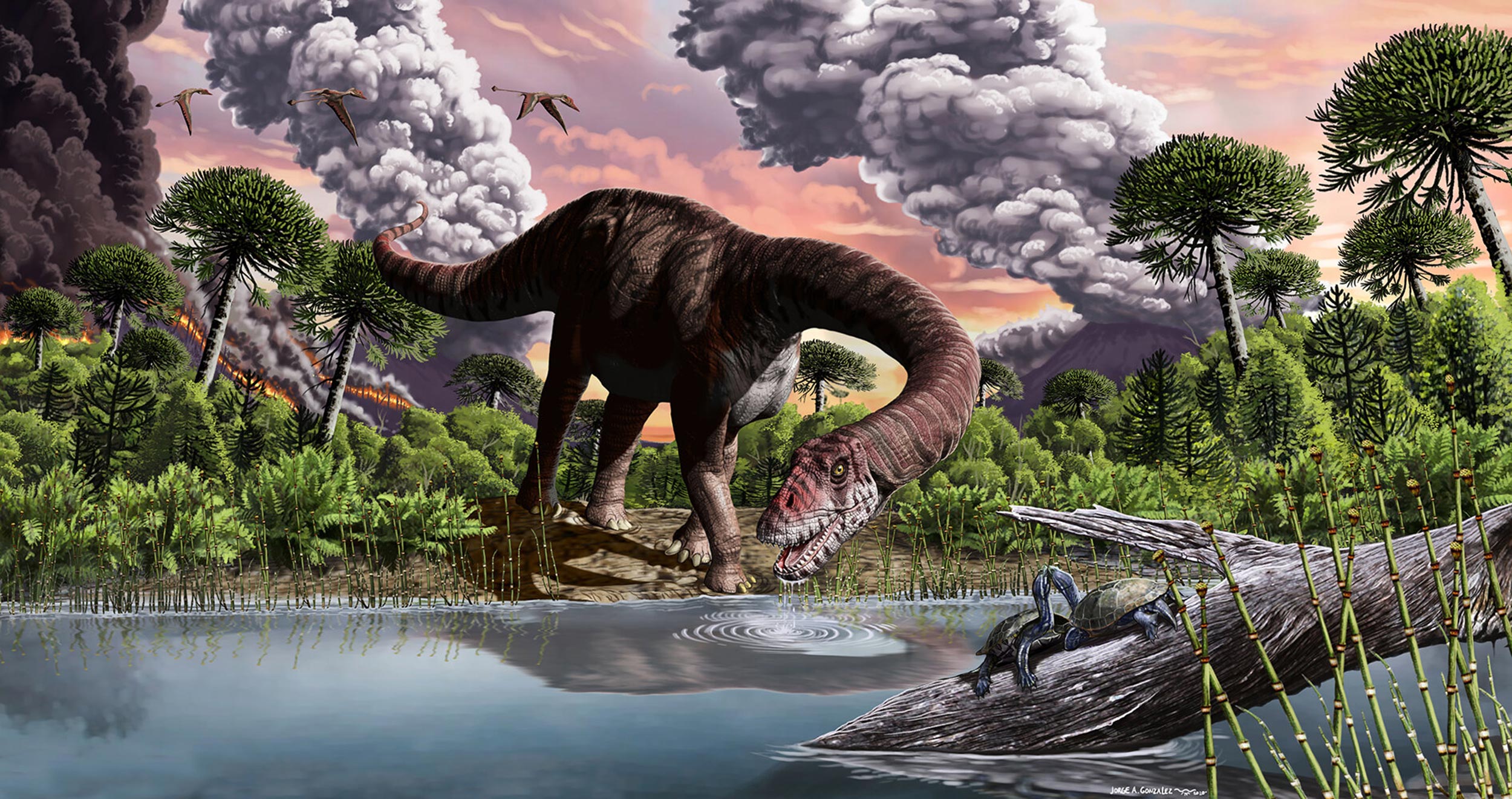
Global warming triggered the evolution of giant dinosaurs. An international team of paleontologists, including LMU Professor Oliver Rauhut, finds evidence of rapid climate change 180 million years ago as the cause of the spread of the well-known long-necked dinosaurs.
When we hear the word dinosaur, most of us probably immediately think of giant animals with massive bodies, long necks and tails, and tiny heads. These “quintessential dinosaurs” actually represent one prominent subgroup of the Dinosauria, the so-called Sauropoda (‚long-necked dinosaurs in popular culture). Sauropods were truly amazing animals, and included the largest land-living animals known, with body lengths of up to 40 m (130 ft) and weights of 70 tons or more.
However, these giant animals did not appear directly at the beginning of the era of dinosaurs. For the first fifty million years of their evolutionary history, the Sauropodomorpha — the lineage that the sauropods belong to — were represented by several groups of bipedal to quadrupedal animals. Although some of them reached already large body sizes of about ten meters (33 feet) in length and a few tons in weight, these groups also included smaller, and lightly built animals, some of which not larger than a goat. Furthermore, all of these animals had rather slender teeth, indicating that these plant-eating animals fed on rather soft and lush vegetation. However, towards the end of the Early Jurassic period, some 180 million years ago, all these groups suddenly disappeared, and only one lineage survived and thrived — the sauropods. What caused this faunal change during the Early Jurassic has remained enigmatic so far.
An international team of researchers, led by Argentinean paleontologist Diego Pol and including Munich researcher Oliver Rauhut of the Ludwig-Maximilians-University and the Bayerische Staatssammlung für Paläontologie und Geologie, now report new evidence on what might have caused these changes. In the province of Chubut, Argentinean Patagonia, they not only discovered the fossil remains of one of the oldest large sauropods known, which the team named Bagualia alba, but could also place it very precisely in its temporal and ecological context. Thus, the layers the new sauropod comes from could very precisely be dated as 179 million years ago, just after the mysterious disappearance of the other sauropodomorph groups, and finds of plant fossils in rock layers just before that time and at the time that Bagualia alba lived provide evidence for the climate and the ecology that these animals lived in.
Thus, the data indicate that there was a relatively rapid change in climate about 180 million years ago, from a temperate warm, and humid climate, in which a diverse, lush vegetation flourished, to a strongly seasonal, very hot, and dry climate, characterized by a less diverse flora, dominated by forms showing adaptations for hot climates, such as certain conifers. These environmental changes were apparently driven by a greenhouse effect due to climate gasses such as CO2 and methane caused by increased volcanism at that time; evidence of these volcanic eruptions are found on many southern continents, such as the Drakensberge in southern Africa.
With their slender teeth, the non-sauropodan sauropodomorphs were adapted to the rather soft vegetation flourishing before this global warming event, but when this flora was replaced by the much tougher greenhouse vegetation, these animals died out. The sauropods represented the only group of sauropodomorphs with a much more robust dentition, well-adapted for such tough vegetation, and thus they flourished and became the dominant group of herbivorous dinosaurs at that time. Indeed the specialization for this kind of vegetation was probably one of the reasons why these animals reached their gigantic sizes: As large digestion chambers are needed to cope with such food, there was a general tendency for these animals to become ever larger.
Reference: “Extinction of herbivorous dinosaurs linked to Early Jurassic global warming event” by D. Pol, J. Ramezani, K. Gomez, J. L. Carballido, A. Paulina Carabajal, O. W. M. Rauhut, I. H. Escapa and N. R. Cúneo, 18 November 2020, Proceedings of the Royal Society B.
DOI: 10.1098/rspb.2020.2310
Never miss a breakthrough: Join the SciTechDaily newsletter.
Follow us on Google and Google News.
2 Comments
So how did these giants rid themselves of excessive heat in this climate?
By going in big pools of water so walking in to shady forest or the ones that had sails or spikes like Spinosaurus or stegosaurus would send more blood through for to warm up from the sun or the heat would escape kind like if you put a hat on in the winter and take it off in the summer