
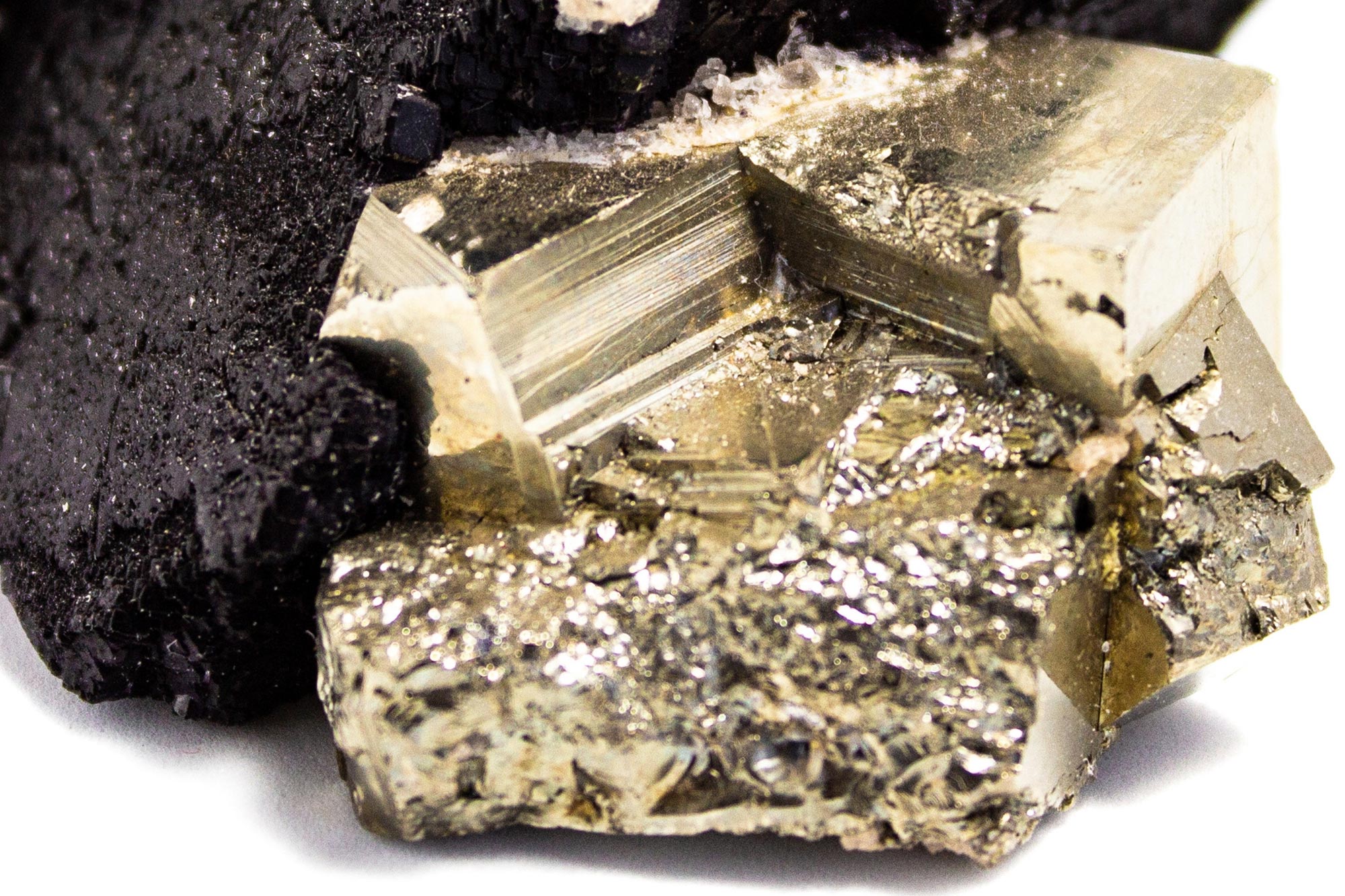
Once dismissed as “fool’s gold,” pyrite may hold more value than previously believed.
The mineral pyrite was historically nicknamed fool’s gold because of its deceptive resemblance to the precious metal. The term was often used during the California gold rush in the 1840s because inexperienced prospectors would claim discoveries of gold, but in reality it would be pyrite, composed of worthless iron disulfide (FeS₂).
Ironically, pyrite crystals can contain small amounts of real gold, although it is notoriously hard to extract. Gold hiding within pyrite is sometimes referred to as “invisible gold,” because it is not observable with standard microscopes, but instead requires sophisticated scientific instruments.
It wasn’t until the 1980s when researchers discovered that gold in pyrite can come in different forms – either as particles of gold, or as an alloy, in which the pyrite and gold are finely mixed.
In our new research, published in Geology, my colleagues and I discovered a third, previously unrecognized way that gold can lurk inside pyrite. When the pyrite crystal is forming under extreme temperature or pressure, it can develop tiny imperfections in its crystal structure that can be “decorated” with gold atoms.
What Are These ‘Crystal Defects’?
The atoms within a crystal are arranged in a characteristic pattern called an atomic lattice. But when a mineral crystal such as pyrite is growing inside a rock, this lattice pattern can develop imperfections. Like many minerals, pyrite is tough and hard at Earth’s surface, but can become more twisty and stretchy when forming deep in the Earth, which is also where gold deposits form.
When crystals stretch or twist, the bonds between neighboring atoms are broken and remade, forming billions of tiny imperfections called “dislocations,” each roughly 100,000 times smaller than the width of a human hair, or 100 times smaller than a virus particle.
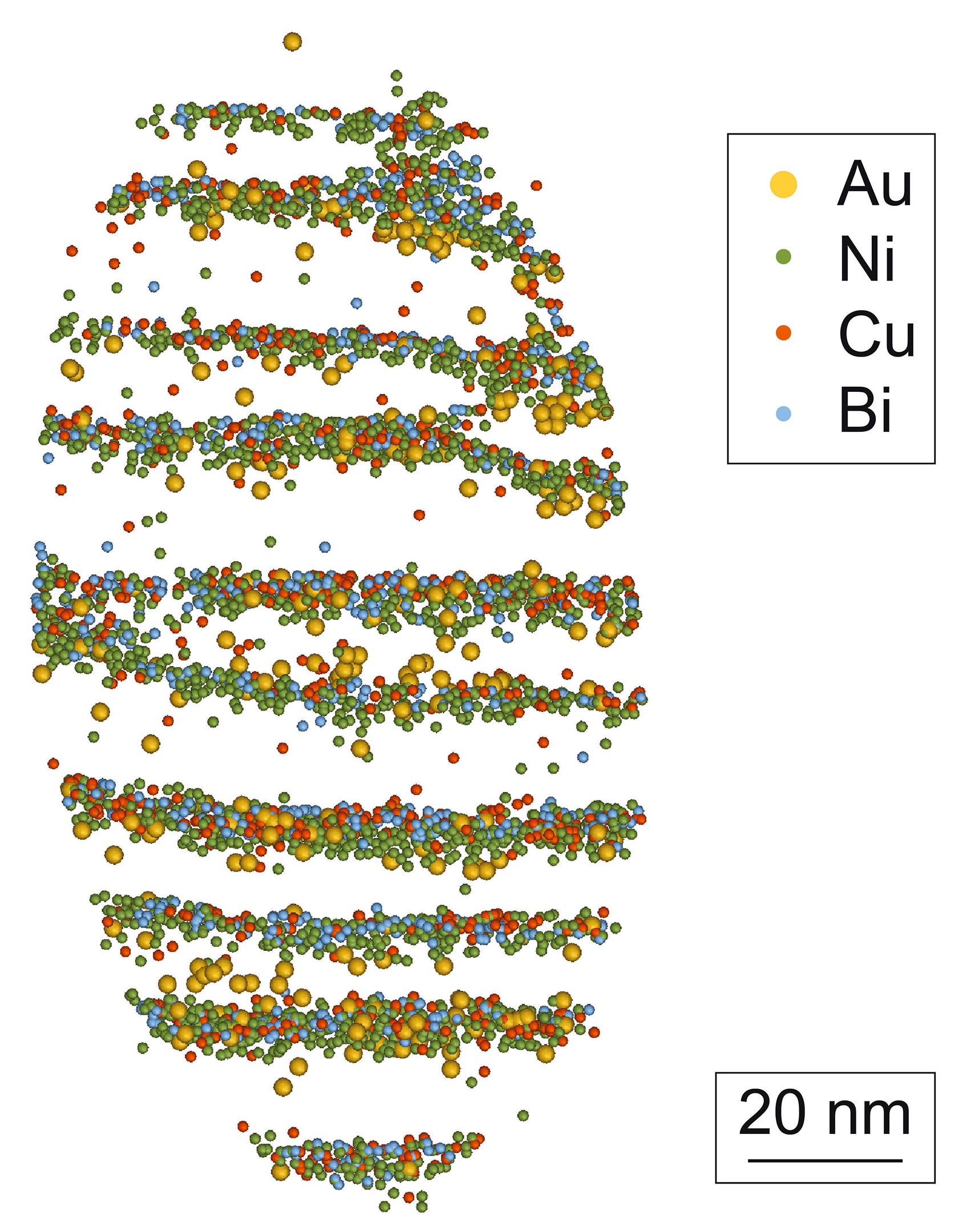
The chemistry of these atomic-scale imperfections is notoriously difficult to study because they are so small, so any impurities are present in absolutely minuscule quantities. Detecting them requires a specialized instrument called an atom probe.
An atom probe can analyze materials at extremely high resolution, but its main advantage over other methods is that it allows us to build a 3D map showing the precise locations of impurities within a crystal — something that was never possible before.
Our research reveals that dislocations within pyrite crystals can be “decorated” with gold atoms. This is particularly common where the crystals have been twisted during their history; here, gold can be present at concentrations several times higher than in the rest of the crystal.
A Potential Goldmine
Why should anyone care about something so tiny? Well, it gives interesting insights into how mineral deposits form, and is also a potential boon for the gold mining industry.
Previously, it was suspected that gold in anomalously rich pyrite crystals was in fact made of gold particles formed during a multi-step process, suggesting the pyrite and gold crystallized at different times and then became clumped together. But our discovery that gold can decorate these crystal imperfections suggests that even pyrite crystals with relatively high gold content can form in a single process.
Our discovery may also help gold miners more efficiently extract gold from pyrite, potentially reducing greenhouse emissions. To extract the gold, the mineral is usually oxidized in large reactors, which uses considerable amounts of energy.
Dislocation sites within crystals could potentially offer an enhanced partial leaching or a target for bacteria to attack and break down the crystal, releasing the gold in a process known as “bio-leaching,” thus potentially reducing energy consumption necessary for extraction. This idea is still untested, but definitely merits investigation.
If it helps pave the way for more sustainable gold-mining methods, then perhaps fool’s gold isn’t so foolish after all.
Perhaps pyrite still lives up to its historic reputation of “fool’s gold” until better, more environmentally sustainable ore processing techniques are developed.
Written by Denis Fougerouse, Research Fellow, School of Earth and Planetary Sciences, Curtin University.
Adapted from an article originally published on The Conversation.
For more on this discovery, read “Invisible” Gold – Scientists Discover “Fool’s Gold” Is Not So Foolish After All.
Reference: “A new kind of invisible gold in pyrite hosted in deformation-related dislocations” by Denis Fougerouse; Steven M. Reddy; Mark Aylmore; Lin Yang; Paul Guagliardo; David W. Saxey; William D.A. Rickard and Nicholas Timms, 24 June 2021, Geology.
DOI: 10.1130/G49028.1
Never miss a breakthrough: Join the SciTechDaily newsletter.
Follow us on Google and Google News.
7 Comments
“Gold hiding within pyrite is sometimes referred to as “invisible gold,” because it is not observable with standard microscopes, but instead requires sophisticated scientific instruments.”
It has been known for a very long time that not only is native gold commonly associated with pyrite, but that the pyrite contained gold. Assayers could determine the quantitative abundance of the gold using unsophisticated techniques dating back to the time of alchemy.
The typical solution used by miners to extract the gold was to roast the crushed pyrite, driving off the sulfur, and then either amalgamating or, in more recent times, using chlorine or cyanide to extract the gold. Bio-leaching has potential, but has not yet been demonstrated to be commercially viable.
Pyrite has also been used as a source of sulfur for making sulfuric acid. The trick is to amortize the cost of roasting the gold ore by the co-production of sulfur and sulfuric acid.
People sometimes wear blinders with respect to what business they are in. They are all in the business of making money! Yet, I have had aggregate producers in California rationalize throwing away gold and platinum in their process stream by telling me, “We’re in the aggregate business, not gold mining.”
So,the real fool is the one who put name “fool’s gold” 🙂
If pyrite is shiny and pretty like gold, and is harder, why do we not exploit it for itself?
If somebody want by gold, call or Write, mail [email protected] fone 0385915851š54,thanks an greet from Croatia
What if I had a machine that took gold out,Like paning .My dad made a machine that would blow you away.It takes out so much in so little time..
Gold is overvalued and a bad investment..The amount of gold on the planet can only fill the surface of a football field five to 10 feet down that’s it.
Platinum which is rarer than Gold was more expensive than gold up until recently. But unfortunately stock investors have run the price of gold up to be more expensive than Platinum. This is dangerous because gold prices could actually tumble down soon because of the coming recession.
Also they cheat people with gold. By selling people a coin with a face value of a dollar for 10 dollars or more..And cheating people with gold filled jewelry…
As a young person I always wondered was what man Called fools gold ( might be (gold in its first stage of becoming Gold).🕵/////Same with Crystal, maybe first sages of becoming diamond….😏