
Close Menu
    Facebook X (Twitter) Instagram
    SciTechDaily
    • Biology
    • Chemistry
    • Earth
    • Health
    • Physics
    • Science
    • Space
    • Technology
    Facebook X (Twitter) Pinterest YouTube RSS
    SciTechDaily
    Home»Space»Near a Galaxy Not So Far Away… An Ultra-Bright X-Ray Source Awakens
    Space

    Near a Galaxy Not So Far Away… An Ultra-Bright X-Ray Source Awakens

    By Royal Astronomical SocietyJune 6, 2020No Comments3 Mins Read
    Facebook Twitter Pinterest Telegram LinkedIn WhatsApp Email Reddit
    Share
    Facebook Twitter LinkedIn Pinterest Telegram Email Reddit
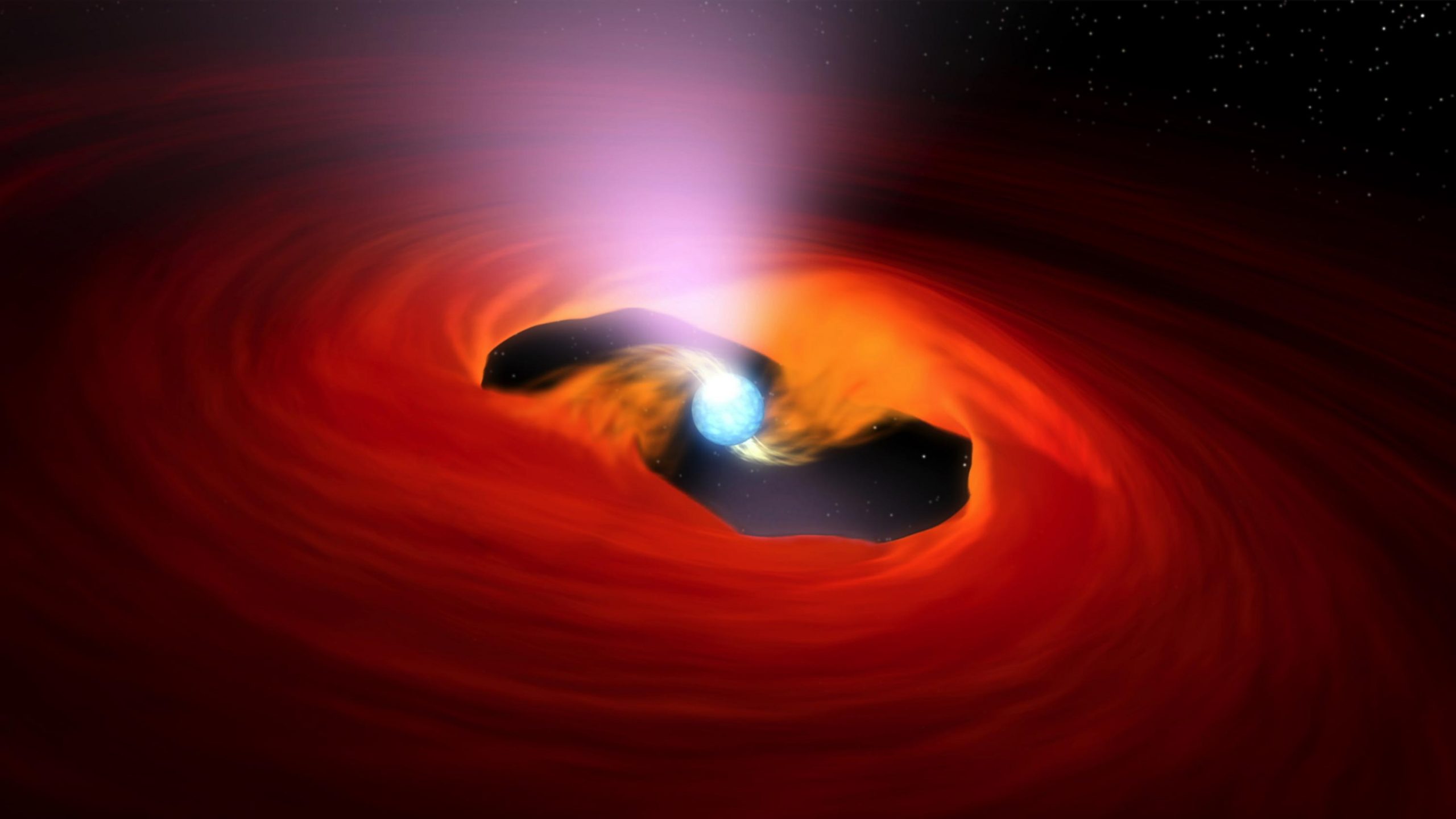
    Ultra Luminous X-Ray Pulsar
    Artist’s impression of an ultra-luminous X-ray pulsar. Credit: NASA / JPL-Caltech

    A new ultra-bright source of X-rays has awakened in between our galactic neighbors the Magellanic Clouds, after a 26-year slumber. This is the second-closest such object known to date, with a brightness greater than a million Suns. The discovery is published in the journal Monthly Notices of the Royal Astronomical Society.

    The object, known as RX J0209.6-7427, was first detected during a 6-month long outburst in 1993. Though it was initially identified as a Be-type X-ray binary, its true nature remained a mystery as it lingered in a dormant state for the next 26 years, only flaring up again in November last year.

    Now, a team of Indian scientists have used AstroSat, India’s first dedicated space observatory, to reveal the extreme nature of the source, and have detected broad-energy X-ray pulsations in the object for the first time. This classifies it as a type of object known as an ultra-luminous X-ray pulsar (ULXP).

    The pulsar is located in the Magellanic Bridge, a stream of gas and stars linking the Magellanic Clouds. These are two of our nearest galactic companions, and some of the most distant objects visible to the naked eye. The new X-ray source is the second-closest ULXP known to date, after a 2018 discovery in our own Milky Way galaxy, and is only the eighth such object ever discovered.

    Ultra-luminous X-ray sources are observable as single points in the sky, but with brightnesses comparable to entire galaxies. “The conventional theory is that in order to shine so brightly, ULXPs must be glowing accretion discs around black holes,” said Amar Deo Chandra, lead author on the new study. “However, recent discoveries of pulsations in these objects suggest that they may in fact have neutron stars at their heart.”

    A neutron star is the remnant of a dead star that contains as much matter as our Sun, but is compressed into a tiny radius of as little as 10km – the size of a small city. The neutron star in this object is thought to be spinning as rapidly as 100 times per second, and emits pulses of energetic X-rays from its magnetic poles, leading to the new ‘X-ray pulsar’ classification.

    The group of astronomers, from IISER Kolkata, IUCAA Pune and the Center for Excellence in Basic Sciences (UM-DAE CEBS) Mumbai, have also found that the pulsar may even be speeding up, setting off bright X-ray ‘fireworks’. This is thought to happen when the neutron star captures material from a companion star, injecting energy into the system and speeding up the rotation.

    The scarcity of similar sources makes detecting and studying new ULXPs essential for X-ray astronomers seeking to understand the Universe.

    “This is only the eighth ULXP detected so far, and the first one near the Magellanic Clouds,” Chandra adds. “It raises the interesting possibility that a significant fraction of ultra-luminous X-ray sources may really be neutron stars accreting at super Eddington rates, rather than black holes as previously thought.”

    Reference: “Study of recent outburst in the Be/X-ray binary RX J0209.6−7427 with AstroSat: a new ultraluminous X-ray pulsar in the Magellanic Bridge?” by Amar Deo Chandra, Jayashree Roy, P C Agrawal and Manojendu Choudhury, 3 June 2020, Monthly Notices of the Royal Astronomical Society.
    DOI: 10.1093/mnras/staa1041

    Never miss a breakthrough: Join the SciTechDaily newsletter.
    Follow us on Google and Google News.

    Astronomy Astrophysics Royal Astronomical Society
    Share. Facebook Twitter Pinterest LinkedIn Email Reddit

    Related Articles

    Martian Meteorite Hunters: Paving the Way for Future Rovers To Search for Meteorites on Mars

    Planetary Shields Will Buckle Under Furious Stellar Winds From Their Dying Stars – Nearly Impossible for Life To Survive

    Lucky Encounter: Solar Orbiter Spacecraft Flies Through the Tail of a Disintegrated Comet

    A Bug’s Life: Mountains on Neutron Stars May Be Only Fractions of Millimeters Tall

    Habitable Planets With Earth-Like Biospheres May Be Much Rarer Than Thought

    Mysterious Hydrogen-Free Supernova Sheds Light on Massive Stars’ Violent Death Throes

    New Research Finds That Supermassive Black Holes Could Form From Dark Matter

    Stunning “Honeycomb Heart” Revealed in Iconic Supernova Explosion Remnant

    Giant Radio Galaxies: Cosmic Beasts and Where to Find Them

    Leave A Reply Cancel Reply

    • Facebook
    • Twitter
    • Pinterest
    • YouTube

    Don't Miss a Discovery

    Subscribe for the Latest in Science & Tech!

    Trending News

    Monster Storms on Jupiter Unleash Lightning Beyond Anything on Earth

    Scientists Create “Liquid Gears” That Spin Without Touching

    The Simple Habit That Could Help Prevent Cancer

    Millions Take These IBS Drugs, But a New Study Finds Serious Risks

    Scientists Unlock Hidden Secrets of 2,300-Year-Old Mummies Using Cutting-Edge CT Scanner

    Bread Might Be Making You Gain Weight Even Without Eating More Calories

    Scientists Discover Massive Magma Reservoir Beneath Tuscany

    Europe’s Most Active Volcano Just Got Stranger – Here’s Why Scientists Are Rethinking It

    Follow SciTechDaily
    • Facebook
    • Twitter
    • YouTube
    • Pinterest
    • Newsletter
    • RSS
    SciTech News
    • Biology News
    • Chemistry News
    • Earth News
    • Health News
    • Physics News
    • Science News
    • Space News
    • Technology News
    Recent Posts
    • Scientists Were Wrong About This Strange “Rule-Breaking” Particle
    • Webb Space Telescope Uncovers Unexpected Ice Clouds on a Jupiter-Like World
    • 289-Million-Year-Old Reptile Mummy Reveals Origin of Human Breathing System
    • New Brain Discovery Challenges Long-Held Theory of Teenage Brain Development
    • Sharks Are Overheating as Warming Oceans Push Them to the Edge
    Copyright © 1998 - 2026 SciTechDaily. All Rights Reserved.
    • Science News
    • About
    • Contact
    • Editorial Board
    • Privacy Policy
    • Terms of Use

    Type above and press Enter to search. Press Esc to cancel.