
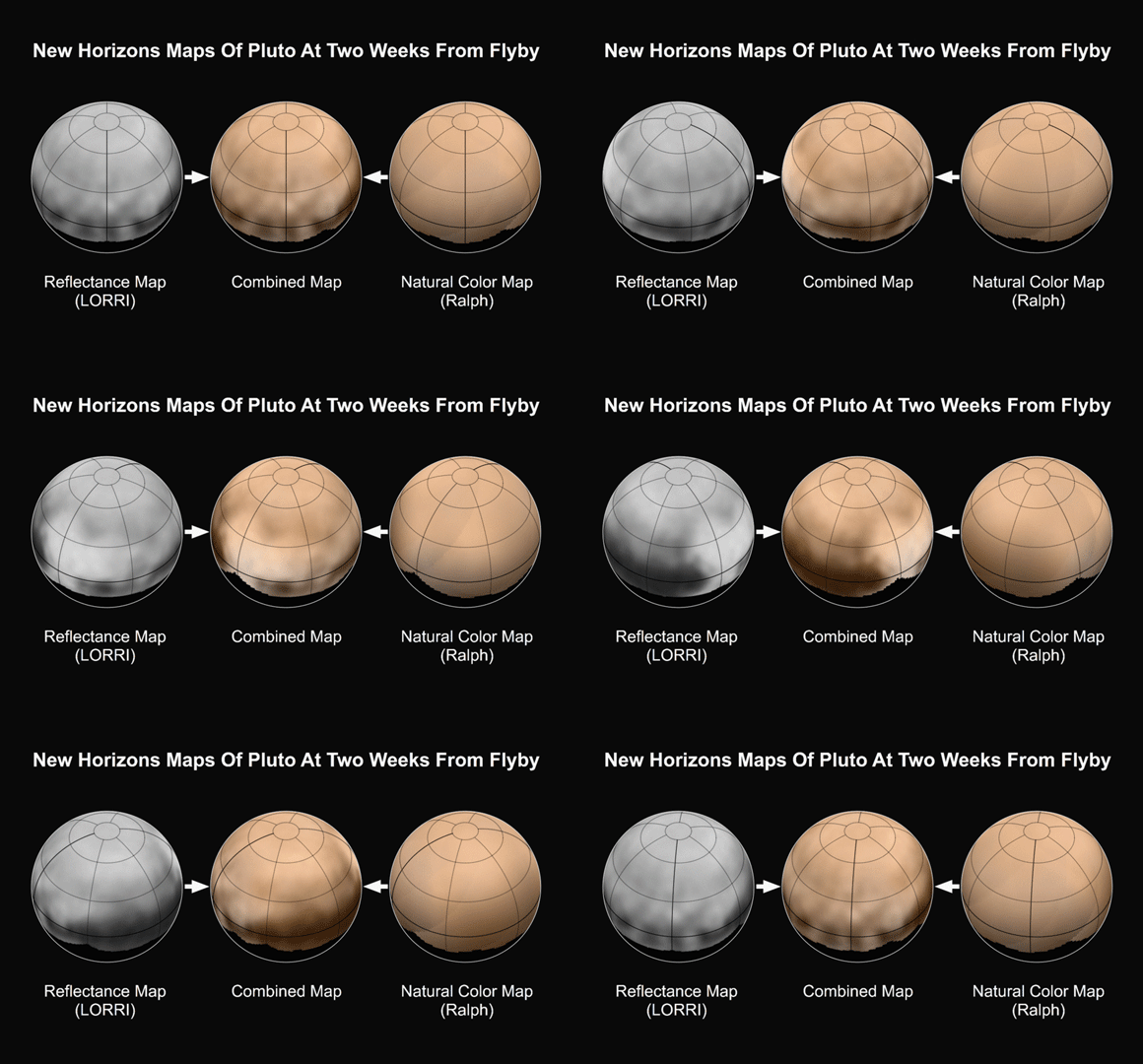
Observations from the New Horizons Spacecraft reveal that Mars isn’t the only red planet in our solar system; dwarf planet Pluto has a reddish color as well.
What color is Pluto? The answer, revealed in the first maps made from New Horizons data, turns out to be shades of reddish brown. Although this is reminiscent of Mars, the cause is almost certainly very different. On Mars the coloring agent is iron oxide, commonly known as rust. On the dwarf planet Pluto, the reddish color is likely caused by hydrocarbon molecules that are formed when cosmic rays and solar ultraviolet light interact with methane in Pluto’s atmosphere and on its surface.
“Pluto’s reddish color has been known for decades, but New Horizons is now allowing us to correlate the color of different places on the surface with their geology and soon, with their compositions,” said New Horizons principal investigator Alan Stern of the Southwest Research Institute, Boulder, Colorado. “This will make it possible to build sophisticated computer models to understand how Pluto has evolved to its current appearance.”
Experts have long thought that reddish substances are generated as a particular color of ultraviolet light from the sun, called Lyman-alpha, strikes molecules of the gas methane (CH4) in Pluto’s atmosphere, powering chemical reactions that create complex compounds called tholins. The tholins drop to the ground to form a reddish “gunk.” Recent measurements with New Horizons’ Alice instrument reveal that a diffuse Lyman-alpha glow falling on Pluto from all directions in interplanetary space is strong enough to produce almost as much tholin as the direct rays of the sun. “This means Pluto’s reddening process occurs even on the night side where there’s no sunlight, and in the depths of winter when the sun remains below the horizon for decades at a time,” said New Horizons co-investigator Michael Summers, George Mason University, Fairfax, Virginia.
Tholins have been found on other bodies in the outer solar system, including Titan and Triton, the largest moons of Saturn and Neptune, respectively, and made in laboratory experiments that simulate the atmospheres of those bodies.
The mission’s first map of Pluto is in approximate true color—that is, the color you would see if you were riding on New Horizons. At left, a map of Pluto’s northern hemisphere composed using high-resolution black-and-white images from New Horizons LORRI instrument. At right is a map of Pluto’s colors created using data from the Ralph instrument. In the center is the combined map, produced by merging the LORRI and Ralph data.
“Now the unique colors and characteristics of its varied terrains are coming into view,” said Simon Porter, a member of the New Horizons Geology and Geophysics team. Added Alex Parker, a member of the New Horizons Composition team, “Pluto’s largest dark spot is clearly more red than the majority of the surface, while the brightest area appears closer to neutral gray.”
Scientists hope to learn more about the cause of Pluto’s reddish tint as New Horizons closes in for its July 14 flyby.
Never miss a breakthrough: Join the SciTechDaily newsletter.
Follow us on Google and Google News.
11 Comments
You know what? Mars is a red planet! How did you forget that?
Yeah that was a typo…Let’s call it an early July 4th weekend mistake :) The post has been corrected.
I think Mars is the red planet. Jupiter has a giant red spot, or storm, but any 3rd grader will tell you Mars is the red planet.
Someone didn’t study their science, did they?
Well once again modern science has given us more info on the planet Pluto. I cant wait for the stunning digital pictures that we will see in the next coming months. Bravo NASA a job well done.
So Mars is not the red planet????
Jupiter isn’t the Red Planet, it’s the big bright outer one. It’s Mars that is the Red Planet.
Golden brown isn’t red. It’s toast. Pluto is the Toast Planet!
Pluto will always be a planet to me, just because a group of nerds decided to write new rules that have been around for more decades than they have been alive.
Ancient Sumerians referred to this planet as Nibiru. Shame NASA sent a probe all that way just to flyby.
More importantly. Why is pork considered the other white meat? Shouldn’t that be turkey?
Looks brownish to me…what “red”?