
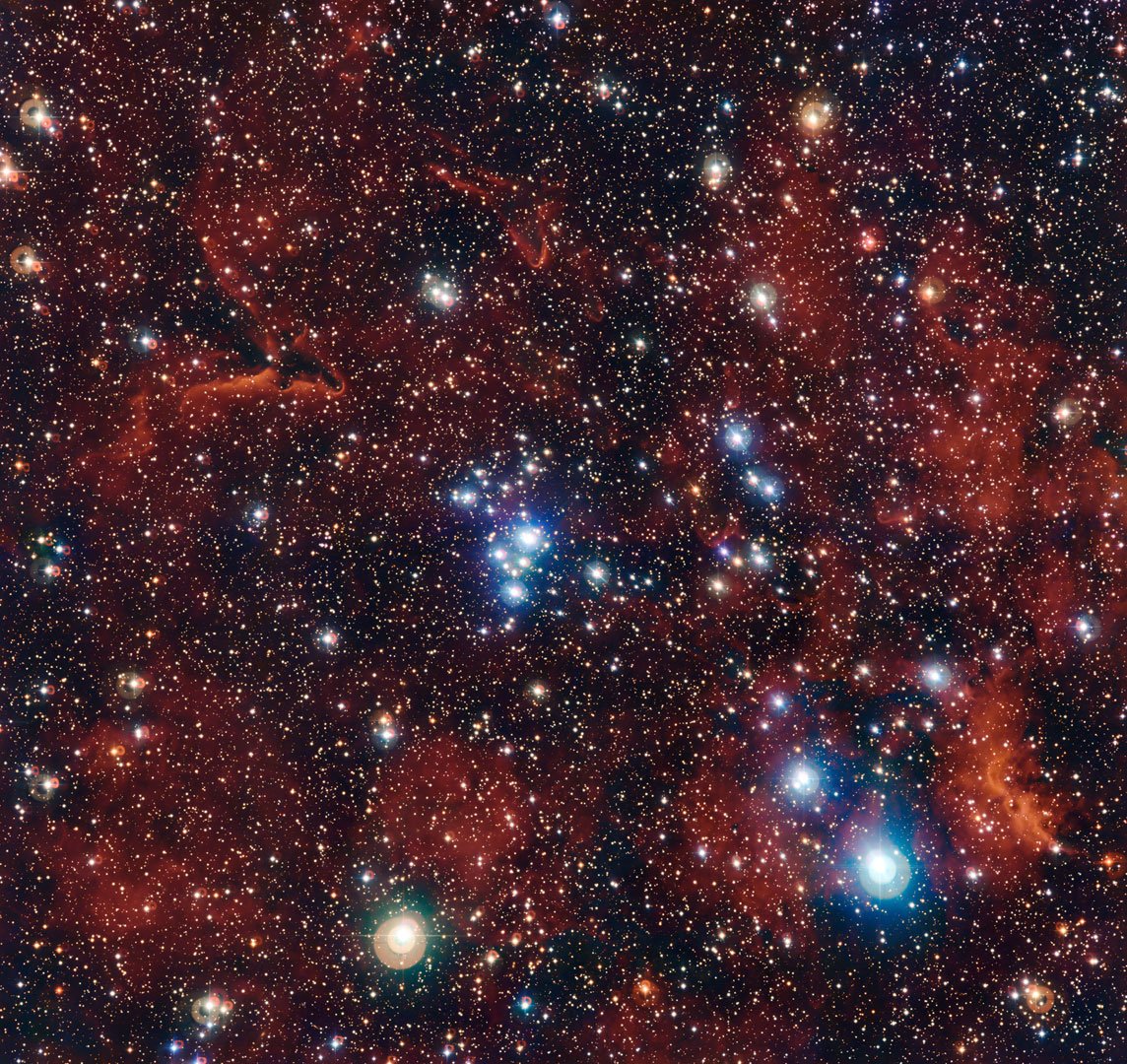
This newly released ESO image shows star cluster NGC 2367, an infant stellar grouping that lies at the center of an immense and ancient structure on the margins of the Milky Way.
This rich view of an array of colorful stars and gas was captured by the Wide Field Imager (WFI) camera, on the MPG/ESO 2.2-meter telescope at ESO’s La Silla Observatory in Chile. It shows a young open cluster of stars known as NGC 2367, an infant stellar grouping that lies at the center of an immense and ancient structure on the margins of the Milky Way.
Discovered from England by the tireless observer Sir William Herschel on 20 November 1784, the bright star cluster NGC 2367 lies about 7000 light-years from Earth in the constellation Canis Major. Having only existed for about five million years, most of its stars are young and hot and shine with an intense blue light. This contrasts wonderfully in this new image with the silky-red glow from the surrounding hydrogen gas.
Open clusters like NGC 2367 are a common sight in spiral galaxies like the Milky Way, and tend to form in their host’s outer regions. On their travels about the galactic center, they are affected by the gravity of other clusters, as well as by large clouds of gas that they pass close to. Because open clusters are only loosely bound by gravity to begin with, and because they constantly lose mass as some of their gas is pushed away by the radiation of the young hot stars, these disturbances occur often enough to cause the stars to wander off from their siblings, just as the Sun is believed to have done many years ago. An open cluster is generally expected to survive for a few hundred million years before it is completely dispersed.
This pan video gives a close-up view of an array of colorful stars and gas in a young open cluster of stars known as NGC 2367.
In the meantime, clusters serve as excellent case studies for stellar evolution. All the constituent stars are born at roughly the same time from the same cloud of material, meaning they can be compared alongside one another with greater ease, allowing their ages to be readily determined and their evolution mapped.
Like many open clusters, NGC 2367 is embedded within an emission nebula, from which its stars were born. The remains show up as wisps and clouds of hydrogen gas, ionized by the ultraviolet radiation being emitted by the hottest stars. What is more unusual is that, as you begin to pan out from the cluster and its nebula, a far more expansive structure is revealed: NGC 2367 and the nebula containing it are thought to be the nucleus of a larger nebula, known as Brand 16, which in turn is only a small part of a huge supershell, known as GS234-02.
The GS234-02 supershell lies towards the outskirts of our galaxy, the Milky Way. It is a vast structure, spanning hundreds of light-years. It began its life when a group of particularly massive stars, producing strong stellar winds, created individual expanding bubbles of hot gas. These neighboring bubbles eventually merged to form a superbubble, and the short life spans of the stars at its heart meant that they exploded as supernovae at similar times, expanding the superbubble even further, to the point that it merged with other superbubbles, which is when the supershell was formed. The resulting formation ranks as one of the largest possible structures within a galaxy.
This concentrically expanding system, as ancient as it is enormous, provides a wonderful example of the intricate, interrelated structures that are sculpted in galaxies by the lives and deaths of stars.
Never miss a breakthrough: Join the SciTechDaily newsletter.
Follow us on Google and Google News.