
Close Menu
    Facebook X (Twitter) Instagram
    SciTechDaily
    • Biology
    • Chemistry
    • Earth
    • Health
    • Physics
    • Science
    • Space
    • Technology
    Facebook X (Twitter) Pinterest YouTube RSS
    SciTechDaily
    Home»Space»New Image of Rose-Colored Star Forming Region Messier 17
    Space

    New Image of Rose-Colored Star Forming Region Messier 17

    By European Southern ObservatorySeptember 23, 2015No Comments3 Mins Read
    Facebook Twitter Pinterest Telegram LinkedIn WhatsApp Email Reddit
    Share
    Facebook Twitter LinkedIn Pinterest Telegram Email Reddit
    ESO Views the Star Formation Region Messier 17
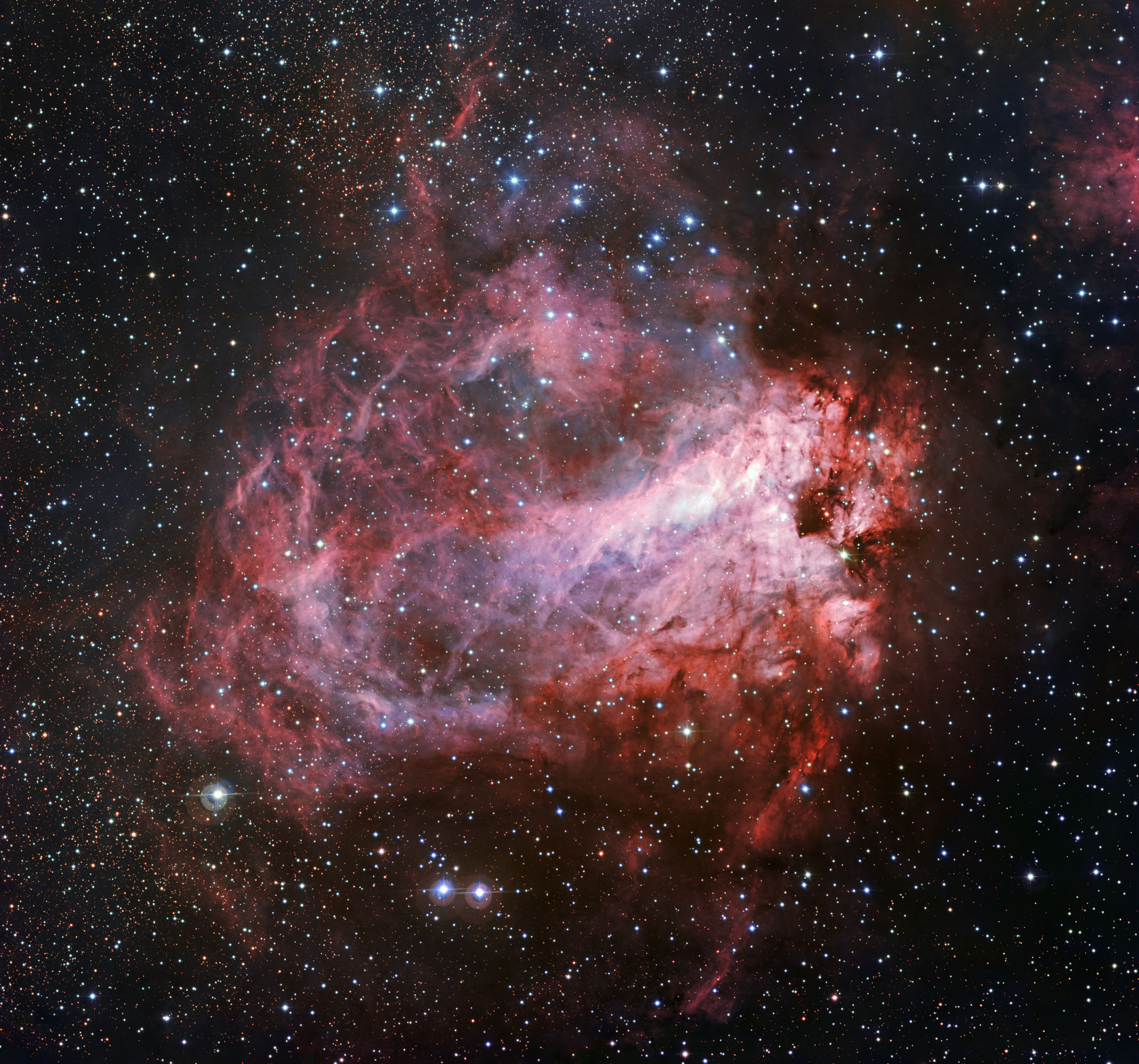
    This image of the rose-colored star-forming region Messier 17 was captured by the Wide Field Imager on the MPG/ESO 2.2-meter telescope at ESO’s La Silla Observatory in Chile. It is one of the sharpest images showing the entire nebula and not only reveals its full size but also retains fine detail throughout the cosmic landscape of gas clouds, dust and newborn stars. Credit: ESO

    This newly released ESO image shows the rose-colored star-forming region Messier 17.

    This new image of the star-forming region Messier 17 was captured by the Wide Field Imager on the MPG/ESO 2.2-meter telescope at ESO’s La Silla Observatory in Chile. It is one of the sharpest images showing the entire nebula and not only reveals its full size but also retains fine detail throughout the cosmic landscape of gas clouds, dust, and newborn stars.

    The nebula pictured here may have had more names bestowed upon it over the ages than any other object of its kind. Although officially known as Messier 17, its nicknames include: the Omega Nebula, the Swan Nebula, the Checkmark Nebula, the Horseshoe Nebula, and — lest those with more of a more marine bent miss out — the Lobster Nebula.

    Messier 17 is located about 5,500 light-years from Earth near the plane of the Milky Way and in the constellation of Sagittarius (The Archer). The object spans a big section of the sky — its gas and dust clouds measure about 15 light-years across. This material is fueling the birth of new stars and the wide field of view of the new picture reveals many stars in front of, in, or behind Messier 17.

    The nebula appears as a complex red structure with some graduation to pink. Its coloring is a signature of glowing hydrogen gas. The short-lived blue stars that recently formed in Messier 17 emit enough ultraviolet light to heat up surrounding gas to the extent that it begins to glow brightly. In the central region the colors are lighter, and some parts appear white. This white color is real — it arises as a result of mixing the light from the hottest gas with the starlight reflected by dust.

    The gas in the nebula is estimated to have more than 30,000 times the mass of the Sun. Messier 17 also contains an open star cluster of 35 stars, which is known as NGC 6618. The total number of stars in the nebula, however, is much higher — there are almost 800 stars in the center with even more forming in its outer regions.

    Throughout this rosy glow, the nebula shows a web of darker regions of dust that obscure the light. This obscuring material is also glowing and — although these areas are dark in this visible-light image — they look bright when observed using infrared cameras.

    The nebula owes its official name to the French comet hunter Charles Messier who included the nebula as the seventeenth object in his famous astronomical catalog in 1764. But even with a name as bland as Messier 17, this flowery nebula still looks dazzling.

    This picture comes from the ESO Cosmic Gems program.

    Never miss a breakthrough: Join the SciTechDaily newsletter.
    Follow us on Google and Google News.

    Astronomy European Southern Observatory Popular Star Formation
    Share. Facebook Twitter Pinterest LinkedIn Email Reddit

    Related Articles

    The Realm of Buried Giants – Star Formation Region RCW 106

    Detailed Images of the Hypergiant Star VY Canis Majoris

    Astronomers Discover VFTS 352 – The Hottest and Most Massive Touching Double Star System to Date

    ESO Views Star Forming Cloud RCW 34

    SMA Reveals New Insights Into How Cosmic Seeds Grow Into Massive Stars

    Quasar 3C 279 Shown in Unprecedented Sharpness

    Scientists Detect Dark Galaxies for the First Time

    Gas Cloud Headed Towards Milky Way’s Supermassive Black Hole

    APEX Provides Images of Dust near Orion’s Belt

    Leave A Reply Cancel Reply

    • Facebook
    • Twitter
    • Pinterest
    • YouTube

    Don't Miss a Discovery

    Subscribe for the Latest in Science & Tech!

    Trending News

    The Universe Is Expanding Too Fast and Scientists Can’t Explain Why

    “Like Liquid Metal”: Scientists Create Strange Shape-Shifting Material

    Early Warning Signals of Esophageal Cancer May Be Hiding in Plain Sight

    Common Blood Pressure Drug Shows Surprising Power Against Deadly Antibiotic-Resistant Superbug

    Scientists Uncover Dangerous Connection Between Serotonin and Heart Valve Disease

    Scientists Discover a “Protector” Protein That Could Help Reverse Hair Loss

    Bone-Strengthening Discovery Could Reverse Osteoporosis

    Scientists Uncover Hidden Trigger Behind Stem Cell Aging

    Follow SciTechDaily
    • Facebook
    • Twitter
    • YouTube
    • Pinterest
    • Newsletter
    • RSS
    SciTech News
    • Biology News
    • Chemistry News
    • Earth News
    • Health News
    • Physics News
    • Science News
    • Space News
    • Technology News
    Recent Posts
    • Scientists Overcome Major Quantum Bottleneck, Potentially Transforming Teleportation and Computing
    • Quantum Physics’ Strangest Problem May Hold the Key to Time Itself
    • Scientists Create “Liquid Gears” That Spin Without Touching
    • The Simple Habit That Could Help Prevent Cancer
    • Forgotten Medicinal Plant Shows Promise in Fighting Dangerous Superbugs
    Copyright © 1998 - 2026 SciTechDaily. All Rights Reserved.
    • Science News
    • About
    • Contact
    • Editorial Board
    • Privacy Policy
    • Terms of Use

    Type above and press Enter to search. Press Esc to cancel.