
Close Menu
    Facebook X (Twitter) Instagram
    SciTechDaily
    • Biology
    • Chemistry
    • Earth
    • Health
    • Physics
    • Science
    • Space
    • Technology
    Facebook X (Twitter) Pinterest YouTube RSS
    SciTechDaily
    Home»Space»The Realm of Buried Giants – Star Formation Region RCW 106
    Space

    The Realm of Buried Giants – Star Formation Region RCW 106

    By European Southern ObservatoryMarch 7, 2016No Comments4 Mins Read
    Facebook Twitter Pinterest Telegram LinkedIn WhatsApp Email Reddit
    Share
    Facebook Twitter LinkedIn Pinterest Telegram Email Reddit
    ESO Views the Sky Around the Star Formation Region RCW 106
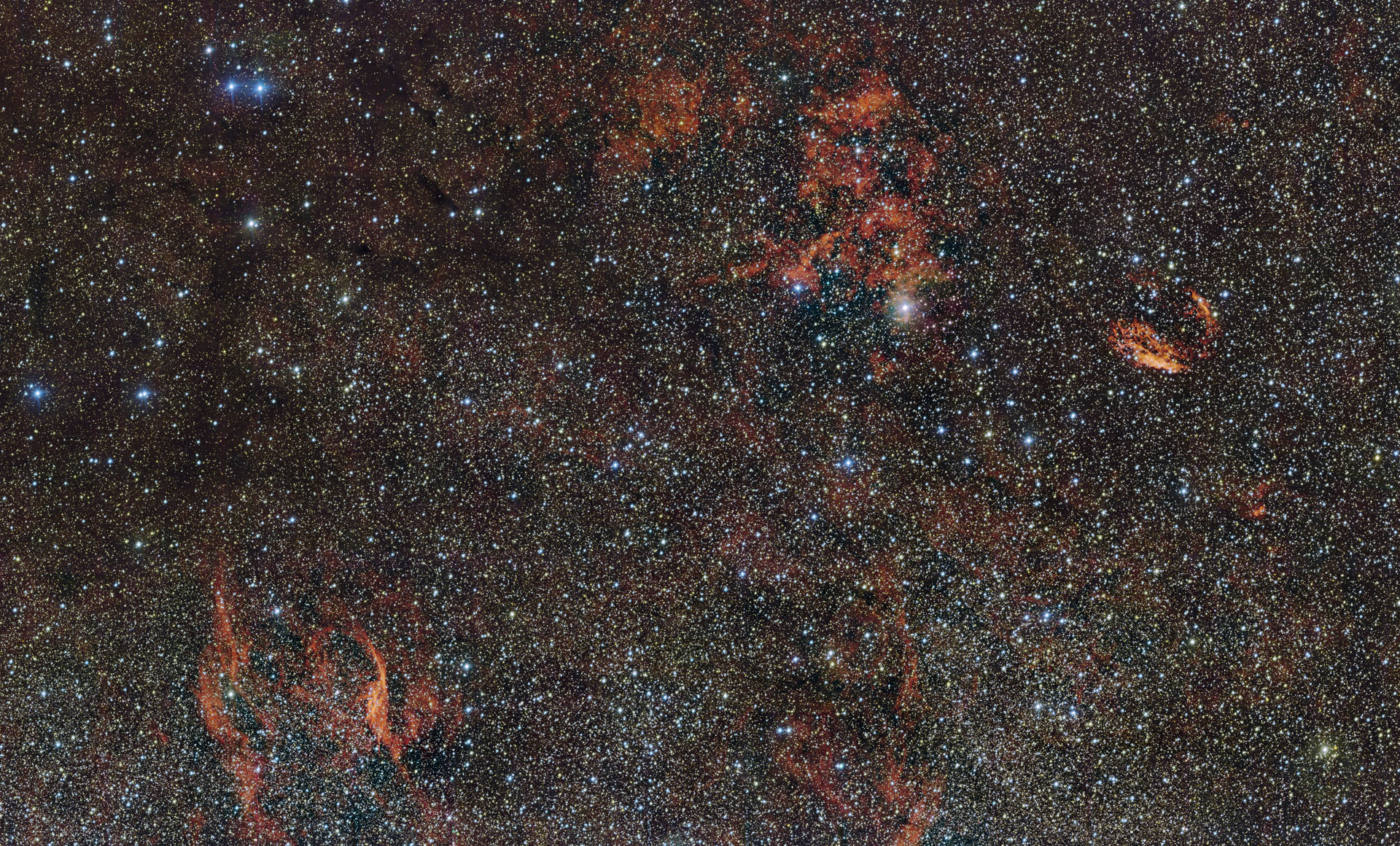
    RCW 106 is a sprawling cloud of gas and dust located about 12,000 light-years away in the southern constellation of Norma (The Carpenter’s Square). RCW 106 itself is the red cloud above the center in this new image.

    This new ESO VLT Survey Telescope image shows the vast nebula where giant stars were born, known as RCW 106. The brightest part appears just above the center of the image.

    In this huge new image clouds of crimson gas are illuminated by rare, massive stars that have only recently ignited and are still buried deep in thick dust clouds. These scorching-hot, very young stars are only fleeting characters on the cosmic stage and their origins remain mysterious.

    RCW 106 is a sprawling cloud of gas and dust located about 12,000 light-years away in the southern constellation of Norma (The Carpenter’s Square). The region gets its name from being the 106th entry in a catalog of H II regions in the southern Milky Way. H II regions like RCW 106 are clouds of hydrogen gas that are being ionized by the intense starlight of scorching-hot, young stars, causing them to glow and display weird and wonderful shapes.

    RCW 106 itself is the red cloud above the center in this new image, although much of this huge H II region is hidden by dust and it is much more extensive than the visible part. Many other unrelated objects are also visible in this wide-field VST image. For example, the filaments to the right of the image are the remnants of an ancient supernova, and the glowing red filaments at the lower left surround an unusual and very hot star. Patches of dark obscuring dust are also visible across the entire cosmic landscape.


    A close look at the sky around the star formation region RCW 106

    Astronomers have been studying RCW 106 for some time, although it is not the crimson clouds that draw their attention, but rather the mysterious origin of the massive and powerful stars buried within. Although they are very bright, these stars cannot be seen in visible-light images such as this one as the surrounding dust is too thick, but they make their presence clear in images of the region at longer wavelengths.

    For less massive stars like the Sun the process that brings them into existence is quite well understood — as clouds of gas are pulled together under gravity, density and temperature increase, and nuclear fusion begins — but for the most massive stars buried in regions like RCW 106 this explanation does not seem to be fully adequate. These stars — known to astronomers as O-type stars — may have masses many dozens of times the mass of the Sun and it is not clear how they manage to gather, and keep together, enough gas to form.

    O-type stars likely form from the densest parts of the nebular clouds like RCW 106 and they are notoriously difficult to study. Apart from obscuration by dust, another challenge is the brevity of an O-type star’s life. They burn through their nuclear fuel in mere tens of millions of years, while the lightest stars have lifetimes that span many tens of billions of years. The difficulty of forming a star of this mass, and the shortness of their lifetimes, means that they are very rare — only one in every three million stars in our cosmic neighborhood is an O-type star. None of those that do exist are close enough for detailed investigation and so the formation of these fleeting stellar giants remains mysterious, although their out-sized influence is unmistakable in glowing H II regions like this one.

    Never miss a breakthrough: Join the SciTechDaily newsletter.
    Follow us on Google and Google News.

    Astronomy Cosmology European Southern Observatory Popular Star Formation
    Share. Facebook Twitter Pinterest LinkedIn Email Reddit

    Related Articles

    Detailed Images of the Hypergiant Star VY Canis Majoris

    Astronomers Discover VFTS 352 – The Hottest and Most Massive Touching Double Star System to Date

    Evidence of Galaxy Star Birth Regulated by Black Holes

    VLT Discovers the Brightest Distant Galaxy to Date and Signs of Population III Stars

    VLT/SPHERE Reveal a Star Giving Birth to a Butterfly-Like Planetary Nebula

    ESO Views Star Forming Cloud RCW 34

    Strangulation is the Primary Mechanism for Star Formation Shut Down

    Survey of Carina Nebula Reveals Details of Star Formation

    SMA Reveals New Insights Into How Cosmic Seeds Grow Into Massive Stars

    Leave A Reply Cancel Reply

    • Facebook
    • Twitter
    • Pinterest
    • YouTube

    Don't Miss a Discovery

    Subscribe for the Latest in Science & Tech!

    Trending News

    Millions Take These IBS Drugs, But a New Study Finds Serious Risks

    Scientists Unlock Hidden Secrets of 2,300-Year-Old Mummies Using Cutting-Edge CT Scanner

    Bread Might Be Making You Gain Weight Even Without Eating More Calories

    Scientists Discover Massive Magma Reservoir Beneath Tuscany

    Europe’s Most Active Volcano Just Got Stranger – Here’s Why Scientists Are Rethinking It

    Alzheimer’s Symptoms May Start Outside the Brain, Study Finds

    Millions Take This Popular Supplement – Scientists Discover a Concerning Link to Heart Failure

    The Universe Is Expanding Too Fast and Scientists Can’t Explain Why

    Follow SciTechDaily
    • Facebook
    • Twitter
    • YouTube
    • Pinterest
    • Newsletter
    • RSS
    SciTech News
    • Biology News
    • Chemistry News
    • Earth News
    • Health News
    • Physics News
    • Science News
    • Space News
    • Technology News
    Recent Posts
    • Doctors Surprised by the Power of a Simple Drug Against Colon Cancer
    • Why Popular Diabetes Drugs Like Ozempic Don’t Work for Everyone: The “Genetic Glitch”
    • Scientists Create Improved Insulin Cells That Reverse Diabetes in Mice
    • Scientists Stunned After Finding Plant Thought Extinct for 60 Years
    • A Common Diabetes Drug May Hold the Key to Stopping HIV From Coming Back
    Copyright © 1998 - 2026 SciTechDaily. All Rights Reserved.
    • Science News
    • About
    • Contact
    • Editorial Board
    • Privacy Policy
    • Terms of Use

    Type above and press Enter to search. Press Esc to cancel.