
Close Menu
    Facebook X (Twitter) Instagram
    SciTechDaily
    • Biology
    • Chemistry
    • Earth
    • Health
    • Physics
    • Science
    • Space
    • Technology
    Facebook X (Twitter) Pinterest YouTube RSS
    SciTechDaily
    Home»Biology»Filamentous Bacteria Act as Living Power Cables
    Biology

    Filamentous Bacteria Act as Living Power Cables

    By SciTechDailyOctober 30, 2012No Comments2 Mins Read
    Facebook Twitter Pinterest Telegram LinkedIn WhatsApp Email Reddit
    Share
    Facebook Twitter LinkedIn Pinterest Telegram Email Reddit
    desulfobulbus-seafloor-power-cable
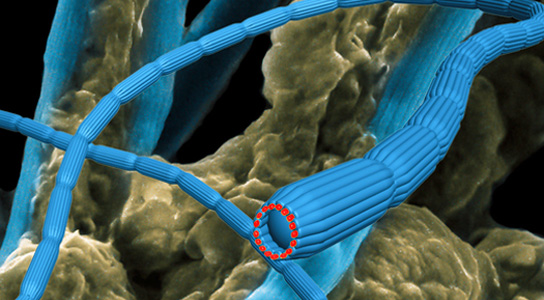
    Cable bacteria in the mud of the sea floor. Credit: Mingdong Dong, Jie Song and Nils Risgaard-Petersen/Aarhus University

    The filamentous bacteria Desulfobulbus can function as living power cables in order to transmit electrons thousands of cell lengths away. The bacteria, which are only a few thousandths of a millimeter in length and are invisible to the naked eye, can form a multicellular filament that can transmit electrons across a distance as large as 1 cm under the right conditions.

    The scientists published their findings in the journal Nature. This behavior is part of Desulfobulbus‘ respiration and ingestion process. It was thought to be impossible to move electrons over such enormous biological distances. Scientists had previously discovered inexplicable electric currents along the sea floor. In new experiments, it was revealed that these currents are mediated by multicellular bacteria that act as living power cables.
    seafloor-mud
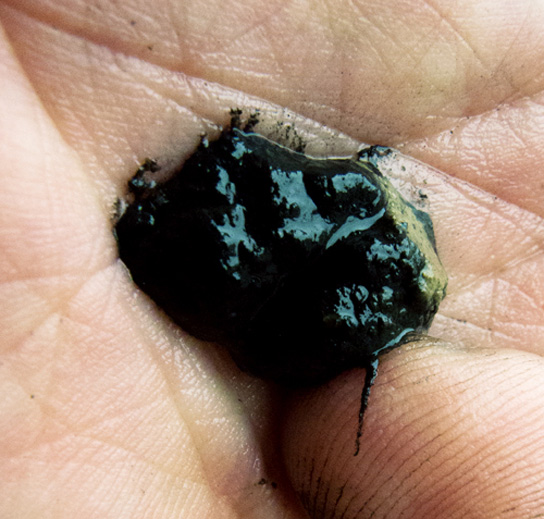
    In a teaspoonful of mud, there may be up to one kilometer’s worth of living power cables. Credit: Nils Risgaard-Petersen/Aarhus University

    It was surprising to find out that this process was occurring inside a single organism. Cells at the bottom of marine sediments live in a zone that is poor in oxygen but rich in hydrogen sulfide and those at the top live in an area rich in oxygen but poor in hydrogen sulfide. Desulfobulbus forms long chains that transport individual electrons from the bottom to the top, completing a chemical reaction and generating life-sustaining energy.

    Reference: “Filamentous bacteria transport electrons over centimetre distances” by Christian Pfeffer, Steffen Larsen, Jie Song, Mingdong Dong, Flemming Besenbacher, Rikke Louise Meyer, Kasper Urup Kjeldsen, Lars Schreiber, Yuri A. Gorby, Mohamed Y. El-Naggar, Kar Man Leung, Andreas Schramm, Nils Risgaard-Petersen and Lars Peter Nielsen, 24 October 2012, Nature.
    DOI: 10.1038/nature11586

    Never miss a breakthrough: Join the SciTechDaily newsletter.
    Follow us on Google and Google News.

    Bacteria
    Share. Facebook Twitter Pinterest LinkedIn Email Reddit

    Related Articles

    Acorn, White-Footed Mice and Tick Cycle Augment Risks of Lyme Disease in 2012

    Rare Example of Bacterial Gene Transfer Providing Evolutionary Benefit

    Marine Bacteria Use Bioluminescence to Lure Zooplankton and Fish

    Researchers Use Bacteria From Space to Create New Biofilm

    Genetically Modified Mosquitoes to Fight Diseases

    Antibiotic-Free Meat Might Still Be Contaminated with Drug Resistant Bacteria

    NDM-1 Super Bacteria Scares Medical Community in India

    Viruses Use Bacteria for Reproduction

    Autistic Children Have Different Gastrointestinal Bacteria

    Leave A Reply Cancel Reply

    • Facebook
    • Twitter
    • Pinterest
    • YouTube

    Don't Miss a Discovery

    Subscribe for the Latest in Science & Tech!

    Trending News

    Scientists Warn That This Common Pet Fish Can Wreck Entire Ecosystems

    Scientists Make Breakthrough in Turning Plastic Trash Into Clean Fuel Using Sunlight

    This Popular Supplement May Interfere With Cancer Treatment, Scientists Warn

    Scientists Finally Solved One of Water’s Biggest Mysteries

    Could This New Weight-Loss Pill Disrupt the Entire Market? Here’s What You Should Know About Orforglipron

    Earth’s Crust Is Tearing Open in Africa, and It Could Form a New Ocean

    Breakthrough Bowel Cancer Trial Leaves Patients Cancer-Free for Nearly 3 Years

    Natural Compound Shows Powerful Potential Against Rheumatoid Arthritis

    Follow SciTechDaily
    • Facebook
    • Twitter
    • YouTube
    • Pinterest
    • Newsletter
    • RSS
    SciTech News
    • Biology News
    • Chemistry News
    • Earth News
    • Health News
    • Physics News
    • Science News
    • Space News
    • Technology News
    Recent Posts
    • Kratom Use Explodes in the US, With Life-Changing Consequences
    • Scientists Uncover Fatal Weakness in “Zombie Cells” Linked to Cancer
    • World-First Study Reveals Human Hearts Can Regenerate After a Heart Attack
    • Why Your Dreams Feel So Real Sometimes and So Strange Other Times
    • Scientists Debunk 100-Year-Old Belief About Brain Cells, Rewriting Textbooks
    Copyright © 1998 - 2026 SciTechDaily. All Rights Reserved.
    • Science News
    • About
    • Contact
    • Editorial Board
    • Privacy Policy
    • Terms of Use

    Type above and press Enter to search. Press Esc to cancel.