
Close Menu
    Facebook X (Twitter) Instagram
    SciTechDaily
    • Biology
    • Chemistry
    • Earth
    • Health
    • Physics
    • Science
    • Space
    • Technology
    Facebook X (Twitter) Pinterest YouTube RSS
    SciTechDaily
    Home»Earth»Changing Gulf Stream Is Destabilizing Gases Trapped in Sediments
    Earth

    Changing Gulf Stream Is Destabilizing Gases Trapped in Sediments

    By SciTechDailyOctober 30, 2012No Comments3 Mins Read
    Facebook Twitter Pinterest Telegram LinkedIn WhatsApp Email Reddit
    Share
    Facebook Twitter LinkedIn Pinterest Telegram Email Reddit
    eddy-gulf-stream
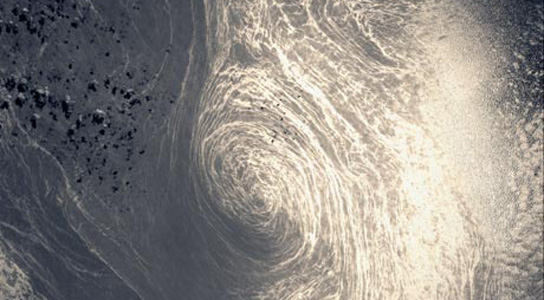
    Sunlight shines on a Gulf Stream eddy in the north Atlantic, as seen from space. Credit: NASA/Corbis

    Methane gas is escaping from the seabed sediments somewhere off the coast of North Carolina. Researchers think that a shifting Gulf Stream, the Atlantic Ocean current that flows north from the Gulf of Mexico, is to blame since it is delivering warmer waters to areas that had previously only received colder waters.

    The scientists published their findings in the journal Nature. The methane hydrates could lead to less stable sediments in the region if the warming continues, states Matthew Hornbach, a marine geologist at the Southern Methodist University in Dallas, Texas, and lead author of the study. These warmer temperatures could destabilize up to 2.5 gigatonnes of methane hydrate along the continental slope of the eastern USA. This region is already prone to underwater landslides, which could release the methane.
    satellite-image-gulf-stream
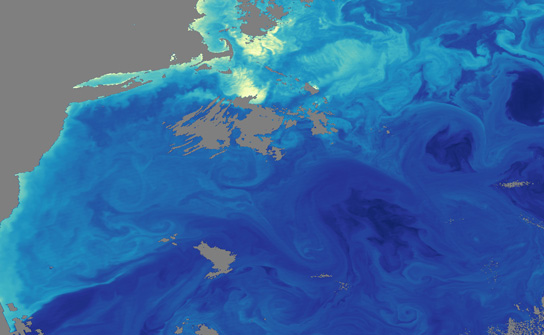
    The Gulf Stream current, as seen from space. Credit: NASA images courtesy Norman Kuring, MODIS Ocean Team.

    It’s still unclear whether the methane would make it into the atmosphere and possibly worsen global warming, but scientists think that this is an unlikely event. This study has uncovered a powerful new way to use data from the geological record to catch non-anthropogenic climate changes that are already happening, states Carolyn Ruppel, a geophysicist at the US Geological Survey in Woods Hole, Massachusetts.

    The scientists combined models of subsurface temperature dynamics with seismic images to directly detect the depth at which the methane hydrate is no longer stable and shifts from a frozen solid to free gas. The hydrate’s formation is dependent on temperature and the position of the bottom of this frozen zone can be used to estimate subsurface temperature dynamics.

    The observed interaction between the frozen solid and the free gas was much deeper than previously expected. The team ruled out factors that could have explained these observations, like sea-level changes, increased sedimentation rates or decreased heat flow through sediments. The only thing that could cause this discrepancy was the water was cooler than in the past.

    The heat flow was modeled through the methane hydrate sediments in relation to time, and it was estimated that it would take around 5,000 years of warmer water for all of the methane to sublimate and become gaseous. The scientists don’t know where we stand in relation to the 5,000-year time frame, but the best approximation suggests that we are 800 to 1,000 years in, states Benjamin Phrampus, Southern Methodist University, and co-author.

    This study will help spur on more research into whether destabilized hydrates could make the continental slopes more unstable. Dramatic degassing events require changes in pressure. The Arctic is currently undergoing rapid warming and the dramatic loss of sea ice could be where the most dramatic oceanographic changes occur.

    Reference: “Recent changes to the Gulf Stream causing widespread gas hydrate destabilization” by Benjamin J. Phrampus and Matthew J. Hornbach, 24 October 2012, Nature.
    DOI: 10.1038/nature11528

    Never miss a breakthrough: Join the SciTechDaily newsletter.
    Follow us on Google and Google News.

    Climate Change Climatology Environment Greenhouse Gas Marine Geology
    Share. Facebook Twitter Pinterest LinkedIn Email Reddit

    Related Articles

    Thawing Permafrost Could Leach Microbes, Greenhouse Gases, and Chemicals Into Environment

    Reducing Methane Emissions at Landfills – New Technology To Capture More of the Potent Greenhouse Gas

    Inactive Oil Wells May Be a Big Source of Methane Emissions

    The Truth Behind the Paris Agreement Climate Pledges – “Insufficient to Address Climate Change”

    As Much as One-Third of Greenhouses Gases Come From Agriculture

    Carbon Absorption by Plants Limited by the Abundance of Soil Nutrients

    Record Arctic Snow Melt Might Be Prolonging American Drought

    Diseased Trees May Be a Significant Source of Methane That Causes Climate Change

    Particulate Pollution Created ‘Warming Hole’ that Delayed Climate Change

    Leave A Reply Cancel Reply

    • Facebook
    • Twitter
    • Pinterest
    • YouTube

    Don't Miss a Discovery

    Subscribe for the Latest in Science & Tech!

    Trending News

    Scientists Just Discovered a Hidden Freshwater World Beneath the Great Salt Lake

    Why Your Daily Shower Could Be Worsening the Water Crisis

    Scientists Discover New “Magic Mushroom” Species That Rewrites Evolutionary History

    Mystery Deepens: Astrophysicists Say Dark Matter May Not Be One Thing

    Your BMI Might Be Wrong: Study Finds Millions Are Misclassified

    A Simple Blood Test Could Predict Dementia Risk 25 Years Early

    3.5-Billion-Year-Old Rocks Rewrite the Story of Plate Tectonics

    Why Aging Lungs Turn Mild Infections Into Life-Threatening Illness

    Follow SciTechDaily
    • Facebook
    • Twitter
    • YouTube
    • Pinterest
    • Newsletter
    • RSS
    SciTech News
    • Biology News
    • Chemistry News
    • Earth News
    • Health News
    • Physics News
    • Science News
    • Space News
    • Technology News
    Recent Posts
    • Antarctica’s Ancient Ice Cycles Once Controlled Life in Distant Oceans
    • Warming Waters Are Supercharging an Invasive Predator in Alaska
    • The Mediterranean Isn’t Safe: Scientists Warn of Inevitable Tsunami
    • This Deadly Parasite Stays Invisible by Shredding Its Own Genes
    • Researchers Uncover Hidden Genetic World Beneath Antarctic Seas
    Copyright © 1998 - 2026 SciTechDaily. All Rights Reserved.
    • Science News
    • About
    • Contact
    • Editorial Board
    • Privacy Policy
    • Terms of Use

    Type above and press Enter to search. Press Esc to cancel.