
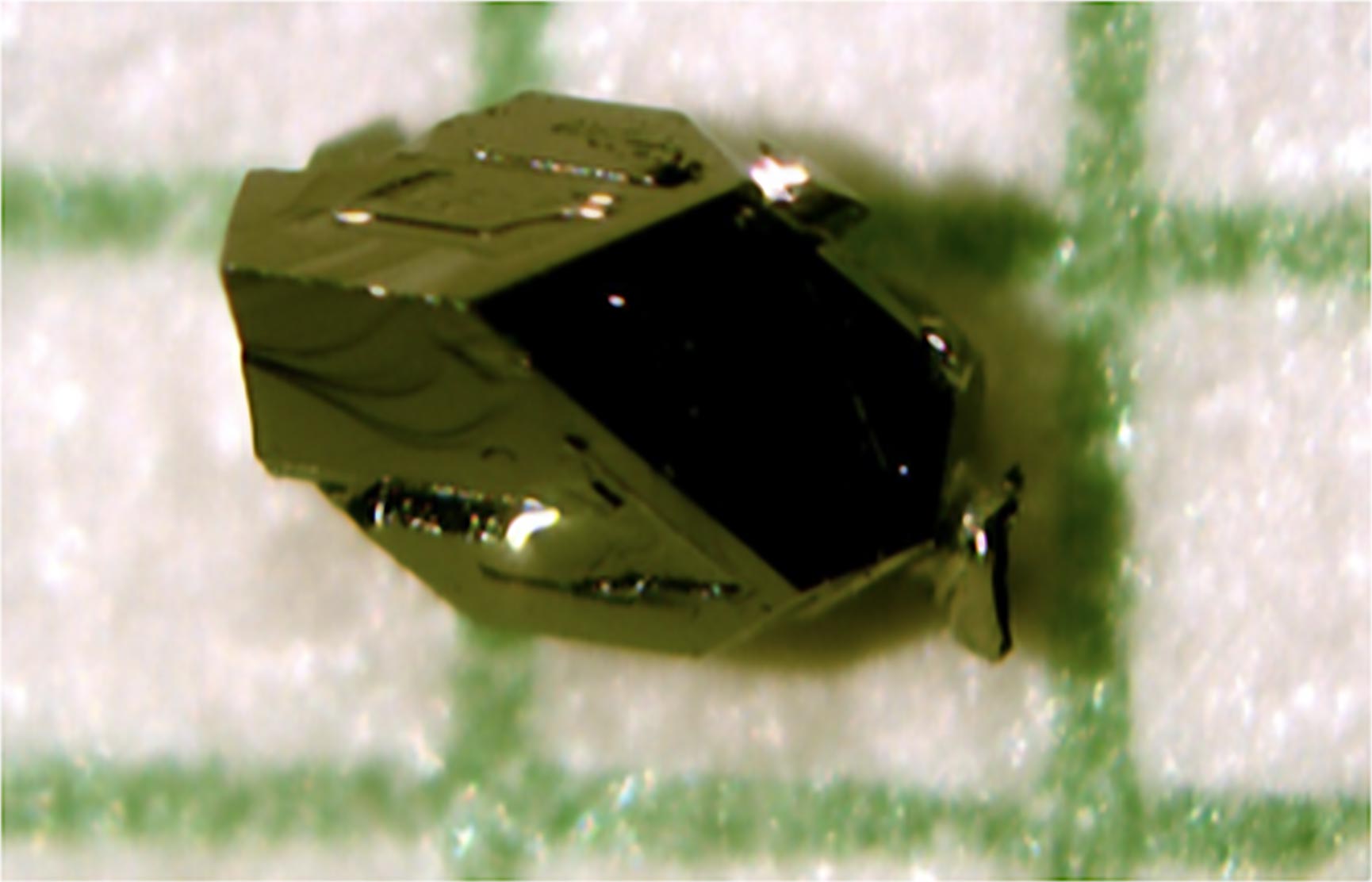
Scientists at Ames National Laboratory have discovered miassite, a naturally occurring mineral that is an unconventional superconductor, challenging previous beliefs and advancing our understanding of superconductivity for future technology.
Scientists from Ames National Laboratory have identified the first unconventional superconductor with a chemical composition also found in nature. Miassite is one of only four minerals found in nature that act as a superconductor when grown in the lab.
The team’s investigation of miassite revealed that it is an unconventional superconductor with properties similar to high-temperature superconductors. Their findings further scientists’ understanding of this type of superconductivity, which could lead to more sustainable and economical superconductor-based technology in the future.
Understanding Superconductivity
Superconductivity is when a material can conduct electricity without energy loss. Superconductors have applications including medical MRI machines, power cables, and quantum computers. Conventional superconductors are well understood but have low critical temperatures. The critical temperature is the highest temperature at which a material acts as a superconductor.
In the 1980s, scientists discovered unconventional superconductors, many of which have much higher critical temperatures. According to Ruslan Prozorov, a scientist at Ames Lab, all these materials are grown in the lab. This fact has led to the general belief that unconventional superconductivity is not a natural phenomenon.
Natural Occurrence
Prozorov explained that it is difficult to find superconductors in nature because most superconducting elements and compounds are metals and tend to react with other elements, like oxygen. He said that miassite (Rh17S15) is an interesting mineral for several reasons, one of which is its complex chemical formula. “Intuitively, you think that this is something which is produced deliberately during a focused search, and it cannot possibly exist in nature,” said Prozorov, “But it turns out it does.”
Paul Canfield, Distinguished Professor of Physics and Astronomy at Iowa State University and a scientist at Ames Lab, has expertise in design, discovery, growth, and characterization of novel crystalline materials. He synthesized high-quality miassite crystals for this project. “Although miassite is a mineral that was discovered near the Miass River in Chelyabinsk Oblast, Russia,” said Canfield, “it is a rare one that generally does not grow as well-formed crystals.”
Growing the miassite crystals was part of a larger effort to discover compounds that combine very high melting elements (like Rh) and volatile elements (like S). “Contrary to the nature of the pure elements, we have been mastering the use of mixtures of these elements that allow for low-temperature growth of crystals with minimal vapor pressure,” said Canfield. “It’s like finding a hidden fishing hole that is full of big fat fish. In the Rh-S system we discovered three new superconductors. And, through Ruslan’s detailed measurements, we discovered that the miassite is an unconventional superconductor.”
Advanced Techniques and Findings
Prozorov’s group specializes in advanced techniques to study superconductors at low temperatures. He said the material needed to be as cold as 50 millikelvins, which is about -460 degrees Fahrenheit.
Prozorov’s team used three different tests to determine the nature of miassite’s superconductivity. The main test is called the “London penetration depth.” It determines how far a weak magnetic field can penetrate the superconductor bulk from the surface. In a conventional superconductor, this length is basically constant at low temperature. However, in unconventional superconductors, it varies linearly with the temperature. This test showed that miassite behaves as an unconventional superconductor.
Another test the team performed was introducing defects into the material. Prozorov said that this test is a signature technique his team has employed over the past decade. It involves bombarding the material with high-energy electrons. This process knocks-out ions from their positions, thus creating defects in the crystal structure. This disorder can cause changes in the material’s critical temperature.
Conventional superconductors are not sensitive to non-magnetic disorder, so this test would show no or very little change in the critical temperature. Unconventional superconductors have a high sensitivity to disorder, and introducing defects changes or suppresses the critical temperature. It also affects the critical magnetic field of the material. In miassite, the team found that both the critical temperature and the critical magnetic field behaved as predicted in unconventional superconductors.
Investigating unconventional superconductors improves scientists understanding of how they work. Prozorov explained that this is important because, “Uncovering the mechanisms behind unconventional superconductivity is key to economically sound applications of superconductors.”
Reference: “Nodal superconductivity in miassite Rh17S15” by Hyunsoo Kim, Makariy A. Tanatar, Marcin Kończykowski, Romain Grasset, Udhara S. Kaluarachchi, Serafim Teknowijoyo, Kyuil Cho, Aashish Sapkota, John M. Wilde, Matthew J. Krogstad, Sergey L. Bud’ko, Philip M. R. Brydon, Paul C. Canfield and Ruslan Prozorov, 17 February 2024, Communications Materials.
DOI: 10.1038/s43246-024-00456-w
This work was supported by the DOE Office of Science (Office of Basic Energy Sciences) and used resources of the Advanced Photon Source, a U.S. Department of Energy (DOE) Office of Science User Facility.
Never miss a breakthrough: Join the SciTechDaily newsletter.
Follow us on Google and Google News.
3 Comments
“grows naturally”. There are going to be signs of electrogeology near the Miass River as well as mineral deposits, probably with metals and sulfur in mix. Eh will be the results of electrically caused transmutation. Water might be the catalyst for directing cataclysmic electricity into the transmuted deposits.
Very cool article and research.
Would like to see the crystallin structure.
This URL has no model, but it does have the X-ray diffraction peaks and the formal crystal symmetry: https://www.mindat.org/min-7250.html